Hazard Tiles
Spike tiles on the ground damage the player on contact. The tile collision code now distinguishes between tile types — not just solid or empty, but safe or dangerous.
The level has coins to collect and an obstacle to avoid — but the ground itself is always safe. Walk anywhere and nothing happens. This unit adds spike tiles to the ground. Step on them and the player snaps back to the start. The nametable is no longer just scenery — it’s a hazard.
The key idea: the tile collision code already reads which tile the player is standing on. Until now, it only checked “is there a tile here?” (non-zero = solid). Now it checks what kind of tile it is. A ground tile is safe. A spike tile is dangerous.
The Spike Tile
Tile 15 in CHR-ROM is an upward-pointing triangle — a classic spike:
SPIKE_TILE = 15 ; Hazard tile; Tile 15: Spikes (upward-pointing triangle)
.byte $18,$18,$3C,$3C,$7E,$7E,$FF,$FF ; Plane 0
.byte $18,$18,$3C,$3C,$7E,$7E,$FF,$FF ; Plane 1 (both = colour 3)Both bit planes are identical, so the colour index is 3. On background palette 1 (the ground palette), colour 3 is $29 — bright green. The spikes are the same hue as the ground but brighter, making them stand out as danger.
Placing Spikes in the Level
Two spike tiles sit on the ground surface at columns 10–11. They’re written to the nametable after the ground fill:
; Write spike tiles (row 26, columns 10-11)
bit PPUSTATUS
lda #$23
sta PPUADDR
lda #$4A
sta PPUADDR ; PPU address $234A (row 26, col 10)
lda #SPIKE_TILE
sta PPUDATA
sta PPUDATA ; Two consecutive spike tilesThe ground write loop fills rows 26–29 with GROUND_TILE. Then the spike write overwrites two specific positions. The order matters — ground first, then spikes on top.
The level data also needs a new row template so the collision code knows about the spikes:
level_ground_spike_row:
.byte 3,3,3,3, 3,3,3,3, 3,3,15,15, 3,3,3,3
.byte 3,3,3,3, 3,3,3,3, 3,3,3,3, 3,3,3,3Row 26 in the pointer table now points to level_ground_spike_row instead of level_ground_row. Columns 10–11 contain tile 15 (spikes); everything else is tile 3 (ground). The nametable and the level data must match — if one has spikes and the other doesn’t, the visuals and collision disagree.
Tile Type Checking
The hazard check runs every frame when the player is on the ground. It reads the tile beneath the player’s feet and compares it against SPIKE_TILE:
; =============================================================================
; Hazard tile check
; =============================================================================
; After the floor collision code sets on_ground, this section reads the tile
; beneath the player's feet. If it's a spike, the player resets to start.
; =============================================================================
; --- Check for hazard tiles ---
lda on_ground
beq @no_hazard
; Get tile below player's feet
lda player_y
clc
adc #8 ; Feet position
lsr
lsr
lsr ; Tile row
tax
cpx #30
bcs @no_hazard ; Below nametable — safe
lda level_rows_lo, x
sta tile_ptr
lda level_rows_hi, x
sta tile_ptr+1
lda player_x
clc
adc #4 ; Sprite centre
lsr
lsr
lsr ; Tile column
tay
lda (tile_ptr), y
cmp #SPIKE_TILE
bne @no_hazard
; Hit spikes! Reset player to start
lda #PLAYER_X
sta player_x
lda #PLAYER_Y
sta player_y
lda #0
sta vel_y
lda #1
sta on_ground
; Damage sound (pulse channel — harsh buzz)
lda #%00111100 ; Duty 12.5%, volume 12
sta SQ1_VOL
lda #%00000000 ; No sweep
sta SQ1_SWEEP
lda #$80 ; Timer low — low pitch
sta SQ1_LO
lda #$01 ; Timer high=1, length counter
sta SQ1_HI
@no_hazard:
The logic mirrors the floor collision from Unit 7: calculate the tile row from the player’s feet position, load the row pointer, calculate the tile column from the sprite centre, and read the tile with (tile_ptr), Y. The difference is what happens with the result.
Previously: BEQ @no_floor — tile 0 means empty, anything else means solid.
Now: CMP #SPIKE_TILE / BNE @no_hazard — specifically checks for tile 15. Ground tiles (3) pass through safely. Only spikes trigger damage.
This is the first use of CMP to distinguish between different non-zero tile values. The same pattern extends to any number of tile types: check for each one and branch accordingly.
Damage
When the player stands on a spike, four things happen:
- Position resets to the start (
PLAYER_X,PLAYER_Y) - Velocity clears to zero
on_groundsets to 1- A harsh buzz plays on the pulse channel
The damage sound uses duty cycle 12.5% — the harshest setting. Combined with a low pitch (timer $180), it produces a short, unpleasant buzz that’s clearly different from both the jump sound (falling sweep) and the collect sound (bright triangle ding).
; Damage sound (pulse channel — harsh buzz)
lda #%00111100 ; Duty 12.5%, volume 12
sta SQ1_VOL
lda #%00000000 ; No sweep
sta SQ1_SWEEP
lda #$80 ; Timer low — low pitch
sta SQ1_LO
lda #$01 ; Timer high=1, length counter
sta SQ1_HISpikes as Obstacles
The spikes sit at columns 10–11, right in the player’s path between the starting position (column 7) and the floating platform (columns 12–19). The player must jump over them to reach the platform and its coin.
Walking into the spike columns while on the ground triggers instant damage. The player needs to be airborne over those tiles. The hazard check only runs when on_ground is true — jumping over spikes is completely safe.
This creates a natural flow: run right, see spikes, jump over them, land on the other side. The spikes teach the player to jump proactively, not just reactively.
The Complete Code
; =============================================================================
; DASH - Unit 12: Hazard Tiles
; =============================================================================
; Spike tiles on the ground damage the player on contact. The tile collision
; code now distinguishes between solid tiles and hazard tiles.
; =============================================================================
; -----------------------------------------------------------------------------
; NES Hardware Addresses
; -----------------------------------------------------------------------------
PPUCTRL = $2000
PPUMASK = $2001
PPUSTATUS = $2002
OAMADDR = $2003
PPUSCROLL = $2005
PPUADDR = $2006
PPUDATA = $2007
OAMDMA = $4014
JOYPAD1 = $4016
; -----------------------------------------------------------------------------
; APU Registers
; -----------------------------------------------------------------------------
SQ1_VOL = $4000
SQ1_SWEEP = $4001
SQ1_LO = $4002
SQ1_HI = $4003
TRI_LINEAR = $4008
TRI_LO = $400A
TRI_HI = $400B
APU_STATUS = $4015
; -----------------------------------------------------------------------------
; Button Masks
; -----------------------------------------------------------------------------
BTN_A = %10000000
BTN_B = %01000000
BTN_SELECT = %00100000
BTN_START = %00010000
BTN_UP = %00001000
BTN_DOWN = %00000100
BTN_LEFT = %00000010
BTN_RIGHT = %00000001
; -----------------------------------------------------------------------------
; Game Constants
; -----------------------------------------------------------------------------
PLAYER_X = 60
PLAYER_Y = 200
PLAYER_TILE = 1
RIGHT_WALL = 248
FLOOR_Y = 200 ; Obstacle Y position (ground level)
GRAVITY = 1
JUMP_VEL = $F6
OBSTACLE_TILE = 2
OBSTACLE_SPEED = 2
GROUND_TILE = 3
COIN_TILE = 4
DIGIT_ZERO = 5 ; First digit tile (0-9 are tiles 5-14)
SPIKE_TILE = 15 ; Hazard tile
; -----------------------------------------------------------------------------
; Memory
; -----------------------------------------------------------------------------
.segment "ZEROPAGE"
player_x: .res 1
player_y: .res 1
vel_y: .res 1
buttons: .res 1
nmi_flag: .res 1
on_ground: .res 1
obstacle_x: .res 1
tile_ptr: .res 2 ; Pointer for level data lookup
score: .res 1 ; Current score (0-255)
.segment "OAM"
oam_buffer: .res 256
.segment "BSS"
; =============================================================================
; iNES Header
; =============================================================================
.segment "HEADER"
.byte "NES", $1A
.byte 2
.byte 1
.byte $01
.byte $00
.byte 0,0,0,0,0,0,0,0
; =============================================================================
; Code
; =============================================================================
.segment "CODE"
; --- Reset ---
reset:
sei
cld
ldx #$40
stx $4017
ldx #$FF
txs
inx
stx PPUCTRL
stx PPUMASK
stx $4010
stx APU_STATUS
@vblank1:
bit PPUSTATUS
bpl @vblank1
lda #0
@clear_ram:
sta $0000, x
sta $0100, x
sta $0200, x
sta $0300, x
sta $0400, x
sta $0500, x
sta $0600, x
sta $0700, x
inx
bne @clear_ram
@vblank2:
bit PPUSTATUS
bpl @vblank2
; --- Load palette ---
bit PPUSTATUS
lda #$3F
sta PPUADDR
lda #$00
sta PPUADDR
ldx #0
@load_palette:
lda palette_data, x
sta PPUDATA
inx
cpx #32
bne @load_palette
; --- Clear nametable 0 ---
bit PPUSTATUS
lda #$20
sta PPUADDR
lda #$00
sta PPUADDR
lda #0
ldy #4
ldx #0
@clear_nt:
sta PPUDATA
dex
bne @clear_nt
dey
bne @clear_nt
; --- Write ground tiles (rows 26-29) ---
bit PPUSTATUS
lda #$23
sta PPUADDR
lda #$40
sta PPUADDR ; PPU address $2340 (row 26)
lda #GROUND_TILE
ldx #128 ; 4 rows × 32 tiles
@write_ground:
sta PPUDATA
dex
bne @write_ground
; --- Write spike tiles (row 26, columns 10-11) ---
bit PPUSTATUS
lda #$23
sta PPUADDR
lda #$4A
sta PPUADDR ; PPU address $234A (row 26, col 10)
lda #SPIKE_TILE
sta PPUDATA
sta PPUDATA ; Two consecutive spike tiles
; --- Write platform tiles (row 20, columns 12-19) ---
bit PPUSTATUS
lda #$22
sta PPUADDR
lda #$8C
sta PPUADDR ; PPU address $228C (row 20, col 12)
lda #GROUND_TILE
ldx #8 ; 8 tiles wide
@write_platform:
sta PPUDATA
dex
bne @write_platform
; --- Write wall tiles (rows 24-25, columns 22-23) ---
bit PPUSTATUS
lda #$23
sta PPUADDR
lda #$16
sta PPUADDR ; PPU address $2316 (row 24, col 22)
lda #GROUND_TILE
sta PPUDATA
sta PPUDATA ; Cols 22-23
bit PPUSTATUS
lda #$23
sta PPUADDR
lda #$36
sta PPUADDR ; PPU address $2336 (row 25, col 22)
lda #GROUND_TILE
sta PPUDATA
sta PPUDATA ; Cols 22-23
; --- Write initial score display ---
bit PPUSTATUS
lda #$20
sta PPUADDR
lda #$22
sta PPUADDR ; PPU address $2022 (row 1, col 2)
lda #DIGIT_ZERO ; Tile for "0"
sta PPUDATA
; --- Set attributes (platform + wall + ground palettes) ---
bit PPUSTATUS
lda #$23
sta PPUADDR
lda #$E8
sta PPUADDR ; PPU address $23E8 (attribute row 5)
ldx #0
@write_attrs:
lda attr_data, x
sta PPUDATA
inx
cpx #24
bne @write_attrs
; --- Set up player sprite (OAM entry 0) ---
lda #PLAYER_Y
sta oam_buffer+0
lda #PLAYER_TILE
sta oam_buffer+1
lda #0
sta oam_buffer+2
lda #PLAYER_X
sta oam_buffer+3
; Set up obstacle sprite (OAM entry 1)
lda #FLOOR_Y
sta oam_buffer+4
lda #OBSTACLE_TILE
sta oam_buffer+5
lda #1
sta oam_buffer+6
lda #255
sta oam_buffer+7
; Set up collectible sprites (OAM entries 2-4)
; Coin 0: on the platform
lda #152 ; Y = 152 (sits on row 20 platform)
sta oam_buffer+8
lda #COIN_TILE
sta oam_buffer+9
lda #2 ; Sprite palette 2 (yellow)
sta oam_buffer+10
lda #128 ; X = 128 (centre of platform)
sta oam_buffer+11
; Coin 1: past the wall on the ground
lda #FLOOR_Y
sta oam_buffer+12
lda #COIN_TILE
sta oam_buffer+13
lda #2
sta oam_buffer+14
lda #200 ; X = 200
sta oam_buffer+15
; Coin 2: in the air (jump to collect)
lda #168 ; Y = 168 (above ground, reachable by jumping)
sta oam_buffer+16
lda #COIN_TILE
sta oam_buffer+17
lda #2
sta oam_buffer+18
lda #32 ; X = 32 (left side)
sta oam_buffer+19
; Initialise game state
lda #PLAYER_X
sta player_x
lda #PLAYER_Y
sta player_y
lda #0
sta vel_y
sta score ; Score starts at 0
lda #1
sta on_ground
lda #255
sta obstacle_x
; Hide other sprites (entries 5-63)
lda #$EF
ldx #20
@hide_sprites:
sta oam_buffer, x
inx
bne @hide_sprites
; Enable APU channels: pulse 1 + triangle
lda #%00000101
sta APU_STATUS
; Reset scroll position
bit PPUSTATUS
lda #0
sta PPUSCROLL
sta PPUSCROLL
; Enable rendering
lda #%10000000
sta PPUCTRL
lda #%00011110
sta PPUMASK
; =============================================================================
; Main Loop
; =============================================================================
main_loop:
lda nmi_flag
beq main_loop
lda #0
sta nmi_flag
; --- Read controller ---
lda #1
sta JOYPAD1
lda #0
sta JOYPAD1
ldx #8
@read_pad:
lda JOYPAD1
lsr a
rol buttons
dex
bne @read_pad
; --- Jump check ---
lda buttons
and #BTN_A
beq @no_jump
lda on_ground
beq @no_jump
lda #JUMP_VEL
sta vel_y
lda #0
sta on_ground
; Play jump sound (pulse channel)
lda #%10111000
sta SQ1_VOL
lda #%10111001
sta SQ1_SWEEP
lda #$C8
sta SQ1_LO
lda #$00
sta SQ1_HI
@no_jump:
; --- Move left (with wall check) ---
lda buttons
and #BTN_LEFT
beq @not_left
lda player_x
beq @not_left
lda player_y
clc
adc #4
lsr
lsr
lsr
tax
lda level_rows_lo, x
sta tile_ptr
lda level_rows_hi, x
sta tile_ptr+1
lda player_x
sec
sbc #1
lsr
lsr
lsr
tay
lda (tile_ptr), y
bne @not_left
dec player_x
@not_left:
; --- Move right (with wall check) ---
lda buttons
and #BTN_RIGHT
beq @not_right
lda player_x
cmp #RIGHT_WALL
bcs @not_right
lda player_y
clc
adc #4
lsr
lsr
lsr
tax
lda level_rows_lo, x
sta tile_ptr
lda level_rows_hi, x
sta tile_ptr+1
lda player_x
clc
adc #8
lsr
lsr
lsr
tay
lda (tile_ptr), y
bne @not_right
inc player_x
@not_right:
; --- Apply gravity ---
lda vel_y
clc
adc #GRAVITY
sta vel_y
; --- Apply velocity to Y position ---
lda player_y
clc
adc vel_y
sta player_y
; --- Tile collision (vertical) ---
lda vel_y
bmi @no_floor
lda player_y
clc
adc #8
lsr
lsr
lsr
tax
cpx #30
bcs @on_solid
lda level_rows_lo, x
sta tile_ptr
lda level_rows_hi, x
sta tile_ptr+1
lda player_x
clc
adc #4
lsr
lsr
lsr
tay
lda (tile_ptr), y
beq @no_floor
@on_solid:
lda player_y
clc
adc #8
and #%11111000
sec
sbc #8
sta player_y
lda #0
sta vel_y
lda #1
sta on_ground
jmp @done_floor
@no_floor:
lda #0
sta on_ground
@done_floor:
; --- Check for hazard tiles ---
lda on_ground
beq @no_hazard
; Get tile below player's feet
lda player_y
clc
adc #8 ; Feet position
lsr
lsr
lsr ; Tile row
tax
cpx #30
bcs @no_hazard ; Below nametable — safe
lda level_rows_lo, x
sta tile_ptr
lda level_rows_hi, x
sta tile_ptr+1
lda player_x
clc
adc #4 ; Sprite centre
lsr
lsr
lsr ; Tile column
tay
lda (tile_ptr), y
cmp #SPIKE_TILE
bne @no_hazard
; Hit spikes! Reset player to start
lda #PLAYER_X
sta player_x
lda #PLAYER_Y
sta player_y
lda #0
sta vel_y
lda #1
sta on_ground
; Damage sound (pulse channel — harsh buzz)
lda #%00111100 ; Duty 12.5%, volume 12
sta SQ1_VOL
lda #%00000000 ; No sweep
sta SQ1_SWEEP
lda #$80 ; Timer low — low pitch
sta SQ1_LO
lda #$01 ; Timer high=1, length counter
sta SQ1_HI
@no_hazard:
; --- Check collectibles ---
ldx #8 ; OAM entry 2 (coin 0)
jsr check_collect
ldx #12 ; OAM entry 3 (coin 1)
jsr check_collect
ldx #16 ; OAM entry 4 (coin 2)
jsr check_collect
; --- Move obstacle ---
lda obstacle_x
sec
sbc #OBSTACLE_SPEED
sta obstacle_x
; --- Collision with obstacle ---
lda on_ground
beq @no_collide
lda player_y
cmp #(FLOOR_Y - 7)
bcc @no_collide
lda obstacle_x
cmp #240
bcs @no_collide
lda player_x
clc
adc #8
cmp obstacle_x
bcc @no_collide
beq @no_collide
lda obstacle_x
clc
adc #8
cmp player_x
bcc @no_collide
beq @no_collide
lda #PLAYER_X
sta player_x
@no_collide:
; --- Update sprite positions ---
lda player_y
sta oam_buffer+0
lda player_x
sta oam_buffer+3
lda #FLOOR_Y
sta oam_buffer+4
lda obstacle_x
sta oam_buffer+7
jmp main_loop
; =============================================================================
; Subroutines
; =============================================================================
; -----------------------------------------------------------------------------
; check_collect: Check if the player overlaps a collectible sprite
; Input: X = OAM buffer offset (8, 12, or 16)
; Effect: If overlapping, hides the sprite, increments score, plays sound
; -----------------------------------------------------------------------------
check_collect:
; Skip if already collected
lda oam_buffer, x ; Sprite Y position
cmp #$EF
beq @done
; --- Y overlap ---
; Player bottom vs item top
lda player_y
clc
adc #8
cmp oam_buffer, x
bcc @done
beq @done
; Item bottom vs player top
lda oam_buffer, x
clc
adc #8
cmp player_y
bcc @done
beq @done
; --- X overlap ---
; Player right vs item left
lda player_x
clc
adc #8
cmp oam_buffer+3, x
bcc @done
beq @done
; Item right vs player left
lda oam_buffer+3, x
clc
adc #8
cmp player_x
bcc @done
beq @done
; Collected! Hide the sprite and add to score
lda #$EF
sta oam_buffer, x
inc score
; Play collect sound (triangle channel)
lda #%00011000 ; Linear counter: halt=0, reload=24 (~100ms)
sta TRI_LINEAR
lda #$29 ; Timer low — bright pitch (~1330 Hz)
sta TRI_LO
lda #$00 ; Timer high=0, length counter=0 (10 frames)
sta TRI_HI
@done:
rts
; =============================================================================
; NMI Handler
; =============================================================================
nmi:
pha
txa
pha
tya
pha
; --- OAM DMA ---
lda #0
sta OAMADDR
lda #>oam_buffer
sta OAMDMA
; --- Update score display on nametable ---
bit PPUSTATUS ; Reset address latch
lda #$20
sta PPUADDR
lda #$22
sta PPUADDR ; PPU address $2022 (row 1, col 2)
lda score
clc
adc #DIGIT_ZERO ; Convert score to tile index
sta PPUDATA
; --- Reset scroll (required after PPUADDR writes) ---
lda #0
sta PPUSCROLL
sta PPUSCROLL
lda #1
sta nmi_flag
pla
tay
pla
tax
pla
rti
irq:
rti
; =============================================================================
; Data
; =============================================================================
palette_data:
; Background palettes
.byte $0F, $00, $10, $20 ; Palette 0: greys (sky)
.byte $0F, $09, $19, $29 ; Palette 1: greens (ground)
.byte $0F, $00, $10, $20
.byte $0F, $00, $10, $20
; Sprite palettes
.byte $0F, $30, $16, $27 ; Palette 0: white (player)
.byte $0F, $16, $27, $30 ; Palette 1: red (obstacle)
.byte $0F, $28, $38, $30 ; Palette 2: yellow (coins)
.byte $0F, $30, $16, $27
attr_data:
; Attribute row 5 ($23E8) — platform
.byte $00, $00, $00, $05, $05, $00, $00, $00
; Attribute row 6 ($23F0) — wall + ground
.byte $50, $50, $50, $50, $50, $54, $50, $50
; Attribute row 7 ($23F8) — ground (top quadrants)
.byte $05, $05, $05, $05, $05, $05, $05, $05
; -----------------------------------------------------------------------------
; Level Data
; -----------------------------------------------------------------------------
level_empty_row:
.byte 0,0,0,0, 0,0,0,0, 0,0,0,0, 0,0,0,0
.byte 0,0,0,0, 0,0,0,0, 0,0,0,0, 0,0,0,0
level_platform_row:
.byte 0,0,0,0, 0,0,0,0, 0,0,0,0, 3,3,3,3
.byte 3,3,3,3, 0,0,0,0, 0,0,0,0, 0,0,0,0
level_wall_row:
.byte 0,0,0,0, 0,0,0,0, 0,0,0,0, 0,0,0,0
.byte 0,0,0,0, 0,0,3,3, 0,0,0,0, 0,0,0,0
level_ground_row:
.byte 3,3,3,3, 3,3,3,3, 3,3,3,3, 3,3,3,3
.byte 3,3,3,3, 3,3,3,3, 3,3,3,3, 3,3,3,3
level_ground_spike_row:
.byte 3,3,3,3, 3,3,3,3, 3,3,15,15, 3,3,3,3
.byte 3,3,3,3, 3,3,3,3, 3,3,3,3, 3,3,3,3
; Row pointer tables (30 entries — one per nametable row)
level_rows_lo:
.byte <level_empty_row ; Row 0
.byte <level_empty_row ; Row 1
.byte <level_empty_row ; Row 2
.byte <level_empty_row ; Row 3
.byte <level_empty_row ; Row 4
.byte <level_empty_row ; Row 5
.byte <level_empty_row ; Row 6
.byte <level_empty_row ; Row 7
.byte <level_empty_row ; Row 8
.byte <level_empty_row ; Row 9
.byte <level_empty_row ; Row 10
.byte <level_empty_row ; Row 11
.byte <level_empty_row ; Row 12
.byte <level_empty_row ; Row 13
.byte <level_empty_row ; Row 14
.byte <level_empty_row ; Row 15
.byte <level_empty_row ; Row 16
.byte <level_empty_row ; Row 17
.byte <level_empty_row ; Row 18
.byte <level_empty_row ; Row 19
.byte <level_platform_row ; Row 20: floating platform
.byte <level_empty_row ; Row 21
.byte <level_empty_row ; Row 22
.byte <level_empty_row ; Row 23
.byte <level_wall_row ; Row 24: wall
.byte <level_wall_row ; Row 25: wall
.byte <level_ground_spike_row ; Row 26: ground with spikes
.byte <level_ground_row ; Row 27
.byte <level_ground_row ; Row 28
.byte <level_ground_row ; Row 29
level_rows_hi:
.byte >level_empty_row ; Row 0
.byte >level_empty_row ; Row 1
.byte >level_empty_row ; Row 2
.byte >level_empty_row ; Row 3
.byte >level_empty_row ; Row 4
.byte >level_empty_row ; Row 5
.byte >level_empty_row ; Row 6
.byte >level_empty_row ; Row 7
.byte >level_empty_row ; Row 8
.byte >level_empty_row ; Row 9
.byte >level_empty_row ; Row 10
.byte >level_empty_row ; Row 11
.byte >level_empty_row ; Row 12
.byte >level_empty_row ; Row 13
.byte >level_empty_row ; Row 14
.byte >level_empty_row ; Row 15
.byte >level_empty_row ; Row 16
.byte >level_empty_row ; Row 17
.byte >level_empty_row ; Row 18
.byte >level_empty_row ; Row 19
.byte >level_platform_row ; Row 20: floating platform
.byte >level_empty_row ; Row 21
.byte >level_empty_row ; Row 22
.byte >level_empty_row ; Row 23
.byte >level_wall_row ; Row 24: wall
.byte >level_wall_row ; Row 25: wall
.byte >level_ground_spike_row ; Row 26: ground with spikes
.byte >level_ground_row ; Row 27
.byte >level_ground_row ; Row 28
.byte >level_ground_row ; Row 29
; =============================================================================
; Vectors
; =============================================================================
.segment "VECTORS"
.word nmi
.word reset
.word irq
; =============================================================================
; CHR-ROM
; =============================================================================
.segment "CHARS"
; Tile 0: Empty
.byte $00,$00,$00,$00,$00,$00,$00,$00
.byte $00,$00,$00,$00,$00,$00,$00,$00
; Tile 1: Running figure
.byte %00110000
.byte %00110000
.byte %01111000
.byte %00110000
.byte %00110000
.byte %00101000
.byte %01000100
.byte %01000100
.byte %00000000
.byte %00000000
.byte %00000000
.byte %00000000
.byte %00000000
.byte %00000000
.byte %00000000
.byte %00000000
; Tile 2: Diamond obstacle
.byte %00011000
.byte %00111100
.byte %01111110
.byte %11111111
.byte %11111111
.byte %01111110
.byte %00111100
.byte %00011000
.byte %00000000
.byte %00000000
.byte %00000000
.byte %00000000
.byte %00000000
.byte %00000000
.byte %00000000
.byte %00000000
; Tile 3: Ground block (light top edge, solid body)
.byte %11111111 ; Plane 0
.byte %11111111
.byte %11111111
.byte %11111111
.byte %11111111
.byte %11111111
.byte %11111111
.byte %11111111
.byte %11111111 ; Plane 1 (row 0: colour 3 = highlight)
.byte %00000000
.byte %00000000
.byte %00000000
.byte %00000000
.byte %00000000
.byte %00000000
.byte %00000000
; Tile 4: Coin
.byte %00111100 ; Plane 0
.byte %01111110
.byte %11111111
.byte %11111111
.byte %11111111
.byte %11111111
.byte %01111110
.byte %00111100
.byte %00000000 ; Plane 1 (all zero = colour 1 only)
.byte %00000000
.byte %00000000
.byte %00000000
.byte %00000000
.byte %00000000
.byte %00000000
.byte %00000000
; Tiles 5-14: Digits 0-9
; Both planes identical = colour 3 (white on BG palette 0)
; Tile 5: Digit 0
.byte $70,$88,$88,$88,$88,$88,$70,$00
.byte $70,$88,$88,$88,$88,$88,$70,$00
; Tile 6: Digit 1
.byte $20,$60,$20,$20,$20,$20,$70,$00
.byte $20,$60,$20,$20,$20,$20,$70,$00
; Tile 7: Digit 2
.byte $70,$88,$08,$30,$40,$80,$F8,$00
.byte $70,$88,$08,$30,$40,$80,$F8,$00
; Tile 8: Digit 3
.byte $70,$88,$08,$30,$08,$88,$70,$00
.byte $70,$88,$08,$30,$08,$88,$70,$00
; Tile 9: Digit 4
.byte $10,$30,$50,$90,$F8,$10,$10,$00
.byte $10,$30,$50,$90,$F8,$10,$10,$00
; Tile 10: Digit 5
.byte $F8,$80,$F0,$08,$08,$88,$70,$00
.byte $F8,$80,$F0,$08,$08,$88,$70,$00
; Tile 11: Digit 6
.byte $30,$40,$80,$F0,$88,$88,$70,$00
.byte $30,$40,$80,$F0,$88,$88,$70,$00
; Tile 12: Digit 7
.byte $F8,$08,$10,$20,$20,$20,$20,$00
.byte $F8,$08,$10,$20,$20,$20,$20,$00
; Tile 13: Digit 8
.byte $70,$88,$88,$70,$88,$88,$70,$00
.byte $70,$88,$88,$70,$88,$88,$70,$00
; Tile 14: Digit 9
.byte $70,$88,$88,$78,$08,$10,$60,$00
.byte $70,$88,$88,$78,$08,$10,$60,$00
; Tile 15: Spikes (upward-pointing triangle)
.byte $18,$18,$3C,$3C,$7E,$7E,$FF,$FF  ; Plane 0
.byte $18,$18,$3C,$3C,$7E,$7E,$FF,$FF  ; Plane 1 (both = colour 3)
.res 8192 - 256, $00
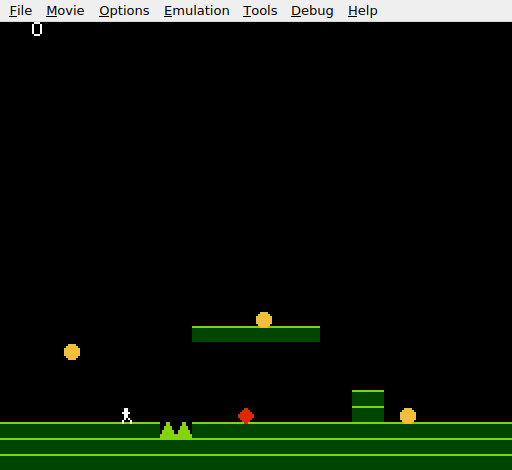
Two bright green spike triangles on the ground, between the player and the platform. The player starts to the left. Walk right without jumping and the spikes send you back to the start. Jump over them to reach the platform and the coins beyond.
Try This: More Spike Patches
Add a second spike area on the far right side (columns 26–27), between the wall and the edge. Update level_ground_spike_row with spike tiles at those columns too. The nametable write needs a second PPUADDR/PPUDATA sequence for the new positions.
Try This: Ceiling Spikes
Place spike tiles on the underside of the platform (row 21, columns 12–19). Use a vertically flipped spike tile (a new CHR tile with the triangle pointing down) or reuse the same tile. These damage the player when jumping up into them — add a check for vertical collision with spikes, not just floor contact.
Try This: Spike Sound Variation
Change the damage sound to use the triangle channel instead of the pulse channel. A deep triangle note (TRI_LO = $FF, linear counter reload = 16) sounds different from the harsh pulse buzz. Compare both and decide which better communicates “danger”.
If It Doesn’t Work
- Spikes don’t appear? Check the nametable write. The PPU address must be
$234A(row 26, column 10). If the address is wrong, the spikes render in the wrong position — or overwrite other tiles. - Spikes appear but don’t hurt? The level data must match the nametable. If
level_ground_spike_rowstill has ground tiles (3) at columns 10–11, the collision code sees ground, not spikes. Both the visual tiles and the data tiles must be 15. - Player dies everywhere on the ground? Make sure only row 26 uses
level_ground_spike_row. Rows 27–29 should still point tolevel_ground_row. If all ground rows have spikes in the data, the hazard check fires wherever the player stands. - Player dies while jumping over spikes? The hazard check must be guarded by
lda on_ground/beq @no_hazard. If this check is missing, the hazard runs even while airborne. - No damage sound? The pulse channel writes use
SQ1_VOL, notTRI_LINEAR. Make sure you’re writing to the correct registers — the pulse and triangle have different addresses.
What You’ve Learnt
- Tile types — not all non-zero tiles are the same.
CMPdistinguishes between ground (safe) and spikes (hazard). The same pattern handles any number of tile types. - Hazard tiles — background tiles that damage on contact. The nametable and level data must agree on which tiles are hazards.
- Level data templates — a new row template (
level_ground_spike_row) mixes tile types in a single row. Different rows can use different templates, creating varied terrain. - Damage response — resetting the player’s position, velocity, and state. The same pattern will later deduct lives instead of just resetting.
- Sound design — duty cycle 12.5% produces the harshest pulse wave. Low pitch + harsh timbre = danger. Each game event now has a distinct sound character.
What’s Next
One hit and the player resets — harsh but temporary. In Unit 13, the player gets three lives. Each spike hit or obstacle collision costs a life. Run out and it’s game over. The HUD expands to show lives alongside the score.