The Complete Game
Combine everything into the finished Minefield game with difficulty, scoring, and end screens.
Every piece is ready. Title screen, difficulty selection, mine placement, neighbour counting, cursor movement, revealing, flagging, win detection, colour, sound. Now combine them into a complete game.
The Complete Program
10 REM Minefield
20 BORDER 0: PAPER 0: INK 7: CLS
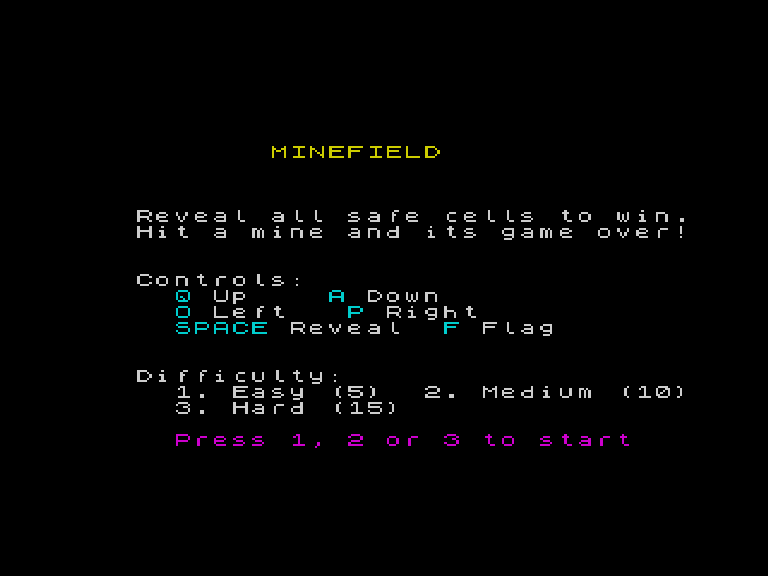
30 INK 6: PRINT AT 3, 10; "MINEFIELD": INK 7
40 PRINT AT 7, 3; "Reveal all safe cells to win."
50 PRINT AT 8, 3; "Hit a mine and its game over!"
60 PRINT AT 11, 3; "Controls:"
70 PRINT AT 12, 5; INK 5; "Q"; INK 7; " Up    "; INK 5; "A"; INK 7; " Down"
80 PRINT AT 13, 5; INK 5; "O"; INK 7; " Left   "; INK 5; "P"; INK 7; " Right"
90 PRINT AT 14, 5; INK 5; "SPACE"; INK 7; " Reveal  "; INK 5; "F"; INK 7; " Flag"
100 PRINT AT 17, 3; "Difficulty:"
110 PRINT AT 18, 5; "1. Easy (5)  2. Medium (10)"
120 PRINT AT 19, 5; "3. Hard (15)"
130 INK 3: PRINT AT 21, 5; "Press 1, 2 or 3 to start": INK 7
140 LET k$ = INKEY$
150 IF k$ < "1" OR k$ > "3" THEN GO TO 140
160 LET d = VAL k$
170 IF d = 1 THEN LET n = 5
180 IF d = 2 THEN LET n = 10
190 IF d = 3 THEN LET n = 15
200 CLS
210 DIM m(8, 8)
220 DIM s(8, 8)
230 LET r = 1: LET c = 1
240 LET s(1, 1) = 1
250 LET f = 0: LET w = 64 - n - 1
260 LET v = 0
270 REM place mines
280 FOR i = 1 TO n
290 LET y = INT (RND * 8) + 1
300 LET x = INT (RND * 8) + 1
310 IF m(y, x) = 9 THEN GO TO 290
320 IF y = 1 AND x = 1 THEN GO TO 290
330 LET m(y, x) = 9
340 NEXT i
350 GO SUB 1000
355 LET r = 1: LET c = 1
360 REM draw headers
370 INK 5
380 FOR i = 1 TO 8
390 PRINT AT 2, i * 2 + 1; i
400 PRINT AT i + 2, 0; i
410 NEXT i
420 INK 7
430 GO SUB 1100
440 GO SUB 1200
450 REM === game loop ===
460 PRINT AT r + 2, c * 2; INK 4; BRIGHT 1; "[": PRINT AT r + 2, c * 2 + 2; "]"
470 LET k$ = INKEY$
480 IF k$ = "" THEN GO TO 470
490 GO SUB 1100
500 IF k$ = "q" AND r > 1 THEN LET r = r - 1
510 IF k$ = "a" AND r < 8 THEN LET r = r + 1
520 IF k$ = "o" AND c > 1 THEN LET c = c - 1
530 IF k$ = "p" AND c < 8 THEN LET c = c + 1
540 IF k$ <> " " THEN GO TO 580
550 IF s(r, c) <> 0 THEN GO TO 580
560 LET s(r, c) = 1: LET w = w - 1: LET v = v + 1: BEEP 0.05, 15
570 IF m(r, c) = 9 THEN GO TO 700
580 IF k$ = "f" AND s(r, c) = 0 THEN LET s(r, c) = 2: LET f = f + 1: BEEP 0.05, 5
590 IF k$ = "f" AND s(r, c) = 2 THEN LET s(r, c) = 0: LET f = f - 1: BEEP 0.05, 5
600 GO SUB 1200
610 IF w = 0 THEN GO TO 750
620 GO TO 450
700 REM === game over ===
710 FOR y = 1 TO 8
720 FOR x = 1 TO 8
730 LET s(y, x) = 1
740 NEXT x
745 NEXT y
750 GO SUB 1100
755 IF w = 0 THEN GO TO 800
760 CLS
770 INK 2: PRINT AT 5, 9; "GAME OVER": INK 7
780 PRINT AT 8, 7; "You hit a mine!"
790 PRINT AT 10, 7; "Moves: "; v
795 IF n = 5 THEN PRINT AT 11, 7; "Difficulty: Easy"
796 IF n = 10 THEN PRINT AT 11, 7; "Difficulty: Medium"
797 IF n = 15 THEN PRINT AT 11, 7; "Difficulty: Hard"
798 BEEP 0.2, 0: BEEP 0.2, -3: BEEP 0.3, -7
799 GO TO 900
800 REM === win ===
810 CLS
820 INK 4: PRINT AT 5, 9; "YOU WIN!": INK 7
830 PRINT AT 8, 5; "All safe cells revealed!"
840 PRINT AT 10, 7; "Moves: "; v
845 IF n = 5 THEN PRINT AT 11, 7; "Difficulty: Easy"
846 IF n = 10 THEN PRINT AT 11, 7; "Difficulty: Medium"
847 IF n = 15 THEN PRINT AT 11, 7; "Difficulty: Hard"
850 IF v < n * 3 THEN PRINT AT 13, 6; "Master minesweeper!"
860 IF v >= n * 3 AND v < n * 5 THEN PRINT AT 13, 8; "Well done!"
870 IF v >= n * 5 THEN PRINT AT 13, 5; "Better luck next time!"
880 BEEP 0.15, 12: BEEP 0.15, 16: BEEP 0.3, 19
900 REM === end screen ===
910 INK 3: PRINT AT 20, 5; "Press any key to exit": INK 7
920 IF INKEY$ <> "" THEN GO TO 920
930 IF INKEY$ = "" THEN GO TO 930
940 BORDER 7: PAPER 7: INK 0: CLS
950 STOP
1000 REM === calculate counts ===
1010 FOR r = 1 TO 8
1020 FOR c = 1 TO 8
1030 IF m(r, c) = 9 THEN GO TO 1090
1040 LET g = 0
1050 FOR i = r - 1 TO r + 1
1060 FOR j = c - 1 TO c + 1
1070 IF i < 1 OR i > 8 OR j < 1 OR j > 8 THEN GO TO 1082
1080 IF m(i, j) = 9 THEN LET g = g + 1
1082 NEXT j
1084 NEXT i
1086 LET m(r, c) = g
1090 NEXT c
1095 NEXT r
1098 RETURN
1100 REM === draw grid ===
1110 FOR y = 1 TO 8
1120 FOR x = 1 TO 8
1130 IF s(y, x) = 0 THEN PRINT AT y + 2, x * 2 + 1; INK 1; "."
1140 IF s(y, x) = 1 AND m(y, x) = 0 THEN PRINT AT y + 2, x * 2 + 1; INK 5; "-"
1150 IF s(y, x) = 1 AND m(y, x) > 0 AND m(y, x) < 9 THEN PRINT AT y + 2, x * 2 + 1; INK 6; m(y, x)
1160 IF s(y, x) = 1 AND m(y, x) = 9 THEN PRINT AT y + 2, x * 2 + 1; INK 2; "*"
1170 IF s(y, x) = 2 THEN PRINT AT y + 2, x * 2 + 1; INK 3; "F"
1180 NEXT x
1190 NEXT y
1195 RETURN
1200 REM === draw HUD ===
1210 PRINT AT 0, 0; INK 7; "Safe:"; w; " Flags:"; f; " Mines:"; n; "  "
1220 PRINT AT 1, 0; INK 7; "Moves:"; v; "  "
1230 RETURN
The Structure
The program has a clear architecture:
| Lines | Section |
|---|---|
| 10-190 | Title screen with difficulty selection |
| 200-260 | Initialise arrays and variables |
| 270-350 | Place mines and calculate counts |
| 360-420 | Draw headers and initial grid |
| 450-620 | Game loop — input, movement, reveal, flag |
| 700-799 | Game over screen |
| 800-880 | Win screen |
| 900-950 | End screen with exit |
| 1000-1098 | Calculate subroutine |
| 1100-1195 | Draw grid subroutine |
| 1200-1230 | HUD subroutine |
Difficulty Integration
The title screen now includes difficulty selection:
140 LET k$ = INKEY$
150 IF k$ < "1" OR k$ > "3" THEN GO TO 140
160 LET d = VAL k$
VAL converts the key character to a number. The mine count n drives everything — placement count, win target, and HUD display.
Move Counter and Scoring
560 LET s(r, c) = 1: LET w = w - 1: LET v = v + 1: BEEP 0.05, 15Variable v counts every reveal. The end screen rates the player:
| Condition | Message |
|---|---|
v < n * 3 | ”Master minesweeper!” |
v < n * 5 | ”Well done!” |
v >= n * 5 | ”Better luck next time!” |
Fewer moves means better deduction. The thresholds scale with difficulty — more mines means more moves are acceptable.
The HUD
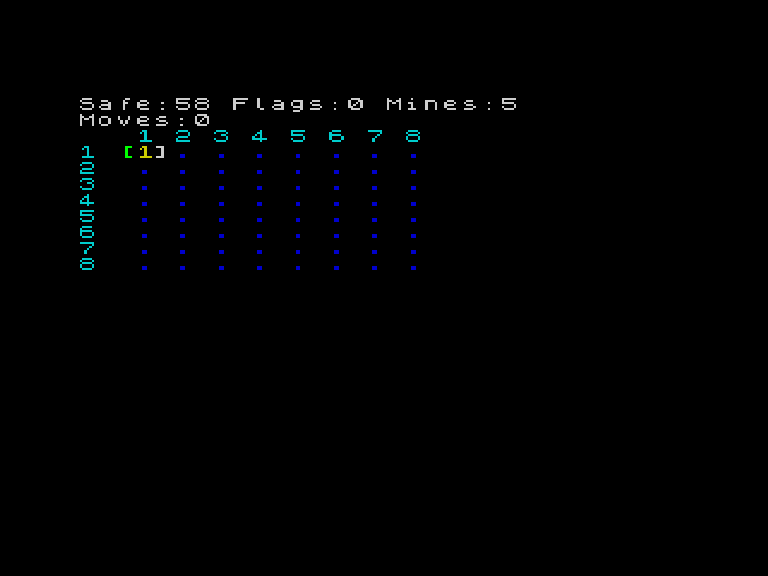
Three subroutines keep the display current:
1210 PRINT AT 0, 0; INK 7; "Safe:"; w; " Flags:"; f; " Mines:"; n; "  "
1220 PRINT AT 1, 0; INK 7; "Moves:"; v; "  "
Safe cells remaining, flags placed, total mines, and move count — everything the player needs to make decisions.
End Screen
Both game-over and win flow to the same end screen:
910 INK 3: PRINT AT 20, 5; "Press any key to exit": INK 7
920 IF INKEY$ <> "" THEN GO TO 920
930 IF INKEY$ = "" THEN GO TO 930
940 BORDER 7: PAPER 7: INK 0: CLS
Line 920 waits for any held key to be released. Line 930 waits for a new keypress. This prevents accidental exits. Line 940 restores the normal Spectrum colours before stopping.
Try This
Play again. Instead of STOP at line 950, GO TO 10 to restart the game. The player can try a different difficulty without reloading.
High score. Store the best move count in a variable h. On the win screen, check if v < h and update. Show the high score on the title screen.
Auto-reveal zeros. When a cell with 0 neighbours is revealed, automatically reveal all its neighbours too. This is how classic Minesweeper works — it cascades outward until it hits numbered cells. The challenge: doing this in BASIC without recursion.
What You’ve Learnt
- Program architecture — title, setup, game loop, end screens, subroutines
- Data-driven design — 2D arrays for world state, separate from display
- Difficulty scaling — one variable controls the entire difficulty curve
- Scoring systems — move count rated against difficulty-scaled thresholds
- Clean exits — restore screen colours, wait for deliberate keypress
What’s Next
You’ve built a logic game where the data lives in arrays, not on screen. The grid is data first, display second — a fundamentally different approach from Treasure Hunt. In Game 9, you’ll work with string arrays and timed challenges, building a word game that tests typing speed under pressure.