Gravity Pulls
A constant fall has no weight. Add velocity as its own variable and let gravity grow it every loop — the lander starts slow and speeds up, just like a real drop. This is the physics at the heart of the game: velocity that accumulates over time.
The dot falls at a steady pace, and that’s the giveaway that it isn’t real. Drop something and it speeds up the whole way down — slow at first, then faster and faster. To get that, the fall needs a velocity that grows, and gravity is what grows it.
10 POKE 53281,0:PRINT CHR$(147)
20 C=20:Y=1:V=0:G=0.02
30 R=INT(Y)
40 POKE 1024+R*40+C,81:POKE 55296+R*40+C,1
50 GOSUB 500
60 FOR D=1 TO 30:NEXT D
70 POKE 1024+R*40+C,32
80 V=V+G
90 Y=Y+V
100 IF Y>21 THEN END
110 GOTO 30
500 POKE 646,1:PRINT CHR$(19);"SPEED:";INT(V*100);"   "
510 RETURN
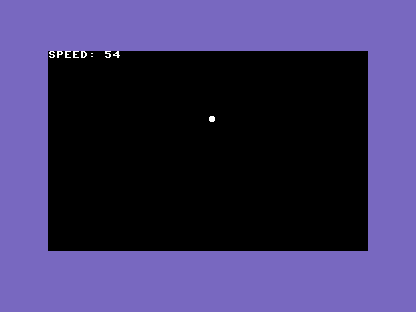
Two variables now describe the fall. V is the velocity — how fast the lander is moving — and
G is gravity, a small constant. The physics is line 80: V = V + G. Every loop, gravity
adds a little to the velocity. Then line 90 moves the lander by that velocity: Y = Y + V. Early
on V is tiny and the lander barely moves; loop after loop V grows, and the fall accelerates.
That’s the embedded concept of the whole game: velocity accumulates. Gravity doesn’t set the
speed — it adds to it, over and over, so the speed builds. The readout (the routine at line 500)
shows V climbing as you watch, which is the lander getting heavier on its way down. It’s the
simplest physics there is, and you’ve written it in one line.
Try this
- Heavier or lighter.
G = 0.02on line 20 is the strength of gravity. Try0.04for a brutal drop or0.01for a feather. The right value reads as a fall, not a plummet or a drift. - Watch the build. Note the SPEED reading at the top of the screen, then near the bottom. The number is far bigger at the end — proof velocity accumulated the whole way down.
What’s next
Gravity pulls the lander down and there’s nothing you can do about it — yet. In Unit 3 a key fires the thruster, shrinking the velocity, and the game finally fights back.