Two Dice, One Total
One die is fair. Roll two and add them, and the total — 2 to 12 — is not. Sevens crowd the middle, twos and twelves are rare. The lopsidedness you'll spend the rest of the game explaining starts here.
A single die is fair — but add two together and something strange happens. The total of two dice runs from 2 to 12, and those totals don’t turn up equally. Some are common, some are rare, and the pattern is the whole reason Tally exists. Roll two dice, add them, and look.
10 PRINT CHR$(147)
20 FOR I=1 TO 10
30 D1=INT(RND(1)*6)+1
40 D2=INT(RND(1)*6)+1
50 T=D1+D2
60 PRINT D1;"+";D2;"=";T
70 NEXT I
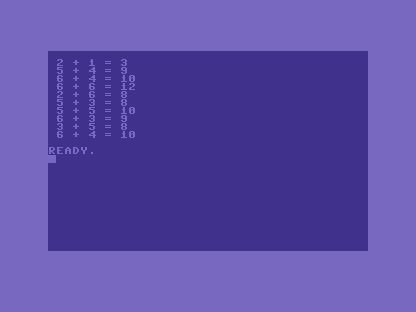
The program rolls two dice into D1 and D2, then line 50 adds them: T = D1+D2. Line 60
prints the sum laid out as an equation — 5 + 4 = 9 — so you can see the two dice and their
total together. The range is now 2 (snake eyes) to 12 (boxcars).
Here’s the thing to notice: the totals cluster. Look down the right-hand column and you’ll see far more 7s, 8s and 9s than 2s or 12s. There’s only one way to roll a 2 — both dice show 1 — but six ways to roll a 7: 1+6, 2+5, 3+4, 4+3, 5+2, 6+1. More ways means more often. The dice are still fair; their total is lopsided, and that lopsidedness has a shape you’re about to uncover.
Try this
- Hunt the rare ones. Run it again and again and count how many rolls pass before a 2 or a 12 appears. They’re out there — just seldom.
- Why six? Write out by hand every pair of dice that adds to 7, then every pair that adds to 3. The counts — six versus two — are exactly why one is commoner than the other.
What’s next
You can see the totals cluster, but counting them by eye gets hard fast. In Unit 3 an array keeps a running tally of every total at once — eleven counters in one named structure.