The Title
FLOCK over the farmyard, Baa Baa Black Sheep on Paula, press fire to begin — and underneath it the state machine every finished game runs on: title, play, won, lost, and back round for one more go.
Until now the game has started the only way a prototype can — abruptly, mid-farmyard, sheep already on the grass — and ended the only way a prototype does, frozen until you pull the plug. What separates that from a finished game is one idea: the game is a loop of states, and play is only one of them. This unit builds the loop: a title screen with the farm idling behind it, a daft Paula jingle, press fire to begin — and when the last sheep is home or lost, a beat of stillness and back to the title for one more go.
The Display
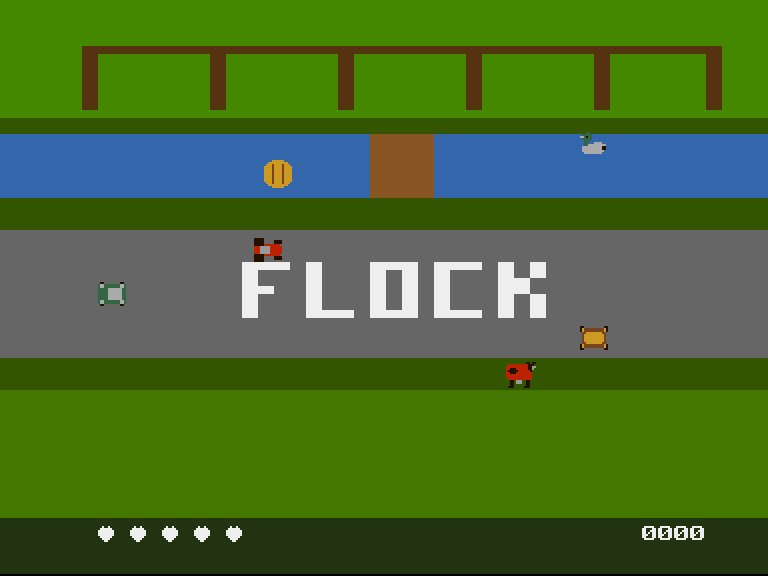
FLOCK, eight pixels at a stroke — and the farm doesn’t stop for it: the tractor clips the F, the cow keeps the verge, both ferries run. The world is the attract mode.
The Spine
;══════════════════════════════════════════════════════════════
; CHECKFIRE / STARTGAME / ENDTICK / GOTOTITLE — the game's spine
;
; Title, play, won, lost — every finished game is a loop of
; states, and the transitions are where resets live. STARTGAME
; is the only place the game becomes new: lives, score, pens,
; nerves, the playfield itself. Miss one reset here and the
; second game inherits the first one's ghosts.
;══════════════════════════════════════════════════════════════

checkfire:
            btst    #7,$bfe001          ; Port 2 fire (active low)
            bne.s   .up
            tst.w   firewas             ; Only the EDGE starts a game —
            bne.s   .held               ;   a held button is one press
            move.w  #1,firewas
            bra.s   startgame
.up:        clr.w   firewas
.held:      rts

startgame:
            move.w  #1,gamestate
            move.w  #FLOCK_SIZE,lives
            clr.w   score
            move.w  #5,unpenned
            clr.w   won
            clr.w   gameover
            clr.w   endtimer
            lea     pentab,a2           ; Every pen empties
            moveq   #5-1,d6
.pen:       clr.b   5(a2)
            addq.l  #6,a2
            dbf     d6,.pen
            move.w  #$0001,DMACON(a5)   ; The jingle stops mid-note
            clr.w   sndtimer
            moveq   #0,d0               ; Clear the whole playfield and
            moveq   #0,d1               ;   redraw it: the title text
            moveq   #ROW_BYTES,d2       ;   goes, the pen glyphs go,
            move.w  #240,d3             ;   the farm comes back clean
            bsr     rectclear
            bsr     drawfarmyard
            bsr     drawflock
            bsr     drawscore
            bsr     newsheep
            rts

endtick:
            tst.w   won                 ; Either ending counts
            bne.s   .ending
            tst.w   gameover
            beq.s   .out
.ending:
            addq.w  #1,endtimer
            cmp.w   #ENDWAIT,endtimer   ; Let the moment land...
            blt.s   .out
            clr.w   gamestate           ; ...then back to the title.
            clr.w   endtimer            ; Score and flock stay on the
            bsr     drawtitle           ;   HUD: the title wears your
            lea     jingle,a0           ;   last game like a rosette
            move.l  a0,jinglep
            clr.w   jingletimer
.out:       rts
The main loop now opens with one test: gamestate. The title is not a separate program — it’s the same loop with different systems switched in. The traffic drives, the duck dips, the jingle plays; what’s missing is the sheep and everything that judges her. One branch, two games.
The transitions are where the real lessons live:
startgameis the only place the game becomes new. Lives, score, pens, nerves, the playfield itself — every reset in one routine. This is the discipline that matters: scatter your resets and the second game inherits the first one’s ghosts. (Our first draft forgot nothing — but only because thirteen units of state had already been listed in one place bynewsheepand friends. Architecture pays compound interest.)checkfirewatches the edge, not the level. A held button is one press, not fifty starts a second.firewasis the same latch pattern as Unit 16’s worried baa — fired once, reset on release.endticklets the moment land. Win or lose, the screen holds forENDWAITframes before the title returns. Snap back instantly and the player never reads their own ending; the pause is the punctuation. And when the title does return, the score and flock stay on the HUD — the title wears your last game like a rosette until fire wipes it.
The title text itself is rectfill walking a table — the same routine that built the farm in Unit 1, fed letter-shaped data. The road band is bared first so the lane markings don’t thread through the lettering. Fonts are just data with opinions.
The Sequencer Soundtick Was Always Going to Need
;══════════════════════════════════════════════════════════════
; TUNETICK — the sequencer soundtick was always going to need
;
; A melody is a table: period, frames, period, frames... and a
; zero to loop. Each entry is one playsound call; the tick just
; watches the clock and serves the next note. Unit 11 played
; one sound at a time; this plays one sound at a time, forever,
; in order — that's all a jingle is. A zero period is a rest.
;══════════════════════════════════════════════════════════════

tunetick:
            tst.w   jingletimer
            beq.s   .next
            subq.w  #1,jingletimer
            rts
.next:
            move.l  jinglep,a0
            move.w  (a0)+,d0            ; Period (0 = rest, -1 = loop)
            bmi.s   .loop
            move.w  (a0)+,d2            ; Frames
            move.w  d2,jingletimer
            move.l  a0,jinglep
            tst.w   d0
            beq.s   .rest
            move.w  d0,d1               ; Steady pitch: both periods
            move.w  #JINGLE_VOL,d3      ;   the same, no slide
            bra     playsound
.rest:
            move.w  #$0001,DMACON(a5)   ; Silence is a note too
            rts
.loop:
            lea     jingle,a0
            move.l  a0,jinglep
            rts
Unit 11 ended with a question: playsound plays one sound, so what’s the smallest change that plays a sequence? This is the answer, and it’s barely a routine. A melody is a table — period, frames, period, frames — and tunetick watches the clock and serves the next entry. Zero period is a rest (silence is a note too — switch the channel off and keep counting); the terminator loops back to the top. Every note is an ordinary playsound call with both periods equal: steady pitch, no slide.
; Baa Baa Black Sheep, one phrase at a time: period, frames.
; 0 period = a rest; -1 = back to the top.
jingle:
            dc.w    NOTE_C,18, NOTE_C,18, NOTE_G,18, NOTE_G,18
            dc.w    NOTE_A,9,  NOTE_A,9,  NOTE_A,9,  NOTE_A,9
            dc.w    NOTE_G,32, 0,14
            dc.w    NOTE_F,18, NOTE_F,18, NOTE_E,18, NOTE_E,18
            dc.w    NOTE_D,9,  NOTE_D,9,  NOTE_D,9,  NOTE_D,9
            dc.w    NOTE_C,32, 0,60
            dc.w    -1
hopgap:     dc.w    COOLDOWN            ; This sheep's hop rhythm
And the tune had to be Baa Baa Black Sheep — public domain since before electricity, and this game has earned it: you met her in Unit 15. Six note constants, eighteen table entries, and the farm has theme music — here’s one loop of it:
The whole apparatus — table, tick, rest, loop — is the seed of every tracker and game-music driver ever written; they are this routine with more columns.
Experiment: Conduct
- Halve every duration in the jingle table. Double them. Tempo is data; nobody recompiles an orchestra.
- Transpose it: multiply every period by 2 for an octave down (and feel a Paula truth: bigger period, lower note). Write
NOTE_C*2and let the assembler do the arithmetic. - Give the rests a pulse: replace the
0,14rest with a whisper-quiet low note. The silence becomes a heartbeat and the jingle suddenly has a rhythm section. ENDWAIT equ 25— the ending barely registers before the title snatches the screen.equ 900— it overstays. Find the dwell where a lost game stings and a won one glows.
The Complete Code
;──────────────────────────────────────────────────────────────
; FLOCK - A sheep-crossing arcade game for the Commodore Amiga
; Unit 12: The Stream
;
; The rule flips. The water is deadly now — step in and she
; drowns — UNLESS she lands on the drifting hay bale, which
; carries her, or keeps to the footbridge. Same collision
; hardware as the road, opposite law: on the lane, touching
; the sprite kills; on the stream, NOT touching one does.
; One CLXDAT read now serves two judges, so the read becomes
; a shared copy — and the bale shares the cart's collision
; bit, so position decides which one the contact means.
;──────────────────────────────────────────────────────────────
;══════════════════════════════════════════════════════════════
; TWEAKABLE VALUES — Change these and see what happens!
;══════════════════════════════════════════════════════════════
; Colours are $0RGB (4 bits per component, values 0-F)
COLOUR_FOLD_GRASS equ $0480 ; The fold's pasture
COLOUR_HEDGE equ $0350 ; Hedgerow between fold and stream
COLOUR_WATER equ $036A ; The stream
COLOUR_BANK equ $0350 ; Grassy bank below the stream
COLOUR_LANE equ $0666 ; The lane's tarmac
COLOUR_VERGE equ $0350 ; Verge below the lane
COLOUR_FIELD equ $0470 ; The field where the flock waits
COLOUR_FENCE equ $0531 ; Pen walls (bitplane, fold band)
COLOUR_WOOD equ $0852 ; The footbridge (bitplane, stream band)
COLOUR_DASH equ $0EEE ; Lane markings (bitplane, lane band)
COLOUR_TUFT equ $0360 ; Spare (bitplane, grass bands)
COLOUR_WOOL equ $0EEE ; The sheep's fleece (sprite colour 1)
COLOUR_FACE equ $0210 ; Her face, ears and tail (sprite colour 2)
COLOUR_SHADE equ $0BBB ; Fleece shading (sprite colour 3)
COLOUR_SOOT equ $0333 ; A black sheep's fleece
COLOUR_SOOTFACE equ $0CCC ; ...and her pale face
COLOUR_SOOTSHADE equ $0222 ; ...and her shading
COLOUR_TRACTOR equ $0B20 ; The tractor's bodywork (sprite colour 1)
COLOUR_TYRE equ $0210 ; Wheels and trim (sprite colour 2)
COLOUR_CAB equ $0999 ; The cab roof (sprite colour 3)
COLOUR_WOODWORK equ $0742 ; The hay cart's bed (sprites 4-5)
COLOUR_HAY equ $0C92 ; Its heaped load
COLOUR_ROVER equ $0364 ; The Land Rover's paint (sprites 6-7)
COLOUR_ROOF equ $0AAA ; Its roof panel
; Where each band begins (screen row 0-255, top to bottom)
ROW_HEDGE equ 40
ROW_STREAM equ 48
ROW_BANK equ 80
ROW_LANE equ 96
ROW_VERGE equ 160
ROW_FIELD equ 176
; Where the sheep starts, and how she moves
SHEEP_X equ 152
SHEEP_Y equ 200
STEP equ 8 ; Pixels per hop
COOLDOWN equ 6 ; Frames between hops
SKITTISH equ 4 ; A black sheep's quicker rhythm
NERVE_EDGE equ 150 ; Three seconds' dithering: trembling
NERVE_BOLT equ 250 ; Five: the wind's up, she bolts
PANIC_HOPS equ 3 ; How far a bolting sheep bolts
; The traffic: three lanes, three rhythms
TRACTOR_Y equ 98 ; Top lane
TRACTOR_SPEED equ 2 ; Steady, rightward
ROVER_Y equ 120 ; Middle lane
ROVER_SPEED equ -3 ; Fast, leftward
CART_Y equ 142 ; Bottom lane — crossed first
CART_SPEED equ -1 ; Plodding, leftward
; How long the world stops when a sheep is lost
SQUASH_BEAT equ 25 ; Frames of stillness
; The flock
FLOCK_SIZE equ 5 ; Sheep in hand at the start
ENDWAIT equ 300 ; Frames to sit with the ending
JINGLE_VOL equ 48 ; The title tune's voice
; The jingle's notes (PAL: period = 3546895 / (freq * 8))
NOTE_C equ 1694
NOTE_D equ 1510
NOTE_E equ 1345
NOTE_F equ 1270
NOTE_G equ 1131
NOTE_A equ 1008
; The fold's pens
PEN_ROW equ 16 ; Where a resident sheep settles
FENCE_Y equ 24 ; She stops here unless a pen is open
PEN_BEAT equ 15 ; Frames of calm after a penning
; What things are worth
ROAD_POINTS equ 5 ; Surviving the road (per sheep)
PEN_POINTS equ 25 ; A sheep safely home
BLACK_BONUS equ 100 ; ...and a black one besides
ROW_BANK_TOP equ 88 ; Past here, the road is behind her
; The farmyard's voice: each sound is two periods (pitch
; slides from the first to the second halfway through), a
; volume, and a length in frames. Bigger period = lower note.
BAA_PER1 equ 1800 ; The hop: a soft baa,
BAA_PER2 equ 2100 ; dropping as it ends
BAA_FRAMES equ 5
BAA_VOL equ 40
SPLAT_PER1 equ 2800 ; The loss: low and flat,
SPLAT_PER2 equ 3600 ; sagging lower
SPLAT_FRAMES equ 16
SPLAT_VOL equ 60
BLEAT_PER1 equ 1700 ; The pen: contented,
BLEAT_PER2 equ 1250 ; rising
BLEAT_FRAMES equ 18
BLEAT_VOL equ 50
CHIME_PER1 equ 850 ; The black sheep's chime:
CHIME_PER2 equ 560 ; high, bright, rising
CHIME_FRAMES equ 22
CHIME_VOL equ 58
FRET_PER1 equ 1150 ; The nervous baa: thin,
FRET_PER2 equ 1400 ; falling, worried
FRET_FRAMES equ 8
FRET_VOL equ 42
DROWN_PER1 equ 2200 ; The stream: a swallowed
DROWN_PER2 equ 3400 ; glub, sinking
DROWN_FRAMES equ 14
DROWN_VOL equ 55
; The stream and its crossings
STREAM_TOP equ 44 ; She's in the water between
STREAM_BOT equ 76 ; these rows...
BRIDGE_MINX equ 144 ; ...unless on the footbridge
BRIDGE_MAXX equ 176 ; (sheep-centre span)...
BALE_Y equ 60 ; ...or aboard the hay bale
DUCK_Y equ 46 ; The duck paddles the north water
DUCK_SPEED equ -1 ; ...heading the other way
DUCK_PADDLE equ 220 ; Frames afloat between feeds
DUCK_WARN equ 50 ; Tail-up: the warning she gives
DUCK_UNDER equ 120 ; Frames spent feeding below
COW_Y equ 160 ; The verge is HER lane
COW_SPEED equ 1<<15 ; Half a pixel a frame, in 16.16
BALE_SPEED equ 1 ; It drifts gently rightward
; The HUD strip at the foot of the screen
ROW_HUD equ 240
COLOUR_HUD equ $0231 ; The strip itself
COLOUR_ICON equ $0EEE ; Sheep icons (bitplane, HUD band)
;══════════════════════════════════════════════════════════════
; HARDWARE REGISTERS
;══════════════════════════════════════════════════════════════
CUSTOM equ $dff000
DMACON equ $096 ; DMA control (write)
INTENA equ $09a ; Interrupt enable (write)
INTREQ equ $09c ; Interrupt request (write)
COP1LC equ $080 ; Copper list pointer
COPJMP1 equ $088 ; Copper restart strobe
VPOSR equ $004 ; Beam position
JOY1DAT equ $00c ; Joystick, control port 2
CLXDAT equ $00e ; Collision data (read clears it!)
CLXCON equ $098 ; Collision control
AUD0LC equ $0a0 ; Audio channel 0: sample address
AUD0LEN equ $0a4 ; sample length (words)
AUD0PER equ $0a6 ; period (pitch)
AUD0VOL equ $0a8 ; volume (0-64)
BPLCON0 equ $100 ; Bitplane control
BPLCON1 equ $102 ; Scroll
BPLCON2 equ $104 ; Priority
BPL1MOD equ $108 ; Odd plane modulo
DDFSTRT equ $092 ; Display data fetch start
DDFSTOP equ $094 ; Display data fetch stop
DIWSTRT equ $08e ; Display window start
DIWSTOP equ $090 ; Display window stop
BPL1PTH equ $0e0 ; Bitplane 1 pointer (high)
BPL1PTL equ $0e2 ; Bitplane 1 pointer (low)
BPL2PTH equ $0e4 ; Bitplane 2 pointer (high)
BPL2PTL equ $0e6 ; Bitplane 2 pointer (low)
BPL2MOD equ $10a ; Even plane modulo
SPR0PTH equ $120 ; Sprite 0 pointer (high)
COLOR00 equ $180 ; Background colour
COLOR01 equ $182 ; Bitplane colour 1
COLOR02 equ $184 ; Bitplane colour 2 (plane 2)
COLOR03 equ $186 ; Bitplane colour 3 (both planes)
COLOR17 equ $1a2 ; Sprite 0/1 colour 1
COLOR18 equ $1a4 ; Sprite 0/1 colour 2
COLOR19 equ $1a6 ; Sprite 0/1 colour 3
COLOR21 equ $1aa ; Sprite 2/3 colour 1
COLOR22 equ $1ac ; Sprite 2/3 colour 2
COLOR23 equ $1ae ; Sprite 2/3 colour 3
COLOR25 equ $1b2 ; Sprite 4/5 colour 1
COLOR26 equ $1b4 ; Sprite 4/5 colour 2
COLOR27 equ $1b6 ; Sprite 4/5 colour 3
COLOR29 equ $1ba ; Sprite 6/7 colour 1
COLOR30 equ $1bc ; Sprite 6/7 colour 2
COLOR31 equ $1be ; Sprite 6/7 colour 3
ROW_BYTES equ 40 ; 320 pixels / 8
;══════════════════════════════════════════════════════════════
; CODE (Chip RAM — the Copper, planes and sprites live here)
;══════════════════════════════════════════════════════════════
section code,code_c
start:
lea CUSTOM,a5 ; A5 = custom chip base ($DFF000)
; --- Take over the machine ---
move.w #$7fff,INTENA(a5) ; Disable all interrupts
move.w #$7fff,INTREQ(a5) ; Clear pending interrupts
move.w #$7fff,DMACON(a5) ; Disable all DMA
; --- Point the Copper's bitplane MOVEs at our planes ---
lea copbpl,a1
lea plane,a0
move.l a0,d0
move.w d0,6(a1) ; Low word into the BPL1PTL move
swap d0
move.w d0,2(a1) ; High word into the BPL1PTH move
lea plane2,a0
move.l a0,d0
move.w d0,14(a1) ; And the same for plane 2
swap d0
move.w d0,10(a1)
; --- Point sprite 0 at the sheep, the rest at nothing ---
lea copsprites,a1 ; Eight pointer pairs in the list
lea sheep0,a0
move.l a0,d0
move.w d0,6(a1) ; Sprite 0 low word
swap d0
move.w d0,2(a1) ; Sprite 0 high word
lea nullspr,a0 ; Sprites 1-7: an empty sprite
move.l a0,d0
moveq #7-1,d6
.nulls:
lea 8(a1),a1 ; Next pointer pair in the list
move.w d0,6(a1)
swap d0
move.w d0,2(a1)
swap d0
dbf d6,.nulls
; --- ...except the traffic: sprites 2, 4 and 6.
; Each vehicle gets the EVEN sprite of its own pair, so
; each lives in its own collision group: tractor in 2/3
; (bit 9 against the sheep), cart in 4/5 (bit 10),
; Land Rover in 6/7 (bit 11) — and its own palette.
lea copsprites+16,a1 ; Sprite 2: the tractor
lea tractor,a0
move.l a0,d0
move.w d0,6(a1)
swap d0
move.w d0,2(a1)
lea copsprites+32,a1 ; Sprite 4: the hay cart
lea cart,a0
move.l a0,d0
move.w d0,6(a1)
swap d0
move.w d0,2(a1)
lea copsprites+48,a1 ; Sprite 6: the Land Rover
lea rover,a0
move.l a0,d0
move.w d0,6(a1)
swap d0
move.w d0,2(a1)
lea copsprites+40,a1 ; Sprite 5: the hay bale —
lea bale,a0 ; the cart's pair, so it
move.l a0,d0 ; borrows the hay palette
move.w d0,6(a1) ; AND the cart's collision
swap d0 ; bit. Position will tell
move.w d0,2(a1) ; them apart.
lea copsprites+24,a1 ; Sprite 3: the cow — the
lea cow,a0 ; tractor's pair, so she
move.l a0,d0 ; shares its colours AND its
move.w d0,6(a1) ; bit 9 — the bit that kills
swap d0 ; without asking where you
move.w d0,2(a1) ; were standing.
lea copsprites+56,a1 ; Sprite 7: the duck — the
lea duck,a0 ; Rover's pair, so she borrows
move.l a0,d0 ; the Rover's palette AND its
move.w d0,6(a1) ; collision bit. Position will
swap d0 ; tell them apart, as it does
move.w d0,2(a1) ; for the cart and the bale.
; --- Arm collision detection ---
move.w #$e000,CLXCON(a5) ; ENSP3+5+7: odd sprites sit OUT
; of collision unless invited —
; the cow, the bale and the
; duck all need their bits set
move.w CLXDAT(a5),d0 ; Prime: reading clears the latches
; --- Draw the farmyard's detail into the bitplane ---
bsr drawfarmyard
bsr drawflock ; The flock in hand, bottom-left
bsr drawscore ; And the score, bottom-right
; --- Place the sheep at her starting spot ---
bsr newsheep ; Even the first one rolls
bsr updsprite
bsr drawtitle ; ...but the game opens on the
; title, sheep in the wings
; --- Install Copper list ---
lea copperlist,a0
move.l a0,COP1LC(a5)
move.w d0,COPJMP1(a5) ; Strobe: restart Copper from COP1LC
; --- Enable DMA ---
move.w #$83a0,DMACON(a5) ; SET + DMAEN + BPLEN + COPEN + SPREN
; === Main Loop ===
mainloop:
; Wait for vertical blank — in two phases. If we only
; waited FOR line 0, a fast loop body could finish while
; the beam is still ON line 0 and run again in the same
; frame. Wait to leave line 0 first, then to reach it.
move.l #$1ff00,d1 ; Mask: bits 8-16 of beam position
.vbleave:
move.l VPOSR(a5),d0 ; Read beam position
and.l d1,d0 ; Isolate line number
beq.s .vbleave ; Loop while still on line 0
.vbwait:
move.l VPOSR(a5),d0 ; Read beam position
and.l d1,d0 ; Isolate line number
bne.s .vbwait ; Loop until line 0 again
; The line number spans TWO registers, and the 68000
; reads them one after the other. Catch the beam mid-
; crossing (255 to 256) and the halves disagree: V8
; from the old line, V0-V7 from the new one — a line
; that reads as 0 but isn't. Read again: a real line 0
; stays 0, a phantom is gone by the second look.
move.l VPOSR(a5),d0 ; Confirm against a second read
and.l d1,d0
bne.s .vbwait ; Phantom — keep waiting
addq.w #1,framecnt ; The entropy clock ticks
; --- Two games share one loop: the title is a game ---
; whose only verb is "press fire". The world drives on
; in both states; only the sheep-facing systems switch.
tst.w gamestate
bne.s .playing
; — TITLE: attract mode —
bsr drivelanes ; The farm doesn't stop for
bsr tendduck ; a title — that's the charm
bsr tunetick ; The jingle walks its table
bsr soundtick
bsr updsprite
bsr showframe ; (Hides the sheep: see below)
bsr checkfire ; Fire starts the game
bra.s .endloop
.playing:
bsr steer ; Read the stick, maybe hop
bsr fret ; Standing still has a price
bsr drivelanes ; All the traffic, one mover
bsr tendduck ; Paddle, warn, vanish, return
move.w CLXDAT(a5),contacts ; ONE read; every judge shares it
bsr checksquash ; Did the lane win?
bsr checkstream ; Did the water?
bsr soundtick ; Wobble, and fall silent on time
bsr updsprite ; Position is data: rewrite POS/CTL
bsr showframe ; Point sprite 0 at this step's image
bsr endtick ; Won or lost: sit, then title
.endloop:
; Check left mouse button (active low at CIAA)
btst #6,$bfe001 ; CIAA Port A, bit 6
bne mainloop ; Not pressed — keep going
; Button pressed — halt
.halt:
bra.s .halt
;══════════════════════════════════════════════════════════════
; STEER — read the joystick, hop the sheep
;
; JOY1DAT is control port 2. The decode is famously sideways:
; right = bit 1 left = bit 9
; down = bit 0 XOR bit 1 up = bit 8 XOR bit 9
; One XOR of the register with itself-shifted turns the two
; awkward pairs into plain testable bits.
;
; A hop is STEP pixels; COOLDOWN frames must pass between hops
; — that's what makes her *step* like a sheep rather than glide
; like a cursor.
;══════════════════════════════════════════════════════════════
steer:
tst.w won ; Fold full — nothing to steer
bne.s .frozen
tst.w gameover ; No flock, no shepherd
bne.s .frozen
tst.w squashtimer ; Mid squash-beat? She can't move
beq.s .alive
.frozen: rts
.alive:
tst.w cooldown
beq.s .ready
subq.w #1,cooldown ; Still mid-hop rhythm — wait
rts
.ready:
tst.w panic ; Bolting? She's not asking
beq.s .listening
subq.w #1,panic
cmp.w #FENCE_Y,sheepy ; A bolt is an UP that ignores
bgt.s .bolthop ; the stick entirely
bsr trypen ; Bolting at the fence: she
bra .done ; slams into it (or a pen)
.bolthop:
sub.w #STEP,sheepy
bra .stepped
.listening:
move.w JOY1DAT(a5),d0 ; Read the stick
move.w d0,d1
lsr.w #1,d1
eor.w d0,d1 ; Now: bit 0 = down, bit 8 = up
btst #8,d1 ; Up?
beq.s .notup
cmp.w #FENCE_Y,sheepy ; At the fence line?
bgt.s .climb
bsr trypen ; Only a pen lets her past
bra .done
.climb:
sub.w #STEP,sheepy
bra.s .stepped
.notup:
btst #0,d1 ; Down?
beq.s .notdown
add.w #STEP,sheepy
bra.s .stepped
.notdown:
btst #9,d0 ; Left?
beq.s .notleft
sub.w #STEP,sheepx
bra.s .stepped
.notleft:
btst #1,d0 ; Right?
beq .done ; Stick centred — no hop
add.w #STEP,sheepx
.stepped:
move.w hopgap,cooldown ; Set THIS sheep's hop rhythm
eori.w #1,curframe ; The other feet, next picture
clr.w nerve ; Moving keeps the fear down
clr.w fretted
; --- The hop has a voice ---
move.w #BAA_PER1,d0
move.w #BAA_PER2,d1
move.w #BAA_FRAMES,d2
move.w #BAA_VOL,d3
bsr playsound
; --- First time past the road? That's worth something.
tst.w roadflag
bne.s .scored
cmp.w #ROW_BANK_TOP,sheepy
bgt.s .scored
move.w #1,roadflag
add.w #ROAD_POINTS,score
bsr drawscore
.scored:
; --- Hold her inside the farm ---
tst.w sheepx
bge.s .xlow
clr.w sheepx
.xlow: cmp.w #320-16,sheepx
ble.s .xhigh
move.w #320-16,sheepx
.xhigh: cmp.w #FENCE_Y,sheepy ; The fence is the ceiling;
bge.s .ylow ; pens are the only way past
move.w #FENCE_Y,sheepy
.ylow: cmp.w #ROW_HUD-16,sheepy ; The HUD strip is not a pasture
ble.s .done
move.w #ROW_HUD-16,sheepy
.done:
rts
;══════════════════════════════════════════════════════════════
; DRIVELANES — advance all the traffic
;
; FRET — the clock on her courage
;
; Mid-crossing, NERVE counts the frames since her last hop.
; Stand still too long and she trembles (showframe alternates
; her step images — the art was always two pictures, and fear
; is just walking on the spot); a worried baa marks the edge.
; Stand longer and the wind gets up: PANIC_HOPS involuntary
; hops, forward, stick ignored. Hopping anywhere resets the
; count — pressure only ever lands on the shepherd who stops.
;══════════════════════════════════════════════════════════════
fret:
tst.w gameover
bne.s .calm
tst.w won
bne.s .calm
tst.w squashtimer ; Beats don't count as dithering
bne.s .calm
tst.w panic ; Already bolting — fear's spent
bne.s .out
cmp.w #ROW_FIELD,sheepy ; Home field: she grazes, easy
bge.s .calm
addq.w #1,nerve
cmp.w #NERVE_EDGE,nerve ; Trembling point?
blt.s .out
tst.w fretted ; One worried baa, not fifty
bne.s .past
move.w #1,fretted
move.w #FRET_PER1,d0
move.w #FRET_PER2,d1
move.w #FRET_FRAMES,d2
move.w #FRET_VOL,d3
bsr playsound
.past:
cmp.w #NERVE_BOLT,nerve ; The wind's up
blt.s .out
move.w #PANIC_HOPS,panic ; She bolts — see steer
clr.w nerve
clr.w fretted
.out: rts
.calm:
clr.w nerve
clr.w fretted
rts
;══════════════════════════════════════════════════════════════
; Unit 5's mover, made data — and now made FRACTIONAL. Every
; position is a longword in 16.16 fixed point: the top word is
; the pixel, the bottom word is the fraction of a pixel the
; vehicle has earned but not yet shown. Adding a 16.16 speed
; each frame accumulates the fraction; when it overflows, the
; pixel above it ticks. The cow ambles at half a pixel a frame
; and the mover never knows she's special. And because the
; 68000 stores the high word FIRST, a plain move.w at the
; label still reads the pixel — every old word-read works.
;══════════════════════════════════════════════════════════════
drivelanes:
lea vehtab,a2
moveq #6-1,d6 ; Three vehicles, two ferries,
.veh: ; one cow
move.l (a2)+,a0 ; A0 = where this one's x lives
move.l (a2)+,d1 ; D1 = its speed (16.16, signed)
move.l (a0),d0
add.l d1,d0
tst.l d1
bmi.s .leftward
cmp.l #320<<16,d0 ; Rightward: clear of the right edge?
blt.s .store
move.l #-16<<16,d0 ; Re-enter from the left
bra.s .store
.leftward:
cmp.l #-16<<16,d0 ; Leftward: clear of the left edge?
bgt.s .store
move.l #320<<16,d0 ; Re-enter from the right
.store:
move.l d0,(a0)
dbf d6,.veh
rts
vehtab: dc.l tractx
dc.l TRACTOR_SPEED<<16
dc.l cartx
dc.l CART_SPEED<<16
dc.l roverx
dc.l ROVER_SPEED<<16
dc.l balex
dc.l BALE_SPEED<<16
dc.l duckx
dc.l DUCK_SPEED<<16
dc.l cowx
dc.l COW_SPEED
;══════════════════════════════════════════════════════════════
; CHECKSQUASH — read the collision latches, judge the lane
;
; CLXDAT accumulates collisions as Denise draws, and READING
; IT CLEARS IT — so read it exactly once per frame and keep
; the copy. Bit 9 means "sprite 0 or 1 touched sprite 2 or 3":
; our sheep met our tractor, pixel against pixel. The hardware
; compared every overlapping pixel pair for us, for free.
;══════════════════════════════════════════════════════════════
checksquash:
tst.w squashtimer ; Already mid-beat?
beq.s .watch
subq.w #1,squashtimer ; Count the stillness down
rts ; (No flush needed any more — the
; shared read drains the latch
; every frame, beat or no beat)
.watch:
tst.w gameover ; Nothing left to lose?
bne.s .safe
move.w contacts,d0 ; The shared copy — no second read
and.w #$0200,d0 ; Bit 9 — tractor or cow: it
bne.s .squashed ; kills wherever she stands
move.w contacts,d0
and.w #$0c00,d0 ; Bits 10+11: cart or bale, Rover
beq.s .safe ; or duck — the shared bits...
cmp.w #ROW_BANK,sheepy ; ...and they only mean the road
blt.s .safe ; pair when she's road-side
.squashed:
; --- Squashed. One fewer in hand. ---
move.w #SPLAT_PER1,d0
move.w #SPLAT_PER2,d1
move.w #SPLAT_FRAMES,d2
move.w #SPLAT_VOL,d3
bsr playsound
bsr losesheep
.safe:
rts
;══════════════════════════════════════════════════════════════
; CHECKSTREAM — the water's law: ride or drown
;
; Only judges while she's in the stream rows. The footbridge
; column is dry land. Aboard a ferry — the bale (bit 10) or
; the duck (bit 11), up here where the road pair can't be —
; she's safe and CARRIED: the deck's drift becomes her
; movement, each at its own speed. Anything else is water.
;══════════════════════════════════════════════════════════════
checkstream:
tst.w squashtimer ; The world can wait out a beat
bne .dry
tst.w gameover
bne .dry
tst.w won
bne .dry
cmp.w #STREAM_TOP,sheepy ; In the water rows at all?
blt .dry
cmp.w #STREAM_BOT,sheepy
bgt.s .dry
move.w sheepx,d0
addq.w #8,d0 ; Her centre...
cmp.w #BRIDGE_MINX,d0 ; ...on the footbridge?
blt.s .wet
cmp.w #BRIDGE_MAXX,d0
ble.s .dry ; Dry planks. Carry on.
.wet:
move.w contacts,d0
and.w #$0c00,d0 ; Either ferry under her feet?
beq.s .adrift
clr.w drownarm ; Feet on something that floats
btst #10,d0 ; Which deck is she on?
beq.s .duckdeck
add.w #BALE_SPEED,sheepx ; Carried with the bale's drift
bra.s .edges
.duckdeck:
add.w #DUCK_SPEED,sheepx ; The duck paddles the other way
.edges:
tst.w sheepx ; Carried off either end of the
bmi.s .drowned ; world is still a loss
cmp.w #320-16,sheepx
blt .dry
bra.s .drowned
.adrift:
; CLXDAT reports the PREVIOUS frame's drawing — the
; instant she lands on the bale, the evidence hasn't
; been drawn yet. The water forgives a moment of
; scrambling before it takes her.
addq.w #1,drownarm
cmp.w #3,drownarm ; Three contactless frames
blt.s .dry
.drowned:
clr.w drownarm
move.w #DROWN_PER1,d0
move.w #DROWN_PER2,d1
move.w #DROWN_FRAMES,d2
move.w #DROWN_VOL,d3
bsr playsound
bsr losesheep
.dry:
rts
;──────────────────────────────────────────────────────────────
; losesheep — one fewer in hand, however it happened
;──────────────────────────────────────────────────────────────
losesheep:
subq.w #1,lives
bsr drawflock ; Redraw the strip
tst.w lives
bgt.s .next ; Sheep remain — send the next one
move.w #1,gameover ; The field is empty
rts
.next:
bsr newsheep ; The next sheep steps up
move.w #SQUASH_BEAT,squashtimer
rts
;══════════════════════════════════════════════════════════════
; NEWSHEEP — the next one steps up, and the dice decide her coat
;
; One sheep in eight is black: worth BLACK_BONUS at the fold,
; and a touch quicker on her feet. The roll mixes the xorshift
; generator with FRAMECNT — a clock that's been ticking since
; power-on — so the dice land where the PLAYER's timing put
; them. A machine with no randomness borrows some from you.
;
; Her colours live in the Copper list, which is only data: the
; same trick that repoints sprites repaints a sheep — three
; words poked into the palette entries before she steps out.
;══════════════════════════════════════════════════════════════
newsheep:
move.w #SHEEP_X,sheepx
move.w #SHEEP_Y,sheepy
clr.w roadflag ; A fresh road ahead of her
clr.w nerve ; Fresh courage, too
clr.w fretted
clr.w panic
bsr rnd
and.w #7,d0 ; One face of an eight-sided die
beq.s .black
clr.w isblack
move.w #COOLDOWN,hopgap
move.w #COLOUR_WOOL,woolentry+2
move.w #COLOUR_FACE,faceentry+2
move.w #COLOUR_SHADE,shadeentry+2
rts
.black:
move.w #1,isblack
move.w #SKITTISH,hopgap ; Quicker on her feet
move.w #COLOUR_SOOT,woolentry+2
move.w #COLOUR_SOOTFACE,faceentry+2
move.w #COLOUR_SOOTSHADE,shadeentry+2
rts
;──────────────────────────────────────────────────────────────
; rnd — 16-bit xorshift (7,9,8), stirred with the frame clock
; returns D0 = next pseudo-random word
;──────────────────────────────────────────────────────────────
rnd:
move.w seed,d0
move.w framecnt,d1 ; EOR only takes a register
eor.w d1,d0 ; Stir in the player's timing
move.w d0,d1
lsl.w #7,d1 ; x ^= x << 7
eor.w d1,d0
move.w d0,d1
lsr.w #8,d1
lsr.w #1,d1 ; x ^= x >> 9
eor.w d1,d0
move.w d0,d1
lsl.w #8,d1 ; x ^= x << 8
eor.w d1,d0
bne.s .live
move.w #$ACE1,d0 ; Zero is the one dead state
.live:
move.w d0,seed
rts
;══════════════════════════════════════════════════════════════
; CHECKFIRE / STARTGAME / ENDTICK / GOTOTITLE — the game's spine
;
; Title, play, won, lost — every finished game is a loop of
; states, and the transitions are where resets live. STARTGAME
; is the only place the game becomes new: lives, score, pens,
; nerves, the playfield itself. Miss one reset here and the
; second game inherits the first one's ghosts.
;══════════════════════════════════════════════════════════════
checkfire:
btst #7,$bfe001 ; Port 2 fire (active low)
bne.s .up
tst.w firewas ; Only the EDGE starts a game —
bne.s .held ; a held button is one press
move.w #1,firewas
bra.s startgame
.up: clr.w firewas
.held: rts
startgame:
move.w #1,gamestate
move.w #FLOCK_SIZE,lives
clr.w score
move.w #5,unpenned
clr.w won
clr.w gameover
clr.w endtimer
lea pentab,a2 ; Every pen empties
moveq #5-1,d6
.pen: clr.b 5(a2)
addq.l #6,a2
dbf d6,.pen
move.w #$0001,DMACON(a5) ; The jingle stops mid-note
clr.w sndtimer
moveq #0,d0 ; Clear the whole playfield and
moveq #0,d1 ; redraw it: the title text
moveq #ROW_BYTES,d2 ; goes, the pen glyphs go,
move.w #240,d3 ; the farm comes back clean
bsr rectclear
bsr drawfarmyard
bsr drawflock
bsr drawscore
bsr newsheep
rts
endtick:
tst.w won ; Either ending counts
bne.s .ending
tst.w gameover
beq.s .out
.ending:
addq.w #1,endtimer
cmp.w #ENDWAIT,endtimer ; Let the moment land...
blt.s .out
clr.w gamestate ; ...then back to the title.
clr.w endtimer ; Score and flock stay on the
bsr drawtitle ; HUD: the title wears your
lea jingle,a0 ; last game like a rosette
move.l a0,jinglep
clr.w jingletimer
.out: rts
;══════════════════════════════════════════════════════════════
; DRAWTITLE — FLOCK, eight pixels at a stroke
;
; Block capitals built from filled rectangles — the same
; rectfill that built the farm, walking a table. Chunky is
; period-honest: fonts are data, and a five-letter logo is
; twenty rows of it.
;══════════════════════════════════════════════════════════════
drawtitle:
moveq #0,d0 ; Bare the whole road band —
move.w #96,d1 ; the dashes would thread
moveq #ROW_BYTES,d2 ; through the lettering
move.w #63,d3
bsr rectclear
lea titletab,a2
.rect:
move.w (a2)+,d0 ; x byte (-1 ends the table)
bmi.s .done
move.w (a2)+,d1 ; row
move.w (a2)+,d2 ; width in bytes
move.w (a2)+,d3 ; height in rows
bsr rectfill
bra.s .rect
.done: rts
;══════════════════════════════════════════════════════════════
; TUNETICK — the sequencer soundtick was always going to need
;
; A melody is a table: period, frames, period, frames... and a
; zero to loop. Each entry is one playsound call; the tick just
; watches the clock and serves the next note. Unit 11 played
; one sound at a time; this plays one sound at a time, forever,
; in order — that's all a jingle is. A zero period is a rest.
;══════════════════════════════════════════════════════════════
tunetick:
tst.w jingletimer
beq.s .next
subq.w #1,jingletimer
rts
.next:
move.l jinglep,a0
move.w (a0)+,d0 ; Period (0 = rest, -1 = loop)
bmi.s .loop
move.w (a0)+,d2 ; Frames
move.w d2,jingletimer
move.l a0,jinglep
tst.w d0
beq.s .rest
move.w d0,d1 ; Steady pitch: both periods
move.w #JINGLE_VOL,d3 ; the same, no slide
bra playsound
.rest:
move.w #$0001,DMACON(a5) ; Silence is a note too
rts
.loop:
lea jingle,a0
move.l a0,jinglep
rts
;══════════════════════════════════════════════════════════════
; SETPOS — pack screen (x, y) into one sprite's POS/CTL
; a0 = sprite structure d0 = x d1 = y
;
; Unit 3's packing, generalised: any sprite, any position. Beam
; coordinates: VSTART = y + $2C, HSTART = x + $80 — and the
; ninth bits ride in CTL's low flags.
;══════════════════════════════════════════════════════════════
setpos:
add.w #$2c,d1 ; D1 = VSTART (beam line)
move.w d1,d2
add.w #16,d2 ; D2 = VSTOP (16 rows tall)
add.w #$80,d0 ; D0 = HSTART (beam position)
; POS = VSTART[7:0] << 8 | HSTART[8:1]
move.w d1,d3
lsl.w #8,d3
move.w d0,d4
lsr.w #1,d4
and.w #$ff,d4
or.w d4,d3
move.w d3,(a0) ; Write POS
; CTL = VSTOP[7:0] << 8 | V8START<<2 | V8STOP<<1 | H0START
move.w d2,d3
and.w #$ff,d3
lsl.w #8,d3
btst #8,d1 ; VSTART's ninth bit
beq.s .nv8s
or.w #%100,d3
.nv8s: btst #8,d2 ; VSTOP's ninth bit
beq.s .nv8e
or.w #%010,d3
.nv8e: btst #0,d0 ; HSTART's odd-pixel bit
beq.s .nh0
or.w #%001,d3
.nh0: move.w d3,2(a0) ; Write CTL
rts
;══════════════════════════════════════════════════════════════
; TENDDUCK — the paddle / tail-up / gone cycle
;
; A timer and three states, and the sprite POINTER is the
; state: paddling art, warning art, or the null sprite. While
; she feeds there are no pixels — and no pixels means no
; collision evidence, so the water's law needs no special
; case for a vanished ferry. Her rider is simply adrift.
;══════════════════════════════════════════════════════════════
tendduck:
subq.w #1,ducktimer
bgt.s .done ; Still mid-state
move.w duckstate,d0
addq.w #1,d0
cmp.w #3,d0
blt.s .store
moveq #0,d0 ; ...and up she pops again
.store:
move.w d0,duckstate
lea duck,a0 ; 0: paddling, deck open
move.w #DUCK_PADDLE,ducktimer
tst.w d0
beq.s .point
lea duckwarn,a0 ; 1: tail up — fair warning
move.w #DUCK_WARN,ducktimer
cmp.w #1,d0
beq.s .point
lea nullspr,a0 ; 2: under. No pixels, no deck.
move.w #DUCK_UNDER,ducktimer
.point:
lea copsprites+56,a1 ; Sprite 7's pointer words
move.l a0,d0
move.w d0,6(a1)
swap d0
move.w d0,2(a1)
.done: rts
;══════════════════════════════════════════════════════════════
; UPDSPRITE — place every sprite for this frame
;
; One routine owns every position write: the sheep (both step
; images, so whichever showframe picks she stands in the same
; place) and the tractor.
;══════════════════════════════════════════════════════════════
updsprite:
lea sheep0,a0
move.w sheepx,d0
move.w sheepy,d1
bsr setpos
lea sheep1,a0
move.w sheepx,d0
move.w sheepy,d1
bsr setpos
lea tractor,a0
move.w tractx,d0
move.w #TRACTOR_Y,d1
bsr setpos
lea cart,a0
move.w cartx,d0
move.w #CART_Y,d1
bsr setpos
lea rover,a0
move.w roverx,d0
move.w #ROVER_Y,d1
bsr setpos
lea bale,a0
move.w balex,d0
move.w #BALE_Y,d1
bsr setpos
lea duck,a0
move.w duckx,d0
move.w #DUCK_Y,d1
bsr setpos
lea duckwarn,a0 ; Both poses, same spot — like
move.w duckx,d0 ; the sheep's two step images
move.w #DUCK_Y,d1
bsr setpos
lea cow,a0
move.w cowx,d0 ; A word read of a 16.16 long
move.w #COW_Y,d1 ; is the integer part — free
bsr setpos
rts
;══════════════════════════════════════════════════════════════
; SHOWFRAME — point sprite 0 at this step's image
;
; Animation is nothing but choosing which data the channel
; fetches. The Copper list's sprite 0 pointer words are
; rewritten with whichever picture curframe names — the same
; poke the startup code did, now done every frame.
;══════════════════════════════════════════════════════════════
showframe:
lea nullspr,a0 ; Game over, the whole flock
tst.w gamestate ; home, or the title screen:
beq.s .picked ; no sheep on the move
tst.w gameover
bne.s .picked
tst.w won
bne.s .picked
lea sheep0,a0
move.w curframe,d0
cmp.w #NERVE_EDGE,nerve ; Trembling: walk on the spot —
blt.s .steady ; the step images alternate
move.w framecnt,d0 ; every few frames, going
lsr.w #2,d0 ; nowhere
.steady:
and.w #1,d0
beq.s .picked
lea sheep1,a0
.picked:
move.l a0,d0
lea copsprites,a1
move.w d0,6(a1) ; Sprite 0 low word
swap d0
move.w d0,2(a1) ; Sprite 0 high word
rts
;══════════════════════════════════════════════════════════════
; DRAW THE FARMYARD (unchanged from Unit 1)
;══════════════════════════════════════════════════════════════
drawfarmyard:
; --- The fold's pens (rows 4-35) ---
moveq #0,d0 ; x = byte 0
moveq #4,d1 ; row 4
moveq #ROW_BYTES,d2 ; full width
moveq #4,d3 ; 4 rows thick
bsr rectfill
lea penposts,a2 ; Post positions (byte columns)
moveq #6-1,d6 ; Six posts
.posts:
moveq #0,d0
move.b (a2)+,d0 ; x = next post column
moveq #8,d1 ; rows 8-35
moveq #1,d2 ; one byte wide
moveq #28,d3
bsr rectfill
dbf d6,.posts
; --- The footbridge (rows 48-79, mid-stream) ---
moveq #18,d0 ; byte 18 = pixel 144
moveq #ROW_STREAM,d1
moveq #4,d2 ; 32 pixels wide
moveq #32,d3 ; the stream's full height
bsr rectfill
; --- Lane markings: two dashed lines (rows 116, 136) ---
moveq #116,d1
bsr dashline
move.w #136,d1
; falls through
;──────────────────────────────────────────────────────────────
; dashline — a row of dashes across the lane
; d1 = starting row. 2 bytes on, 2 bytes off, 4 rows thick.
;──────────────────────────────────────────────────────────────
dashline:
moveq #0,d0 ; x = byte 0
.dash:
move.w d1,-(sp) ; rectfill trashes d1
move.w d0,-(sp) ; ...and d0
moveq #2,d2 ; 2 bytes of dash
moveq #4,d3 ; 4 rows thick
bsr rectfill
move.w (sp)+,d0
move.w (sp)+,d1
addq.w #4,d0 ; next dash 4 bytes along
cmp.w #ROW_BYTES,d0
blt.s .dash
rts
;──────────────────────────────────────────────────────────────
; rectfill — set a byte-aligned rectangle of pixels
; d0 = x (bytes) d1 = row d2 = width (bytes) d3 = height
; Trashes d1, d4, d5, a0, a1.
;──────────────────────────────────────────────────────────────
rectfill:
lea plane,a0
move.w d1,d4
mulu #ROW_BYTES,d4 ; row * 40
add.w d0,d4 ; + x
adda.w d4,a0 ; A0 = first byte of the rectangle
move.w d3,d4 ; D4 = rows to go
.row:
movea.l a0,a1
move.w d2,d5 ; D5 = bytes to go
.col:
move.b #$ff,(a1)+ ; 8 pixels on
subq.w #1,d5
bne.s .col
lea ROW_BYTES(a0),a0 ; down one row
subq.w #1,d4
bne.s .row
rts
penposts: dc.b 0,8,16,24,32,39 ; Byte columns of the six posts
even
;══════════════════════════════════════════════════════════════
; TRYPEN — at the fence, try to enter the pen she's facing
;
; Each pentab row is a pen: the span of sheep-centre x values
; it accepts, the byte column its resident glyph is drawn at,
; and a flag byte that remembers it's taken. A hit pens her:
; the resident appears (plane 2 — white among the brown
; fences), the next sheep steps up, and a full fold wins.
;══════════════════════════════════════════════════════════════
trypen:
move.w sheepx,d0
addq.w #8,d0 ; D0 = her centre
lea pentab,a2
moveq #5-1,d6
.pen:
cmp.w (a2),d0 ; Left of this pen?
blt .nextpen
cmp.w 2(a2),d0 ; Right of it?
bgt.s .nextpen
tst.b 5(a2) ; Already taken?
bne.s .nextpen
; --- She's in. A resident for the fold. ---
move.b #1,5(a2)
move.w 4(a2),d0 ; Glyph byte column
and.w #$ff00,d0
lsr.w #8,d0
bsr penglyph
move.w #BLEAT_PER1,d0 ; A contented sound
move.w #BLEAT_PER2,d1
move.w #BLEAT_FRAMES,d2
move.w #BLEAT_VOL,d3
tst.w isblack ; ...unless she's the gamble —
beq.s .sing
move.w #CHIME_PER1,d0 ; then the game's best sound
move.w #CHIME_PER2,d1
move.w #CHIME_FRAMES,d2
move.w #CHIME_VOL,d3
.sing:
bsr playsound
add.w #PEN_POINTS,score ; A sheep safely home
tst.w isblack
beq.s .paid
add.w #BLACK_BONUS,score ; The gamble pays
.paid:
bsr drawscore
bsr newsheep ; The next sheep steps up
move.w #PEN_BEAT,squashtimer
subq.w #1,unpenned ; A full fold wins
bne.s .out
move.w #1,won
.out:
rts
.nextpen:
addq.l #6,a2
dbf d6,.pen
rts ; Fence, post or a full pen: no way through
;──────────────────────────────────────────────────────────────
; penglyph — stamp the resident-sheep glyph into PLANE 2
; d0 = x (bytes). Row is PEN_ROW; the glyph is the HUD icon.
;──────────────────────────────────────────────────────────────
penglyph:
lea plane2,a0
move.w #PEN_ROW,d4
mulu #ROW_BYTES,d4
add.w d0,d4
adda.w d4,a0
lea sheepicon,a2
moveq #8-1,d4
.row:
move.b (a2)+,(a0)
lea ROW_BYTES(a0),a0
dbf d4,.row
rts
; Per pen: centre-x span (min, max), glyph byte
; column (high byte of the word), taken flag, pad
pentab: dc.w 8,63
dc.b 4,0
even
dc.w 72,127
dc.b 12,0
even
dc.w 136,191
dc.b 20,0
even
dc.w 200,255
dc.b 28,0
even
dc.w 264,311
dc.b 36,0
even
;══════════════════════════════════════════════════════════════
; PLAYSOUND — start a sound on Paula channel 0
; d0 = starting period d1 = second period (from halfway)
; d2 = duration (frames) d3 = volume (0-64)
;
; Paula plays a looping sample on its own DMA: point the
; channel at the wave, say how long it is and how fast to
; step through it (the period), set a volume, switch the DMA
; on. Everything after that is timing: soundtick slides the
; period at halfway and shuts the channel up when time runs
; out. New sounds steal the channel — the farmyard talks over
; itself rather than queueing politely.
;══════════════════════════════════════════════════════════════
playsound:
lea squarewave,a0
move.l a0,AUD0LC(a5) ; The wave to loop
move.w #4,AUD0LEN(a5) ; Four words = eight samples
move.w d0,AUD0PER(a5) ; Pitch now...
move.w d1,sndper2 ; ...pitch later
move.w d3,AUD0VOL(a5)
move.w d2,sndtimer
lsr.w #1,d2
move.w d2,sndhalf ; Where the wobble happens
move.w #$8001,DMACON(a5) ; SET + AUD0EN: sing
rts
;──────────────────────────────────────────────────────────────
; soundtick — once per frame: wobble at halfway, stop on time
;──────────────────────────────────────────────────────────────
soundtick:
tst.w sndtimer
beq.s .quiet
subq.w #1,sndtimer
bne.s .wobble
move.w #$0001,DMACON(a5) ; CLR + AUD0EN: hush
move.w #0,AUD0VOL(a5)
rts
.wobble:
move.w sndtimer,d0
cmp.w sndhalf,d0 ; Halfway through?
bne.s .quiet
move.w sndper2,AUD0PER(a5) ; The second note
.quiet:
rts
;══════════════════════════════════════════════════════════════
; DRAWFLOCK — the sheep in hand, as icons on the HUD strip
;
; One 8x8 glyph per sheep still in hand, drawn at the bottom
; left; the strip is cleared first so a lost sheep disappears.
; The icons are bitplane pixels — the HUD band's COLOR01 makes
; them white, the same per-band trick as the fence and dashes.
;══════════════════════════════════════════════════════════════
drawflock:
; Clear the icon area (a row of byte-rectangles)
moveq #1,d0 ; From byte 1
move.w #ROW_HUD+4,d1
moveq #12,d2 ; Room for the whole flock
moveq #8,d3
bsr rectclear
; One glyph per sheep in hand
move.w lives,d7
ble.s .none ; Empty hand, empty strip
moveq #1,d6 ; First icon at byte 1
.icons:
move.w d6,d0
move.w #ROW_HUD+4,d1
lea sheepicon,a2
bsr drawglyph
addq.w #2,d6 ; Two bytes along for the next
subq.w #1,d7
bne.s .icons
.none:
rts
;──────────────────────────────────────────────────────────────
; drawglyph — copy an 8-row, 1-byte-wide glyph into the plane
; d0 = x (bytes) d1 = row a2 = glyph (8 bytes)
; Trashes d1, d4, a0.
;──────────────────────────────────────────────────────────────
drawglyph:
lea plane,a0
move.w d1,d4
mulu #ROW_BYTES,d4
add.w d0,d4
adda.w d4,a0
moveq #8-1,d4
.row:
move.b (a2)+,(a0)
lea ROW_BYTES(a0),a0
dbf d4,.row
rts
;──────────────────────────────────────────────────────────────
; rectclear — rectfill's opposite: clear a byte-aligned block
; d0 = x (bytes) d1 = row d2 = width (bytes) d3 = height
; Trashes d1, d4, d5, a0, a1.
;──────────────────────────────────────────────────────────────
rectclear:
lea plane,a0
move.w d1,d4
mulu #ROW_BYTES,d4
add.w d0,d4
adda.w d4,a0
move.w d3,d4
.row:
movea.l a0,a1
move.w d2,d5
.col:
clr.b (a1)+
subq.w #1,d5
bne.s .col
lea ROW_BYTES(a0),a0
subq.w #1,d4
bne.s .row
rts
sheepicon: dc.b %00100100 ; A sheep, in eight bytes:
dc.b %01111110 ; ears up top,
dc.b %11111111 ; a fat woolly middle,
dc.b %11111111
dc.b %11111111
dc.b %01111110
dc.b %00111100 ; tapering to
dc.b %00011000 ; a little tail
even
;══════════════════════════════════════════════════════════════
; DRAWSCORE — four decimal digits at the strip's right end
;
; The score lives as one binary word; the display is decimal.
; DIVU by 10 peels the digits off the right: the remainder is
; the next digit, the quotient carries on. Stamp them right to
; left with the same drawglyph the icons use — each digit is
; just a glyph in the font table.
;══════════════════════════════════════════════════════════════
drawscore:
move.w score,d7 ; D7 = what's left to convert
moveq #38,d5 ; Rightmost digit's byte column
moveq #4-1,d6 ; Four digits
.digit:
moveq #0,d0
move.w d7,d0
divu #10,d0 ; Quotient low, remainder high
move.l d0,d1
swap d1 ; D1 = this digit (0-9)
move.w d0,d7 ; D7 = the rest
; Find the digit's glyph: font + digit*8
lea digitfont,a2
add.w d1,d1
add.w d1,d1
add.w d1,d1 ; digit * 8
adda.w d1,a2
move.w d5,d0 ; Byte column
move.w #ROW_HUD+4,d1
bsr drawglyph
subq.w #1,d5 ; Next digit to the left
dbf d6,.digit
rts
digitfont: ; 0-9, one byte per row, eight rows each
dc.b %01111100,%11000110,%11001110,%11010110,%11100110,%11000110,%01111100,0 ; 0
dc.b %00011000,%00111000,%00011000,%00011000,%00011000,%00011000,%01111110,0 ; 1
dc.b %01111100,%11000110,%00000110,%00111100,%01100000,%11000000,%11111110,0 ; 2
dc.b %01111100,%11000110,%00000110,%00111100,%00000110,%11000110,%01111100,0 ; 3
dc.b %00011100,%00111100,%01101100,%11001100,%11111110,%00001100,%00001100,0 ; 4
dc.b %11111110,%11000000,%11111100,%00000110,%00000110,%11000110,%01111100,0 ; 5
dc.b %01111100,%11000000,%11111100,%11000110,%11000110,%11000110,%01111100,0 ; 6
dc.b %11111110,%00000110,%00001100,%00011000,%00110000,%00110000,%00110000,0 ; 7
dc.b %01111100,%11000110,%01111100,%11000110,%11000110,%11000110,%01111100,0 ; 8
dc.b %01111100,%11000110,%11000110,%01111110,%00000110,%00000110,%01111100,0 ; 9
even
;══════════════════════════════════════════════════════════════
; COPPER LIST — the farmyard, plus eight sprite pointers
;══════════════════════════════════════════════════════════════
copperlist:
; --- Display setup ---
dc.w DIWSTRT,$2c81 ; Window: top-left
dc.w DIWSTOP,$2cc1 ; Window: bottom-right
dc.w DDFSTRT,$0038 ; Fetch start (lores)
dc.w DDFSTOP,$00d0 ; Fetch stop
dc.w BPLCON0,$2200 ; 2 bitplanes, colour burst on
dc.w BPLCON1,$0000 ; No scroll
dc.w BPLCON2,$0024 ; Sprites in front of playfield
dc.w BPL1MOD,$0000 ; No modulo — rows pack tight
dc.w BPL2MOD,$0000
copbpl:
dc.w BPL1PTH,$0000 ; Plane addresses, poked in
dc.w BPL1PTL,$0000 ; by the CPU at startup
dc.w BPL2PTH,$0000
dc.w BPL2PTL,$0000
copsprites:
dc.w SPR0PTH+0,$0000 ; Sprite 0: the sheep (poked in)
dc.w SPR0PTH+2,$0000
dc.w SPR0PTH+4,$0000 ; Sprites 1-7: the null sprite
dc.w SPR0PTH+6,$0000
dc.w SPR0PTH+8,$0000
dc.w SPR0PTH+10,$0000
dc.w SPR0PTH+12,$0000
dc.w SPR0PTH+14,$0000
dc.w SPR0PTH+16,$0000
dc.w SPR0PTH+18,$0000
dc.w SPR0PTH+20,$0000
dc.w SPR0PTH+22,$0000
dc.w SPR0PTH+24,$0000
dc.w SPR0PTH+26,$0000
dc.w SPR0PTH+28,$0000
dc.w SPR0PTH+30,$0000
; --- Plane-2 colours: a resident sheep is white wherever
; she settles (colour 2 = plane 2 alone; colour 3 = both
; planes — fence-and-sheep never overlap, white is safe)
dc.w COLOR02,$0EEE
dc.w COLOR03,$0EEE
; --- The sheep's colours (sprites 0-1 share 17-19) ---
; Labelled: newsheep repaints these three words live
woolentry: dc.w COLOR17,COLOUR_WOOL
faceentry: dc.w COLOR18,COLOUR_FACE
shadeentry: dc.w COLOR19,COLOUR_SHADE
; --- The tractor's colours (sprites 2-3 share 21-23) ---
dc.w COLOR21,COLOUR_TRACTOR
dc.w COLOR22,COLOUR_TYRE
dc.w COLOR23,COLOUR_CAB
; --- The hay cart's (sprites 4-5 share 25-27) ---
dc.w COLOR25,COLOUR_WOODWORK
dc.w COLOR26,COLOUR_TYRE
dc.w COLOR27,COLOUR_HAY
; --- The Land Rover's (sprites 6-7 share 29-31) ---
dc.w COLOR29,COLOUR_ROVER
dc.w COLOR30,COLOUR_TYRE
dc.w COLOR31,COLOUR_ROOF
; --- THE FOLD (from the top of the frame) ---
dc.w COLOR00,COLOUR_FOLD_GRASS
dc.w COLOR01,COLOUR_FENCE ; Pixels here are fence
; --- HEDGEROW (row 40) ---
dc.w $5401,$fffe ; Wait: line $2C+40 = $54
dc.w COLOR00,COLOUR_HEDGE
dc.w COLOR01,COLOUR_TUFT
; --- THE STREAM (row 48) ---
dc.w $5c01,$fffe ; Wait: line $2C+48 = $5C
dc.w COLOR00,COLOUR_WATER
dc.w COLOR01,COLOUR_WOOD ; Pixels here are bridge
; --- THE BANK (row 80) ---
dc.w $7c01,$fffe ; Wait: line $2C+80 = $7C
dc.w COLOR00,COLOUR_BANK
dc.w COLOR01,COLOUR_TUFT
; --- THE LANE (row 96) ---
dc.w $8c01,$fffe ; Wait: line $2C+96 = $8C
dc.w COLOR00,COLOUR_LANE
dc.w COLOR01,COLOUR_DASH ; Pixels here are markings
; --- THE VERGE (row 160) ---
dc.w $cc01,$fffe ; Wait: line $2C+160 = $CC
dc.w COLOR00,COLOUR_VERGE
dc.w COLOR01,COLOUR_TUFT
; --- THE FIELD (row 176, down to row 239) ---
dc.w $dc01,$fffe ; Wait: line $2C+176
dc.w COLOR00,COLOUR_FIELD
dc.w COLOR01,COLOUR_TUFT
; --- THE HUD STRIP (row 240) ---
; Row 240 is beam line $11C — past 255, which the Copper's
; 8-bit comparator can't name directly. The classic trick:
; wait for the very end of line 255, THEN wait for the low
; byte. The first wait carries you across the boundary.
dc.w $ffdf,$fffe ; To the end of line 255
dc.w $1c01,$fffe ; Then line $11C & $FF = $1C
dc.w COLOR00,COLOUR_HUD
dc.w COLOR01,COLOUR_ICON
; --- END OF COPPER LIST ---
dc.w $ffff,$fffe ; Wait for impossible position
;══════════════════════════════════════════════════════════════
; THE SHEEP — sprite 0, two step images
;
; Same sheep, two pictures. Step image 0: front-left and
; back-right feet planted. Step image 1: the other diagonal,
; tail swung the other way. Alternate them as she hops and
; she waddles. The control words are written by updsprite.
;══════════════════════════════════════════════════════════════
section data,data_c
sheep0:
dc.w 0 ; POS — written by updsprite
dc.w 0 ; CTL — written by updsprite
; plane A (fleece) plane B (face/shade/feet)
dc.w %0000000000000000,%0000100000010000 ; ..ears..
dc.w %0000000000000000,%0000011111100000 ; ..head..
dc.w %0000000000000000,%0000001111000000 ; ..face..
dc.w %0000111111110000,%0000000000000000 ; fleece ruff
dc.w %0011111111111100,%0000000000000000 ; shoulders
dc.w %0111111111111110,%1000000000000000 ; < front foot
dc.w %0111111111111110,%1001000000001000 ; < + flecks
dc.w %0111111111111110,%0000000000000000
dc.w %0111111111111110,%0000001001000000 ; shade flecks
dc.w %0111111111111110,%0000000000000001 ; back foot >
dc.w %0111111111111110,%0000100000010001 ; + flecks >
dc.w %0011111111111100,%0000000000000000 ; haunches
dc.w %0011111111111100,%0000000000000000
dc.w %0001111111111000,%0000000000000000
dc.w %0000111111110000,%0000000000000000 ; rump
dc.w %0000000000000000,%0000001100000000 ; tail, left
dc.w 0,0 ; End of sprite
sheep1:
dc.w 0 ; POS — written by updsprite
dc.w 0 ; CTL — written by updsprite
; plane A (fleece) plane B (face/shade/feet)
dc.w %0000000000000000,%0000100000010000 ; ..ears..
dc.w %0000000000000000,%0000011111100000 ; ..head..
dc.w %0000000000000000,%0000001111000000 ; ..face..
dc.w %0000111111110000,%0000000000000000 ; fleece ruff
dc.w %0011111111111100,%0000000000000000 ; shoulders
dc.w %0111111111111110,%0000000000000001 ; front foot >
dc.w %0111111111111110,%0001000000001001 ; + flecks >
dc.w %0111111111111110,%0000000000000000
dc.w %0111111111111110,%0000001001000000 ; shade flecks
dc.w %0111111111111110,%1000000000000000 ; < back foot
dc.w %0111111111111110,%1000100000010000 ; < + flecks
dc.w %0011111111111100,%0000000000000000 ; haunches
dc.w %0011111111111100,%0000000000000000
dc.w %0001111111111000,%0000000000000000
dc.w %0000111111110000,%0000000000000000 ; rump
dc.w %0000000000000000,%0000000011000000 ; tail, right
dc.w 0,0 ; End of sprite
;══════════════════════════════════════════════════════════════
; THE TRACTOR — sprite 2
;
; Big rear wheels on the left, small front wheels and the
; bonnet pointing right — the way it drives. Red bodywork,
; dark tyres, a grey cab roof. Its own palette: sprites 2-3
; share colours 21-23.
;══════════════════════════════════════════════════════════════
tractor:
dc.w 0 ; POS — written by updsprite
dc.w 0 ; CTL — written by updsprite
; plane A (body/cab) plane B (tyres/cab)
dc.w %0000000000000000,%0000000000000000
dc.w %0000000000000000,%0000000000000000
dc.w %0000000000000000,%0111110000000000 ; rear wheel
dc.w %0000000000000000,%0111110000011110 ; + front wheel
dc.w %0000000000000000,%0111110000011110
dc.w %0000001111111100,%0111110000000000 ; chassis
dc.w %0111111111111110,%0000111110000000 ; body + cab
dc.w %0111111111111110,%0000111110000000
dc.w %0111111111111110,%0000111110000000
dc.w %0111111111111110,%0000111110000000
dc.w %0000001111111100,%0111110000000000 ; chassis
dc.w %0000000000000000,%0111110000011110
dc.w %0000000000000000,%0111110000011110 ; + front wheel
dc.w %0000000000000000,%0111110000000000 ; rear wheel
dc.w %0000000000000000,%0000000000000000
dc.w %0000000000000000,%0000000000000000
dc.w 0,0 ; End of sprite
nullspr: dc.w 0,0 ; A sprite that displays nothing
dc.w 0,0
; --- The sheep's state ---
sheepx: dc.w SHEEP_X ; Screen x (0-304)
sheepy: dc.w SHEEP_Y ; Screen y (0-240)
cooldown: dc.w 0 ; Frames until the next hop
curframe: dc.w 0 ; Which step image: 0 or 1
;══════════════════════════════════════════════════════════════
; THE HAY CART — sprite 4
;
; Plods leftward: a wooden bed, a heaped load of hay, and
; wheels at the corners. Wood and hay get their own palette
; (sprites 4-5 share colours 25-27).
;══════════════════════════════════════════════════════════════
cart:
dc.w 0 ; POS — written by updsprite
dc.w 0 ; CTL — written by updsprite
; plane A (wood/hay) plane B (wheels/hay)
dc.w %0000000000000000,%0000000000000000
dc.w %0000000000000000,%0000000000000000
dc.w %0000000000000000,%0110000000000110 ; wheels
dc.w %0011111111111100,%0110000000000110
dc.w %0011111111111100,%0110000000000110
dc.w %0011111111111100,%0000111111110000 ; hay rises
dc.w %0011111111111100,%0001111111111000
dc.w %0011111111111100,%0001111111111000
dc.w %0011111111111100,%0001111111111000
dc.w %0011111111111100,%0001111111111000
dc.w %0011111111111100,%0000111111110000 ; hay falls
dc.w %0011111111111100,%0110000000000110
dc.w %0011111111111100,%0110000000000110 ; wheels
dc.w %0000000000000000,%0110000000000110
dc.w %0000000000000000,%0000000000000000
dc.w %0000000000000000,%0000000000000000
dc.w 0,0 ; End of sprite
;══════════════════════════════════════════════════════════════
; THE LAND ROVER — sprite 6
;
; The farmer's in a hurry. Boxy paintwork, a roof panel set
; back from the bonnet (it drives leftward, so the bonnet is
; the left end), wheels at the corners. Sprites 6-7 share
; colours 29-31.
;══════════════════════════════════════════════════════════════
rover:
dc.w 0 ; POS — written by updsprite
dc.w 0 ; CTL — written by updsprite
; plane A (paint/roof) plane B (wheels/roof)
dc.w %0000000000000000,%0000000000000000
dc.w %0000000000000000,%0000000000000000
dc.w %0000000000000000,%0011000000001100 ; wheels
dc.w %0111111111111110,%0011000000001100
dc.w %0111111111111110,%0011000000001100
dc.w %0111111111111110,%0000001111111000 ; roof panel,
dc.w %0111111111111110,%0000001111111000 ; set back
dc.w %0111111111111110,%0000001111111000 ; from the
dc.w %0111111111111110,%0000001111111000 ; bonnet
dc.w %0111111111111110,%0000001111111000
dc.w %0111111111111110,%0000001111111000
dc.w %0111111111111110,%0011000000001100
dc.w %0111111111111110,%0011000000001100 ; wheels
dc.w %0000000000000000,%0011000000001100
dc.w %0000000000000000,%0000000000000000
dc.w %0000000000000000,%0000000000000000
dc.w 0,0 ; End of sprite
;══════════════════════════════════════════════════════════════
; THE HAY BALE — sprite 5
;
; A round bale adrift: hay (the cart-pair's colour 3) bound
; with two woodwork-brown straps (colour 1). Plane A alone is
; the straps; both planes together are the hay.
;══════════════════════════════════════════════════════════════
bale:
dc.w 0 ; POS — written by updsprite
dc.w 0 ; CTL — written by updsprite
; plane A (straps+hay) plane B (hay)
dc.w %0000000000000000,%0000000000000000
dc.w %0000011111100000,%0000011111100000
dc.w %0001111111111000,%0001111111111000
dc.w %0011111111111100,%0011101111011100 ; straps read
dc.w %0111111111111110,%0111101111011110 ; as thin
dc.w %0111111111111110,%0111101111011110 ; brown lines
dc.w %0111111111111110,%0111101111011110
dc.w %0111111111111110,%0111101111011110
dc.w %0111111111111110,%0111101111011110
dc.w %0111111111111110,%0111101111011110
dc.w %0111111111111110,%0111101111011110
dc.w %0111111111111110,%0111101111011110
dc.w %0011111111111100,%0011101111011100
dc.w %0001111111111000,%0001111111111000
dc.w %0000011111100000,%0000011111100000
dc.w %0000000000000000,%0000000000000000
dc.w 0,0 ; End of sprite
duck:
dc.w 0 ; POS — written by updsprite
dc.w 0 ; CTL — written by updsprite
; plane A plane B (green head, pale flank)
dc.w %0000000000000000,%0000000000000000
dc.w %0000110000000000,%0000000000000000
dc.w %0011111000000000,%0000000000000000
dc.w %0111011000000000,%0110100000000000
dc.w %0011111000000000,%0000000000000000
dc.w %0001110000000000,%0000000000000000
dc.w %0001100011110000,%0000000011110000
dc.w %0001111111111100,%0000011111111100
dc.w %0011111111110000,%0011111111111100
dc.w %0011111111110000,%0011111111111100
dc.w %0011111111111000,%0011111111111000
dc.w %0001111111110000,%0001111111110000
dc.w %0000000000000000,%0000000000000000
dc.w %0000000000000000,%0000000000000000
dc.w %0000000000000000,%0000000000000000
dc.w %0000000000000000,%0000000000000000
dc.w 0,0 ; End of sprite
duckwarn:
dc.w 0 ; POS — written by updsprite
dc.w 0 ; CTL — written by updsprite
; plane A plane B (bottoms up — fair warning)
dc.w %0000000000000000,%0000000000000000
dc.w %0000000000000000,%0000000000000000
dc.w %0000000000000000,%0000000000000000
dc.w %0000000000000000,%0000000001000000
dc.w %0000000000000000,%0000000011000000
dc.w %0000000000000000,%0000000011000000
dc.w %0000001111000000,%0000001111000000
dc.w %0000011111100000,%0000011111100000
dc.w %0000111111110000,%0000111111110000
dc.w %0000111111110000,%0000111111110000
dc.w %0000111111110000,%0000111111110000
dc.w %0000011111100000,%0000011111100000
dc.w %0000000000000000,%0000000000000000
dc.w %0000000000000000,%0000000000000000
dc.w %0000000000000000,%0000000000000000
dc.w %0000000000000000,%0000000000000000
dc.w 0,0 ; End of sprite
cow:
dc.w 0 ; POS — written by updsprite
dc.w 0 ; CTL — written by updsprite
; plane A plane B (hide, patches, blaze+udder)
dc.w %0000000000000000,%0000000000000000
dc.w %0000000000000000,%0000000000000000
dc.w %0000000000000000,%0000000000110110
dc.w %0111111111100000,%0000000000011100
dc.w %1111111111100110,%0000000000011110
dc.w %1100011111100100,%0011100000011100
dc.w %1000001111110000,%0111110000001000
dc.w %1100011111111000,%0011100000000000
dc.w %1111111111111000,%0000000000000000
dc.w %1111111111111000,%0000000000000000
dc.w %0111111111111000,%0000000000000000
dc.w %0000011100000000,%0011011100110000
dc.w %0000011100000000,%0011011100110000
dc.w %0000000000000000,%0011000000110000
dc.w %0000000000000000,%0111000001110000
dc.w %0000000000000000,%0000000000000000
dc.w 0,0 ; End of sprite
; --- The traffic's state ---
tractx: dc.l -16<<16 ; The tractor enters from the left
cartx: dc.l 300<<16 ; The cart from the right
roverx: dc.l 160<<16 ; The Rover mid-lane, flat out
balex: dc.l 40<<16 ; The bale, already adrift
duckx: dc.l 300<<16 ; The duck, paddling west
cowx: dc.l 20<<16 ; The cow, in no hurry at all
duckstate: dc.w 0 ; 0 paddle, 1 warn, 2 under
framecnt: dc.w 0 ; Frames since the farm woke
seed: dc.w $ACE1 ; The xorshift state
isblack: dc.w 0 ; Is THIS sheep the gamble?
nerve: dc.w 0 ; Frames since her last hop
fretted: dc.w 0 ; The worried baa, played once
panic: dc.w 0 ; Involuntary hops remaining
gamestate: dc.w 0 ; 0 title, 1 playing
firewas: dc.w 0 ; Fire edge detector
endtimer: dc.w 0 ; Frames since the ending
jinglep: dc.l jingle ; Next note to serve
jingletimer: dc.w 0 ; Frames left on this note
; FLOCK in block capitals: (x byte, row, width bytes, height rows)
; Letters 3 bytes (24px) wide on a 4-byte pitch, rows 104-131.
titletab:
; F
dc.w 10,112,1,28
dc.w 10,112,3,4
dc.w 10,124,2,4
; L
dc.w 14,112,1,28
dc.w 14,136,3,4
; O
dc.w 18,112,1,28
dc.w 20,112,1,28
dc.w 18,112,3,4
dc.w 18,136,3,4
; C
dc.w 22,112,1,28
dc.w 22,112,3,4
dc.w 22,136,3,4
; K
dc.w 26,112,1,28
dc.w 28,112,1,8
dc.w 27,120,1,8
dc.w 28,128,1,12
dc.w -1
; Baa Baa Black Sheep, one phrase at a time: period, frames.
; 0 period = a rest; -1 = back to the top.
jingle:
dc.w NOTE_C,18, NOTE_C,18, NOTE_G,18, NOTE_G,18
dc.w NOTE_A,9, NOTE_A,9, NOTE_A,9, NOTE_A,9
dc.w NOTE_G,32, 0,14
dc.w NOTE_F,18, NOTE_F,18, NOTE_E,18, NOTE_E,18
dc.w NOTE_D,9, NOTE_D,9, NOTE_D,9, NOTE_D,9
dc.w NOTE_C,32, 0,60
dc.w -1
hopgap: dc.w COOLDOWN ; This sheep's hop rhythm
ducktimer: dc.w DUCK_PADDLE ; Frames left in this state
contacts: dc.w 0 ; This frame's CLXDAT, shared
drownarm: dc.w 0 ; Contactless wet frames so far
; --- The squash beat ---
squashtimer: dc.w 0 ; Frames of stillness remaining
; --- The flock ---
lives: dc.w FLOCK_SIZE ; Sheep in hand
gameover: dc.w 0 ; 1 = the field is empty
won: dc.w 0 ; 1 = every pen is full
unpenned: dc.w 5 ; Pens still to fill
score: dc.w 0 ; Points so far
roadflag: dc.w 0 ; This sheep has crossed the road
; --- The voice ---
sndtimer: dc.w 0 ; Frames of sound remaining
sndhalf: dc.w 0 ; When to slide the pitch
sndper2: dc.w 0 ; The pitch to slide to
squarewave: dc.b 64,64,64,64,-64,-64,-64,-64 ; One cycle, eight samples
even
;══════════════════════════════════════════════════════════════
; THE BITPLANE (Chip RAM)
;══════════════════════════════════════════════════════════════
plane: ds.b ROW_BYTES*256 ; Plane 1: fence, bridge, dashes, icons
plane2: ds.b ROW_BYTES*256 ; Plane 2: the fold's residents
If It Doesn’t Work
- The second game starts with last game’s pens full? Something
startgamedoesn’t reset. Walk every variable the game writes and ask “who zeroes this?” — the answer must bestartgameor deliberately nobody (the title keeps the old score on purpose). - The game starts fifty times a second while fire is held? Edge, not level: the
firewaslatch is missing or never clears. - The jingle plays one note and stops?
tunetickmust run every title frame andsoundtickmust still run too — the note’s end issoundtick’s job, the next note’s start istunetick’s. They share the channel by taking turns. - The lettering has road markings through it? Bare the band before drawing.
rectfillORs nothing — it sets bytes — but the dashes outside your letters are still there unless you clear them.
Try This
- Press fire — say so. The title doesn’t tell the player what to do. “PRESS FIRE” in half-height letters is another rect table and a second
drawtitle-style call — and a classic touch is making it blink: draw it, clear it, on a frame-counter schedule. Everything you need is already on the page. - Attract the attract mode. Period games let a ghost sheep wander the farm on the title. You have
panic— a sheep who is always bolting, steered by nobody. Three lines insteer’s gate. Decide if she should be black. - A lose sting and a win fanfare.
endtickknows which ending it’s sitting with;tunetickplays tables. Two more tiny tables — a falling phrase for the empty field, a rising one for the full fold — served duringENDWAIT. The structure begs for it.
What You’ve Learnt
- The game state machine — title, play, won, lost: one loop, one state word, systems switched per state. Every finished game has this spine; most unfinished ones are missing exactly it.
- Resets live in transitions —
startgameowns making-new; miss one variable and game two haunts you. List your state, name its zeroer. - Edge detection for buttons — act on the press, not the hold; one latch word per button.
- The sequencer — melody as a table of (pitch, duration), a tick that serves it, rests as silent notes, a loop marker. The embryo of every music driver.
- Endings need dwell — a beat of stillness is what lets win and loss mean; the pause is part of the design, not dead time.
What’s Next
One unit remains. The game has everything — except escalation: every crossing is the same difficulty, and a full fold just stops. The finale builds the level table (lanes quicken, the duck dips sooner, nerves fray faster), pays a shepherd’s bonus for a clean flock, and closes the loop the title opened. The whole flock home.