Multiple Hazards
Use arrays to manage three independent moving hazard bars.
One hazard bar is a challenge. Three — each moving independently — makes the screen a minefield.
The Program
10 CLS
20 LET r = 10
30 LET c = 15
40 LET n = 0
50 LET v = 3
60 DIM b(3)
70 DIM d(3)
80 REM hazard starting rows
90 LET b(1) = 4: LET d(1) = 1
100 LET b(2) = 10: LET d(2) = -1
110 LET b(3) = 16: LET d(3) = 1
120 REM place coins
130 FOR i = 1 TO 5
140 LET y = INT (RND * 19) + 2
150 LET x = INT (RND * 32)
160 INK 6: PRINT AT y, x; "*": INK 0
170 NEXT i
180 LET f = 5
190 GO SUB 700
200 REM game loop
210 GO SUB 800
220 REM move hazards
230 FOR j = 1 TO 3
240 PRINT AT b(j), 0; "                                "
250 LET b(j) = b(j) + d(j)
260 IF b(j) > 20 OR b(j) < 2 THEN LET d(j) = -d(j): LET b(j) = b(j) + d(j)
270 INK 2: PRINT AT b(j), 0; "--------------------------------": INK 0
280 NEXT j
290 REM check hazard collision
300 FOR j = 1 TO 3
310 IF r = b(j) THEN GO SUB 900: GO TO 340
320 NEXT j
330 GO TO 350
340 REM fell through from collision
350 LET k$ = INKEY$
360 IF k$ = "" THEN GO TO 400
370 PRINT AT r, c; " "
380 IF k$ = "q" AND r > 1 THEN LET r = r - 1
385 IF k$ = "a" AND r < 20 THEN LET r = r + 1
390 IF k$ = "o" AND c > 0 THEN LET c = c - 1
395 IF k$ = "p" AND c < 31 THEN LET c = c + 1
400 IF ATTR (r, c) = 49 THEN LET n = n + 1: LET f = f - 1: BEEP 0.05, 20: GO SUB 700
410 GO SUB 800
420 IF v = 0 THEN GO TO 500
430 GO TO 200
500 CLS
510 PRINT AT 10, 10; "GAME OVER"
520 PRINT AT 12, 8; "Coins: "; n
530 BEEP 0.5, -10
540 STOP
700 REM === draw HUD ===
710 PRINT AT 0, 0; "Coins:"; f; " Lives:"; v; "  "
720 RETURN
800 REM === draw player ===
810 INK 4: PRINT AT r, c; "O": INK 0
820 RETURN
900 REM === lose life ===
910 LET v = v - 1
920 BEEP 0.2, -5
930 GO SUB 700
940 LET r = 10: LET c = 15
950 RETURN
Arrays for Game Objects
One hazard needed two variables: b for position and d for direction. Three hazards would need b1, b2, b3, d1, d2, d3 — messy and hard to loop over.
Arrays solve this:
60 DIM b(3)
70 DIM d(3)b(1), b(2), b(3) hold the three positions. d(1), d(2), d(3) hold the three directions. A single FOR j = 1 TO 3 loop processes all three.
The Movement Loop
230 FOR j = 1 TO 3
240 PRINT AT b(j), 0; "                                "
250 LET b(j) = b(j) + d(j)
260 IF b(j) > 20 OR b(j) < 2 THEN LET d(j) = -d(j): LET b(j) = b(j) + d(j)
270 INK 2: PRINT AT b(j), 0; "--------------------------------": INK 0
280 NEXT j
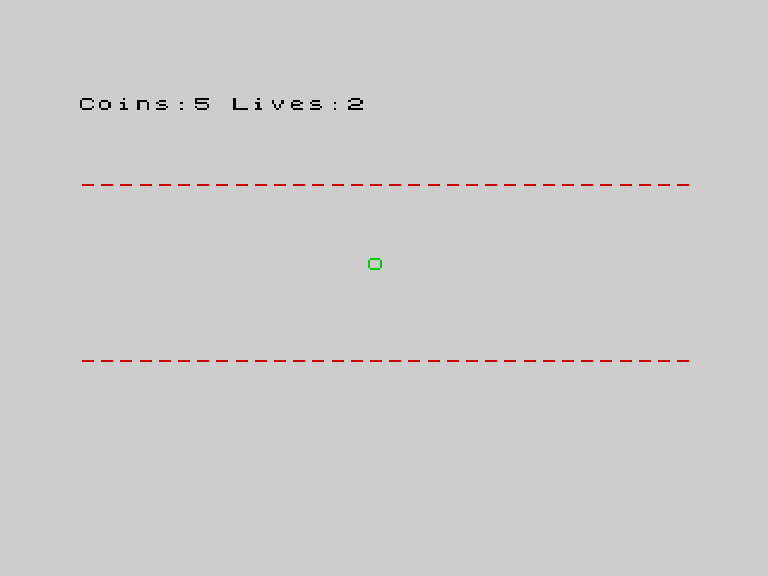
Each hazard erases, moves, bounces, and redraws independently. The dashes (-) instead of hashes (#) make them visually distinct from the static hazards in earlier units.
Collision Across All Hazards
300 FOR j = 1 TO 3
310 IF r = b(j) THEN GO SUB 900: GO TO 340
320 NEXT j
The collision check loops through all three hazards. The GO TO 340 after a hit skips the rest of the loop — you only lose one life per frame, even if multiple hazards overlap.
Try This
Five hazards. Change DIM b(3) to DIM b(5), add starting positions for b(4) and b(5), and change all loops to FOR j = 1 TO 5.
Different speeds. Add a speed array DIM s(3) and multiply: LET b(j) = b(j) + d(j) * s(j). Some bars move faster than others.
What You’ve Learnt
- Arrays for game objects — store position and direction for multiple items
- Loop over objects — one loop handles all hazards identically
- Collision across arrays — check the player against every object
- Independent movement — each object has its own position and direction