Walls
Draw walls and use ATTR to prevent the player from walking through them.
Moving hazards are exciting but they need more complexity in the earlier units. Back to the core game: what if the arena has walls the player can’t walk through?
The Program
10 CLS
20 LET r = 10
30 LET c = 15
40 LET n = 0
50 LET v = 3
60 LET f = 5
70 REM draw walls
80 INK 1
90 FOR i = 0 TO 31
100 PRINT AT 1, i; "="
110 PRINT AT 21, i; "="
120 NEXT i
130 FOR i = 1 TO 21
140 PRINT AT i, 0; "|"
150 PRINT AT i, 31; "|"
160 NEXT i
170 REM inner walls
180 FOR i = 5 TO 15
190 PRINT AT 7, i; "="
200 PRINT AT 14, i + 10; "="
210 NEXT i
220 INK 0
230 REM place coins
240 FOR i = 1 TO f
250 LET y = INT (RND * 18) + 2
260 LET x = INT (RND * 29) + 1
270 IF ATTR (y, x) = 56 THEN INK 6: PRINT AT y, x; "*": INK 0: GO TO 290
280 GO TO 250
290 NEXT i
300 GO SUB 700
310 REM game loop
320 GO SUB 800
330 LET k$ = INKEY$
340 IF k$ = "" THEN GO TO 330
350 LET u = r: LET w = c
360 IF k$ = "q" THEN LET u = r - 1
370 IF k$ = "a" THEN LET u = r + 1
380 IF k$ = "o" THEN LET w = c - 1
390 IF k$ = "p" THEN LET w = c + 1
400 LET a = ATTR (u, w)
410 IF a = 57 THEN GO TO 330
420 PRINT AT r, c; " "
430 LET r = u: LET c = w
440 IF a = 49 THEN LET n = n + 1: LET f = f - 1: BEEP 0.05, 20: GO SUB 700
450 GO SUB 800
460 IF v = 0 THEN GO TO 500
470 IF f = 0 THEN GO TO 500
480 GO TO 330
500 CLS
510 IF f = 0 THEN PRINT AT 10, 9; "LEVEL CLEAR!"
520 IF f > 0 THEN PRINT AT 10, 10; "GAME OVER"
530 PRINT AT 12, 8; "Coins: "; n
540 STOP
700 REM === draw HUD ===
710 PRINT AT 0, 0; "Coins:"; f; " Lives:"; v; "  "
720 RETURN
800 REM === draw player ===
810 INK 4: PRINT AT r, c; "O": INK 0
820 RETURN
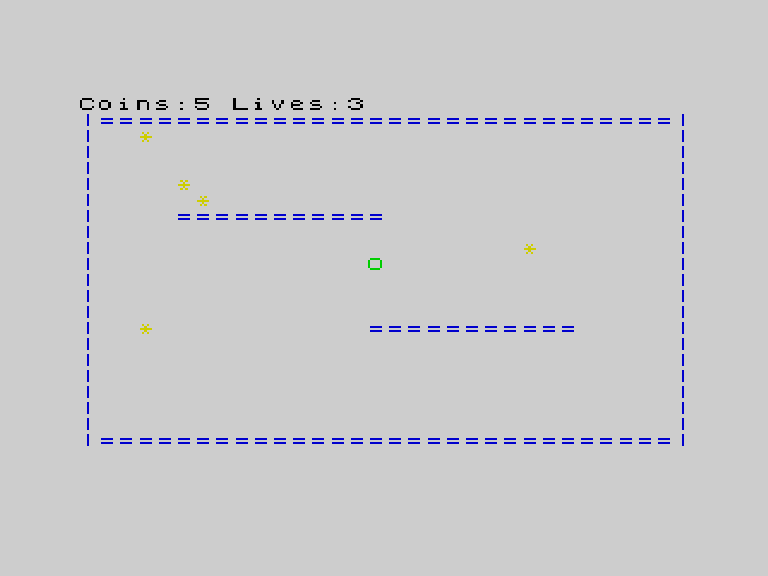
Drawing Walls
Outer walls (lines 90-160). = characters across the top and bottom (rows 1 and 21), | characters down the sides (columns 0 and 31). All printed in INK 1 (blue).
Inner walls (lines 180-210). Two horizontal walls inside the arena — one at row 7 and one at row 14. These create corridors the player must navigate.
Wall Collision
The trick is checking the destination cell before moving there:
400 LET a = ATTR (u, w)
410 IF a = 57 THEN GO TO 330
u and w are the proposed new position. If ATTR(u, w) returns 57, it’s a wall (blue ink on white paper: 1 + 56 = 57). The player stays where they are — the GO TO 330 jumps back to the input loop without updating r and c.
Check Before Move
This is a critical pattern: calculate the new position, check it, then decide whether to accept it.
350 LET u = r: LET w = c
360 IF k$ = "q" THEN LET u = r - 1
...
400 LET a = ATTR (u, w)
410 IF a = 57 THEN GO TO 330
420 PRINT AT r, c; " "
430 LET r = u: LET c = w
Lines 350-390 propose a move into u and w. Line 400 checks the destination. If it’s a wall, reject. Otherwise, line 430 commits the move.
Coin Placement
Line 270 checks that coins don’t land on walls:
270 IF ATTR (y, x) = 56 THEN INK 6: PRINT AT y, x; "*": INK 0: GO TO 290
280 GO TO 250
If the cell’s ATTR is 56 (empty — black ink on white paper), place the coin. If not, try another random position. This ensures coins appear only in open spaces.
Try This
Maze. Add more inner walls to create a maze. Use different row/column ranges in new FOR loops.
Door. Leave a gap in one inner wall — FOR i = 5 TO 10 instead of FOR i = 5 TO 15. The player can pass through the gap.
What You’ve Learnt
- Wall drawing — use loops to print characters along rows and columns
- Wall collision — check ATTR before moving, reject if it’s a wall
- Check-before-move pattern — propose, check, commit or reject
- Placement validation — ensure random objects don’t land on walls