Four Panels, Four Notes
One panel becomes four — red, cyan, green, yellow — each with its own pitch. The flash-and-tone code moves into a GOSUB routine you call by panel number, so the same six lines light any panel. That reusable routine is the engine of the whole game.
Simon has four pads, so Bleeper has four panels — red, cyan, green, yellow — each with its own
note. You could copy the draw-and-flash code four times, but that’s four times the bugs. Instead,
write it once and call it with a panel number. That’s what GOSUB is for.
10 POKE 53281,0
20 PRINT CHR$(147)
30 DIM PR(4),PC(4),PK(4),PF(4)
40 PR(1)=4:PC(1)=7:PK(1)=2:PF(1)=30
50 PR(2)=4:PC(2)=21:PK(2)=3:PF(2)=40
60 PR(3)=14:PC(3)=7:PK(3)=5:PF(3)=50
70 PR(4)=14:PC(4)=21:PK(4)=7:PF(4)=60
80 POKE 54296,15:POKE 54277,0:POKE 54278,240
90 FOR P=1 TO 4:GOSUB 1000:NEXT P
100 FOR P=1 TO 4:GOSUB 1100:FOR T=1 TO 100:NEXT T:NEXT P
110 END
1000 RP=PR(P):CP=PC(P)
1010 FOR Y=0 TO 7:FOR X=0 TO 11
1020 POKE 1024+(RP+Y)*40+CP+X,160
1030 POKE 55296+(RP+Y)*40+CP+X,PK(P)
1040 NEXT X:NEXT Y
1050 RETURN
1100 RP=PR(P):CP=PC(P)
1110 FOR Y=0 TO 7:FOR X=0 TO 11:POKE 55296+(RP+Y)*40+CP+X,1:NEXT X:NEXT Y
1120 POKE 54273,PF(P):POKE 54272,0:POKE 54276,17
1130 FOR T=1 TO 200:NEXT T
1140 POKE 54276,16
1150 FOR Y=0 TO 7:FOR X=0 TO 11:POKE 55296+(RP+Y)*40+CP+X,PK(P):NEXT X:NEXT Y
1160 RETURN
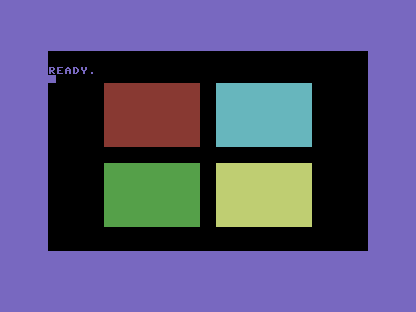
The panel data now fills out all four (lines 40–70): each gets a row, column, colour and a
distinct pitch, spread far enough apart that the ear tells them straight away. Line 90 draws them
all with a FOR P = 1 TO 4 loop calling the draw routine, and line 100 flashes each in turn.
The key idea is the subroutine. GOSUB 1100 jumps to the flash-and-tone code; RETURN at
its end jumps back to where you called from. Because the routine reads the panel’s details from
the arrays using P, the same lines light any panel — set P to 2 and GOSUB 1100 flashes
cyan and sounds cyan’s note. Write it once, call it forever. That one routine is the engine the
rest of Bleeper drives.
Try this
- Tune the four. The pitches are
PF(1)toPF(4)—30, 40, 50, 60. Spread them wider (20, 40, 60, 80) or pack them close, and listen to how memorable each set is. - Play a chord of sorts. Call the panels in a different order in line 100 —
4,3,2,1— and hear the scale run the other way.
What’s next
You have four panels and a routine to light any of them. In Unit 3 you store a sequence of panels in an array and let the machine play it back — the performance the player must repeat.