Bleeper
The C64 plays a tone-and-colour sequence and you repeat it from the keyboard — one panel longer every round. Meet the SID chip as a voice, an array as a growing memory, and GET as the way to read the player's echo and check it, press by press.
In Tally the machine discovered. Here it challenges. Bleeper is the C64’s take on Simon: four colour panels, each with its own note, light up in a sequence that grows by one every round — and you have to play it back from memory. The trick at its heart is escalation: the chain lengthens each time, and the game is just how far you can hold it in your head.
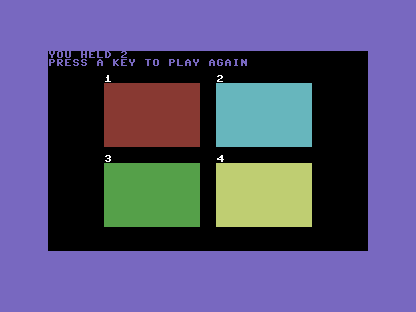
This is the volume’s audio-forward game — the one where the SID chip earns its keep. You’ll
POKE its registers to give each panel a distinct pitch, store the sequence in an array that
grows a slot per round, and read the player’s reply a key at a time with GET, checking each
press against the stored pattern. Sound, memory, and live input, working as one.
What you’ll build:
- A single panel that lights and sounds at once — colour and a SID note together
- Four panels, each its own colour and pitch, lit by one reusable
GOSUBroutine - A sequence stored in an array and played back by a loop
- A round that grows the sequence by one random panel each time
- The player’s echo, read with
GETand checked press by press against the array - A score — the length you held — and a “play again” that starts a fresh sequence
6 units. About 6–8 hours. This follows Tally and builds on Meet C64 BASIC.
Unit roadmap
A panel that speaks
One panel lights and sounds together; then four, each with its own note
The machine plays
A sequence stored in an array plays back — and grows by one each round
Your turn
Read the player's echo, compare it to the array, and keep score