How Far Can You Hold?
Put it together: rounds that grow, an echo checked each round, a score that's just the length you held, and a key to play again. Number the panels so the player knows the keys. Your finished Bleeper — the SID, an array, and live input as one game.
Every piece is built — growing rounds, the echo, the check. The last unit assembles them into a game with a beginning and an end: play a round, read the echo, and if it’s right, grow and go again; if it’s wrong, show how far the player got and offer another go.
10 POKE 53281,0
20 DIM PR(4),PC(4),PK(4),PF(4),S(99)
30 PR(1)=4:PC(1)=7:PK(1)=2:PF(1)=30
40 PR(2)=4:PC(2)=21:PK(2)=3:PF(2)=40
50 PR(3)=14:PC(3)=7:PK(3)=5:PF(3)=50
60 PR(4)=14:PC(4)=21:PK(4)=7:PF(4)=60
70 POKE 54296,15:POKE 54277,0:POKE 54278,240
80 PRINT CHR$(147)
90 FOR P=1 TO 4:GOSUB 1000:NEXT P
100 GOSUB 2000
110 N=0
120 N=N+1:S(N)=INT(RND(1)*4)+1
130 PRINT CHR$(19);"ROUND";N
140 FOR I=1 TO N:P=S(I):GOSUB 1100:FOR T=1 TO 80:NEXT T:NEXT I
150 FOR I=1 TO N
160 GET A$:IF A$="" THEN 160
170 P=VAL(A$):IF P<1 OR P>4 THEN 160
180 GOSUB 1100
190 IF P<>S(I) THEN 400
200 NEXT I
210 FOR T=1 TO 400:NEXT T
220 GOTO 120
400 PRINT CHR$(19);"YOU HELD";N-1;"  "
410 POKE 54273,8:POKE 54272,0:POKE 54276,33
420 FOR T=1 TO 400:NEXT T:POKE 54276,32
430 PRINT "PRESS A KEY TO PLAY AGAIN"
440 GET A$:IF A$="" THEN 440
450 GOTO 80
1000 RP=PR(P):CP=PC(P)
1010 FOR Y=0 TO 7:FOR X=0 TO 11
1020 POKE 1024+(RP+Y)*40+CP+X,160
1030 POKE 55296+(RP+Y)*40+CP+X,PK(P)
1040 NEXT X:NEXT Y
1050 RETURN
1100 RP=PR(P):CP=PC(P)
1110 FOR Y=0 TO 7:FOR X=0 TO 11:POKE 55296+(RP+Y)*40+CP+X,1:NEXT X:NEXT Y
1120 POKE 54273,PF(P):POKE 54272,0:POKE 54276,17
1130 FOR T=1 TO 200:NEXT T
1140 POKE 54276,16
1150 FOR Y=0 TO 7:FOR X=0 TO 11:POKE 55296+(RP+Y)*40+CP+X,PK(P):NEXT X:NEXT Y
1160 RETURN
2000 FOR P=1 TO 4
2010 POKE 1024+(PR(P)-1)*40+PC(P),P+48
2020 POKE 55296+(PR(P)-1)*40+PC(P),1
2030 NEXT P
2040 RETURN
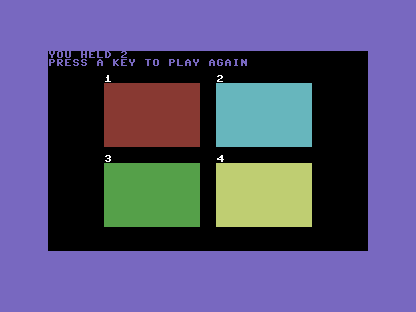
The structure is a loop inside a loop. The round loop (lines 120–220) grows the sequence,
plays it, then runs the echo loop (lines 150–200) to read the player back. A correct echo
falls through to line 210’s pause and line 220’s GOTO 120 — another round, one longer. A wrong
press jumps to line 400: PRINT "YOU HELD"; N-1 shows the score — the length of the last sequence
the player completed — with a harsh tone, then PRESS A KEY TO PLAY AGAIN waits and loops back
to a fresh game.
Two touches finish it. The new routine at line 2000 numbers the panels 1–4 by POKEing a digit
above each, so the player knows red is key 1, cyan key 2, and so on. And the score is phrased to
respect the player: YOU HELD 2 acknowledges what they managed, where a blunt WRONG would
just scold. The score is the length, the length is the depth, and the depth is the whole game.
That’s Bleeper. Four panels with four SID voices, a sequence stored in an array that grows
each round, an echo read with GET and checked press by press, and a score that’s just how far
you held. The SID, an array, and live input — three tools you met apart — working as one game.
Try this
- Raise the stakes. Quicken the playback (
FOR T=1 TO 80in line 140) as the rounds climb, so speed piles onto length. A small change; a big jump in difficulty. - Keep a best. Add a variable that remembers the highest
N-1across games and print it on the game-over screen — “BEST SO FAR” — so each go has something to beat.
What’s next
You’ve built memory and feedback into a game. Next in Volume 1 comes Safe Cracker — the machine hides a number and you close in on it, guess by guess, with the screen telling you warmer or colder.