No Two Cities Alike
Bring in RND. Randomise each tower's height and light each window on a coin-flip, and the program produces more than you typed — run it twice, get two different skylines.
A city where every tower is the same height and every window the same isn’t a city — it’s
wallpaper. RND fixes that. Let it choose each tower’s height, and let it flip a coin for
each window, and the skyline stops being something you drew and starts being something the
program composes.
10 PRINT CHR$(147)
20 POKE 53281,0
30 FOR C=2 TO 38 STEP 4
40 H=INT(RND(1)*12)+5
50 FOR R=24 TO 24-H+1 STEP -1
60 POKE 1024+R*40+C,160
70 CO=12
80 IF RND(1)<.4 THEN CO=7
90 POKE 55296+R*40+C,CO
100 NEXT R
110 NEXT C
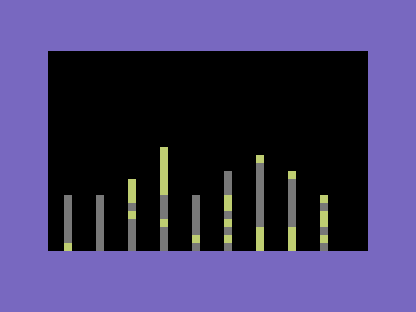
Two changes. Line 40, H = INT(RND(1)*12)+5, gives each tower a random height from 5 to
16: RND(1) is a fraction between 0 and 1, times 12 spreads it across a range, INT
chops it to a whole number, and +5 lifts it off the ground so no tower is a stub. Line 80,
IF RND(1) < .4 THEN CO = 7, lights each window on a coin-flip — about four cells in ten
come up lit, scattered instead of striped.
Notice the clamp on the height — *12 ... +5 keeps towers between 5 and 16 tall. Unbounded
RND would give you the occasional one-block stub or a tower off the top of the screen.
Constrained randomness — random within sensible limits — is what makes the city look
designed, not chaotic. That’s the craft of using RND well.
Try this
- Run it twice.
RUN, thenRUNagain. Each timeRNDcarries on from where it left off, so you get a fresh city every run. - Denser windows. Change
.4to.6and the city blazes; drop it to.2for a sleepy town.
What’s next
The city composes itself now — but it’s still midnight-black. In Unit 6, two registers set the sky and the border, and the same towers tell three different times of day.