The Tally
Give the game a score you read at a glance: eight pip cells on the HUD ledge that's been waiting since Unit 2, one byte counting lit lamps, and a hook in the single line where cold becomes lit.
Lamps light and stay lit — and the game doesn’t notice. Nothing counts them, nothing reports them; you could light all eight and the program would be none the wiser. A game has to answer how am I doing? at a glance, and this unit builds the answer: a tally — eight pips above the square, cold at the start, warming one by one as the lamps do.
We build it the plainest way that works, and the plainest way turns out to be the very first thing this course ever drew: a coloured cell.
Pips are coloured cells
A pip doesn’t need a picture. It’s one cell showing one colour — cold cyan for a lamp not yet lit, bright yellow for one that is:
PIP_UNLIT  equ  %00101000    ; PAPER cyan — a cold block
PIP_LIT    equ  %01110000    ; BRIGHT PAPER yellow — a warm one
Notice these colour the PAPER, not the INK. The lamps and the lamplighter put their colour in the ink because they have glyphs — pixels to show it through. A pip has no glyph at all, and an empty cell shows nothing but paper. So the whole tally is pure attribute: eight bytes of screen, no bitmap, no drawing in any pixel sense. Unit 1’s opening lesson — a cell’s look is one byte — comes back as the game’s scoreboard.
Real digits — a “3/8” readout — are a genuine technique: they need a font and a renderer, and a later game in this course builds exactly that. For eight lamps, eight cells read faster than digits, from across the room. Honest and small beats fancy and unneeded.
The ledge was always there
Where do the pips live? Look at the top of the screen — really look, because this has been hiding in plain sight since Unit 2. The walls have never started at the screen’s edge: the top wall runs along row 1, and row 0 has been kept deliberately empty all along — fill_ground starts at row 1, and the source has called row 0 “the HUD” since the cobbles were first laid. The lamplighter can’t ever reach it; the wall beneath it sees to that, with no extra code.
That’s a design habit worth naming: the ledge cost nothing to reserve in Unit 2 and would have been disruptive to carve out now. Eleven units later, the rent comes due — eight cells of it, columns 12 to 19, centred over the square.
Milestone 1 — the cold row
draw_pips is the smallest loop in the program: eight cells from PIP_BASE, each painted PIP_UNLIT, called once in the setup.
| 11 | 11 | LAMP_UNLIT equ %00000101 ; cold cyan INK on black PAPER — bit 3 | |
| 12 | 12 | ; clear, so a lamp reads as floor | |
| 13 | 13 | LAMP_LIT equ %01000110 ; BRIGHT yellow INK on black — a held flame | |
| 14 | + | | |
| 15 | + | PIP_UNLIT equ %00101000 ; a cold pip: cyan PAPER, a solid block | |
| 16 | + | PIP_LIT equ %01110000 ; a warm pip: BRIGHT yellow PAPER | |
| 17 | + | PIP_BASE equ $5800 + 12 ; row 0, column 12 — the HUD ledge, | |
| 18 | + | ; eight cells, centred over the square | |
| 19 | + | NUM_LAMPS equ 8 | |
| 14 | 20 | | |
| 15 | 21 | START_COL equ 15 ; where the lamplighter begins | |
| 16 | 22 | START_ROW equ 11 | |
| ... | |||
| 62 | 68 | ; Now that the wall cells are painted, fill_walls can read the | |
| 63 | 69 | ; map back and lay brick wherever the wall bit is set. | |
| 64 | 70 | call fill_walls | |
| 71 | + | call draw_pips | |
| 65 | 72 | call draw_lamps | |
| 66 | 73 | ; save what he is about to stand on, BEFORE the first draw | |
| 67 | 74 | call save_under | |
| ... | |||
| 372 | 379 | defb 5, 5, 4, 3 | |
| 373 | 380 | defb 23, 5, 4, 3 | |
| 374 | 381 | defb $FF | |
| 382 | + | | |
| 383 | + | ; ---------------------------------------------------------------------------- | |
| 384 | + | ; draw_pips — the tally row: one cell per lamp on the HUD ledge, all | |
| 385 | + | ; cold to start. A pip is pure attribute — no glyph, just a block of | |
| 386 | + | ; PAPER — so the row costs eight bytes of screen and no bitmap at all. | |
| 387 | + | ; ---------------------------------------------------------------------------- | |
| 388 | + | draw_pips: | |
| 389 | + | ld hl, PIP_BASE | |
| 390 | + | ld b, NUM_LAMPS | |
| 391 | + | ld a, PIP_UNLIT | |
| 392 | + | .dp: | |
| 393 | + | ld (hl), a | |
| 394 | + | inc hl | |
| 395 | + | djnz .dp | |
| 396 | + | ret | |
| 375 | 397 | | |
| 376 | 398 | ; ---------------------------------------------------------------------------- | |
| 377 | 399 | ; draw_lamps — walk the position table: col, row pairs, $FF to finish. |
The complete step 1 program
; Gloaming — Unit 13: The Tally
; Cumulative build; every step runs on its own. Narrative: the unit page.
; Progress as coloured pips — no digits.
org 32768
COBBLE equ %00000001 ; PAPER black (0), INK blue (1) — dark ground
WALL equ %00001111 ; PAPER blue (1), INK white (7) — pale stone
WALL_BIT equ 3 ; the attribute bit that says "this is wall"
LAMP_ATTR equ %01000111 ; BRIGHT, PAPER black, INK white — his own light
LAMP_UNLIT equ %00000101 ; cold cyan INK on black PAPER — bit 3
; clear, so a lamp reads as floor
LAMP_LIT equ %01000110 ; BRIGHT yellow INK on black — a held flame
PIP_UNLIT equ %00101000 ; a cold pip: cyan PAPER, a solid block
PIP_LIT equ %01110000 ; a warm pip: BRIGHT yellow PAPER
PIP_BASE equ $5800 + 12 ; row 0, column 12 — the HUD ledge,
; eight cells, centred over the square
NUM_LAMPS equ 8
START_COL equ 15 ; where the lamplighter begins
START_ROW equ 11
PLAYER_REPEAT equ 6 ; frames between steps while a key is held
KEYS_OP equ $DFFE ; half-row P O I U Y — bits 1 and 0
KEYS_Q equ $FBFE ; half-row Q W E R T — bit 0 is Q
KEYS_A equ $FDFE ; half-row A S D F G — bit 0 is A
start:
; --- the border goes black — the night beyond the square ---
; Port $FE bits 0-2 set the BORDER colour. A = 0 = black.
ld a, 0
out ($FE), a
; --- place the lamplighter ---
; His position is data. Everything that draws him reads it.
ld a, START_COL
ld (lamp_col), a
ld a, START_ROW
ld (lamp_row), a
xor a
ld (player_timer), a
; --- wipe the canvas ---
; The bitmap ($4000-$57FF) is the pixel layer; whatever was on
; screen before us still lives there. Zero it so only our
; attribute colours show.
call clear_bitmap
; --- texture the ground ---
; Blit the cobble stipple into every cell's bitmap, rows 1-23.
; The attributes will colour these pixels in a moment.
call fill_ground
; --- wash in the cobbles ---
; Seed the first attribute cell, point DE one cell ahead, and
; let LDIR cascade the byte through all 768 cells.
ld hl, $5800
ld de, $5801
ld (hl), COBBLE
ld bc, 767
ldir
call paint_walls
call paint_buildings
; --- brick the walls ---
; Now that the wall cells are painted, fill_walls can read the
; map back and lay brick wherever the wall bit is set.
call fill_walls
call draw_pips
call draw_lamps
; save what he is about to stand on, BEFORE the first draw
call save_under
call draw_lamp
; --- start the heartbeat ---
; IM 1: every 50 Hz frame interrupt calls the ROM's handler.
; EI: let it. HALT then sleeps until the next frame arrives,
; so the loop below beats exactly once per frame.
im 1
ei
main_loop:
halt
call play_step
jr main_loop
; play_step — one beat of the game: ask the keyboard.
play_step:
call player_step
ret
; ----------------------------------------------------------------------------
; paint_walls — the square's edge, one attribute write per cell.
; ----------------------------------------------------------------------------
paint_walls:
ld c, WALL ; the byte every wall cell gets
; the top wall: row 1 is 32 cells in a row from $5820
; (row 0 is kept back — it becomes the HUD later)
ld hl, $5820
ld b, 32
.wt:
ld (hl), c
inc hl
djnz .wt
; the bottom wall: row 23, 32 cells from $5AE0
ld hl, $5AE0
ld b, 32
.wb:
ld (hl), c
inc hl
djnz .wb
; the side walls: column 0 and column 31 of rows 1-23.
; Write the row's first cell, hop 31 cells to its last,
; then step a full row (32) down — 23 times.
ld hl, $5820
ld b, 23
.ws:
ld (hl), c
push hl
ld de, 31
add hl, de
ld (hl), c
pop hl
ld de, 32
add hl, de
djnz .ws
ret
; ----------------------------------------------------------------------------
; clear_bitmap — zero the pixel layer, $4000-$57FF, with the same
; seed-and-cascade LDIR idiom the cobble wash uses.
; ----------------------------------------------------------------------------
clear_bitmap:
ld hl, $4000
ld de, $4001
ld (hl), 0
ld bc, 6143
ldir
ret
; ----------------------------------------------------------------------------
; player_step — the keys become movement. Each direction key edits a
; TARGET position (tcol, trow) — a proposal, not yet a move — so it
; can be vetoed before it becomes real. Then the move commits: leave
; the old cell, take the new one, draw.
; ----------------------------------------------------------------------------
player_step:
; --- propose: the target starts where he stands ---
ld a, (lamp_col)
ld (tcol), a
ld a, (lamp_row)
ld (trow), a
; The held-key gate: the first press steps at once, then one
; step every PLAYER_REPEAT frames. Releasing every direction
; key re-arms the instant first step, so taps stay crisp.
ld bc, KEYS_OP
in a, (c)
cpl
and %00000011
ld e, a
ld bc, KEYS_Q
in a, (c)
cpl
and %00000001
or e
ld e, a
ld bc, KEYS_A
in a, (c)
cpl
and %00000001
or e
jr nz, .held
xor a
ld (player_timer), a
ret
.held:
ld a, (player_timer)
or a
jr z, .stepnow
dec a
ld (player_timer), a
ret
.stepnow:
ld a, PLAYER_REPEAT
ld (player_timer), a
ld bc, KEYS_OP
in a, (c)
bit 1, a ; O — a zero bit is a pressed key
jr z, .pleft
bit 0, a ; P, same half-row
jr z, .pright
ld bc, KEYS_Q
in a, (c)
bit 0, a ; Q
jr z, .pup
ld bc, KEYS_A
in a, (c)
bit 0, a ; A
jr z, .pdown
ret ; nothing held — nothing to do
.pleft:
ld hl, tcol
dec (hl)
jr .pmove
.pright:
ld hl, tcol
inc (hl)
jr .pmove
.pup:
ld hl, trow
dec (hl)
jr .pmove
.pdown:
ld hl, trow
inc (hl)
.pmove:
; The veto: ask the target cell's attribute whether it's wall.
; NZ means brick — the proposal dies here and he stays put.
ld a, (trow)
ld b, a
ld a, (tcol)
ld c, a
call wall_at
ret nz
; --- commit: restore, step, save, draw — in that order ---
call restore_under
ld a, (tcol)
ld (lamp_col), a
ld a, (trow)
ld (lamp_row), a
call save_under
; light it where it lives: while he covers the lamp, its truth
; is the buffer — rewrite the saved attribute, and restore will
; paint the lamp back lit when he leaves
ld a, (under_lamp + 8)
cp LAMP_UNLIT
jr nz, .pdrawn
ld a, LAMP_LIT
ld (under_lamp + 8), a
.pdrawn:
call draw_lamp
ret
; ----------------------------------------------------------------------------
; fill_ground — the cobble stipple. Not decoration: the stipple is what
; makes ground-state changes visible later, when the game starts
; recolouring these pixels. Rows 1-23 (row 0 is the HUD).
; ----------------------------------------------------------------------------
fill_ground:
ld b, 1 ; rows 1-23 (row 0 is the HUD)
.fgr:
ld c, 0
.fgc:
ld de, cobble_tex
call blit_tex
inc c
ld a, c
cp 32
jr c, .fgc
inc b
ld a, b
cp 24
jr c, .fgr
ret
; fill_walls — brickwork. Driven by the wall attribute bit, so anything
; painted as wall — now or later in the game — gets its brick for free:
; the map itself decides where the brick goes.
fill_walls:
ld b, 1
.fwr:
ld c, 0
.fwc:
push bc
call attr_addr_cr
bit WALL_BIT, (hl)
pop bc
jr z, .fwn
ld de, brick_tex
call blit_tex
.fwn:
inc c
ld a, c
cp 32
jr c, .fwc
inc b
ld a, b
cp 24
jr c, .fwr
ret
; blit_tex — write the 8-byte texture at DE into cell (C, B)'s bitmap.
; scr_addr_cr finds the cell's first pixel row; INC H steps down the
; other seven, 256 bytes apart.
blit_tex:
push bc
call scr_addr_cr
ld b, 8
.bt:
ld a, (de)
ld (hl), a
inc de
inc h
djnz .bt
pop bc
ret
cobble_tex:
defb %10000010
defb %00000000
defb %00001000
defb %00000000
defb %00100001
defb %00000000
defb %00010000
defb %00000000
brick_tex:
; mortar courses with staggered verticals — dusk-lit stone
defb %00001000
defb %00001000
defb %00001000
defb %11111111
defb %10000000
defb %10000000
defb %10000000
defb %11111111
; paint_buildings — walk the rectangle table: each entry is col, row,
; width, height; $FF ends the list. Every cell inside a rectangle gets
; the WALL attribute — and because fill_walls textures by the wall bit,
; the brickwork arrives without another line of drawing code.
paint_buildings:
ld hl, bldg_data
.pb:
ld a, (hl)
cp $FF
ret z
ld c, a ; col
inc hl
ld b, (hl) ; row
inc hl
ld d, (hl) ; width
inc hl
ld e, (hl) ; height
inc hl
push hl
.pbrow:
push bc
push de
.pbcol:
push bc
push de
call attr_addr_cr
ld (hl), WALL
pop de
pop bc
inc c
dec d
jr nz, .pbcol
pop de
pop bc
inc b
dec e
jr nz, .pbrow
pop hl
jr .pb
bldg_data:
defb 5, 5, 4, 3
defb 23, 5, 4, 3
defb $FF
; ----------------------------------------------------------------------------
; draw_pips — the tally row: one cell per lamp on the HUD ledge, all
; cold to start. A pip is pure attribute — no glyph, just a block of
; PAPER — so the row costs eight bytes of screen and no bitmap at all.
; ----------------------------------------------------------------------------
draw_pips:
ld hl, PIP_BASE
ld b, NUM_LAMPS
ld a, PIP_UNLIT
.dp:
ld (hl), a
inc hl
djnz .dp
ret
; ----------------------------------------------------------------------------
; draw_lamps — walk the position table: col, row pairs, $FF to finish.
; Placement is data; the drawing code neither knows nor cares how many
; lamps the town has tonight.
; ----------------------------------------------------------------------------
draw_lamps:
ld hl, lamp_data
.next:
ld a, (hl)
cp $FF
ret z
ld c, a
inc hl
ld b, (hl)
inc hl
push hl
call draw_lantern
pop hl
jr .next
; draw_lantern — an unlit lamp into cell (C, B): cold cyan attribute,
; then the lantern glyph down the cell like any texture.
draw_lantern:
call attr_addr_cr
ld (hl), LAMP_UNLIT
call scr_addr_cr
ld de, lantern
ld b, 8
.dlt:
ld a, (de)
ld (hl), a
inc de
inc h
djnz .dlt
ret
; ----------------------------------------------------------------------------
; scr_addr_cr — HL = bitmap address of cell (C, B)'s first pixel row.
; The row's top two bits pick the third of the screen (H), its bottom
; three become L's top bits, and the column fills L's low five.
; ----------------------------------------------------------------------------
scr_addr_cr:
ld a, b
and %00011000 ; the third (row bits 4-3) ...
or %01000000 ; ... under the screen base $40xx
ld h, a
ld a, b
and %00000111 ; the char row within the third ...
rrca ; ... rotated into bits 7-5
rrca
rrca
or c ; the column in bits 4-0
ld l, a
ret
; attr_addr_cr — HL = attribute address of cell (C, B):
; $5800 + row*32 + col, the row shifted up five times.
attr_addr_cr:
ld a, b
ld l, a
ld h, 0
add hl, hl
add hl, hl
add hl, hl
add hl, hl
add hl, hl
ld de, $5800
add hl, de
ld a, c
ld e, a
ld d, 0
add hl, de
ret
; wall_at — is cell (C, B) wall? The answer is already on the screen:
; every wall cell's attribute has WALL_BIT set, so one bit-test of
; attribute memory is the whole collision system. NZ = wall.
wall_at:
call attr_addr_cr
bit WALL_BIT, (hl)
ret
; ----------------------------------------------------------------------------
; The lamplighter's save / restore / draw.
; ----------------------------------------------------------------------------
; pos_bc — the lamplighter's cell into (C, B), read fresh from the data.
pos_bc:
ld a, (lamp_row)
ld b, a
ld a, (lamp_col)
ld c, a
ret
; save_under — copy the nine bytes of his cell into the buffer: eight
; bitmap rows, then the attribute. Runs as he ARRIVES, before the
; draw — so the buffer always holds true ground, never him.
save_under:
call pos_bc
call scr_addr_cr
ld de, under_lamp
ld b, 8
.su:
ld a, (hl)
ld (de), a
inc de
inc h
djnz .su
call pos_bc
call attr_addr_cr
ld a, (hl)
ld (under_lamp + 8), a
ret
; restore_under — the same nine bytes back the other way: the ground
; returns exactly as it was. Runs as he LEAVES, while the position
; still points at the old cell.
restore_under:
call pos_bc
call scr_addr_cr
ld de, under_lamp
ld b, 8
.ru:
ld a, (de)
ld (hl), a
inc de
inc h
djnz .ru
call pos_bc
call attr_addr_cr
ld a, (under_lamp + 8)
ld (hl), a
ret
draw_lamp:
; his colour first: the cell's attribute becomes his own —
; bright white on the black, his own light about him
call pos_bc
call attr_addr_cr
ld (hl), LAMP_ATTR
; then his shape, eight bytes down the cell like any texture
call pos_bc
call scr_addr_cr
ld de, lamplighter
ld b, 8
.dl:
ld a, (de)
ld (hl), a
inc de
inc h
djnz .dl
ret
; ----------------------------------------------------------------------------
; Data.
; ----------------------------------------------------------------------------
lamp_data:
defb 4, 3
defb 27, 3
defb 9, 7
defb 22, 7
defb 6, 15
defb 25, 15
defb 13, 20
defb 18, 20
defb $FF
lamp_col:
defb START_COL
lamp_row:
defb START_ROW
tcol:
defb 0
trow:
defb 0
player_timer:
defb 0
under_lamp:
defb 0, 0, 0, 0, 0, 0, 0, 0, 0
lamplighter:
defb %00111100
defb %00111100
defb %00011000
defb %01111110
defb %00011000
defb %00011000
defb %00100100
defb %01000010
lantern:
defb %00011000
defb %00100100
defb %01111110
defb %01111110
defb %01011010
defb %01111110
defb %01111110
defb %00111100
end start
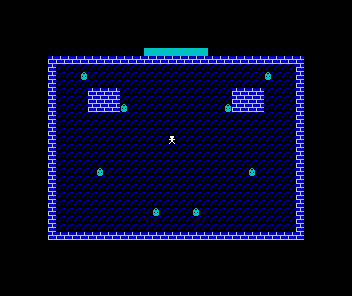
A scoreboard that can’t change is scenery, and it points straight at the real question of this unit: when should a pip warm, and how does the program know?
One byte, and the moment that already exists
The state is a single byte:
lit_count:
        defb 0
And here’s the small idea that makes the whole unit fall into place: lit_count is both readings at once — the number of lamps lit so far, and the index of the next pip to warm. Zero lamps lit, next pip is pip 0. Three lit, next is pip 3. One byte, no arithmetic beyond an add.
light_pip does exactly that: read the count into an index, warm PIP_BASE + index, step the count. But the sharper question is where to call it — and the answer is the discipline this unit teaches. Don’t scan the lamps. Don’t count yellow cells every frame. The program already contains the exact moment a cold lamp becomes lit — Unit 12’s branch, the one guarded by cp LAMP_UNLIT — and that moment fires precisely once per lamp, because the lighting is idempotent. Hang the consequence on the event. One call, in the one place the fact is born.
Milestone 2 — wire it
| 31 | 31 | ; Port $FE bits 0-2 set the BORDER colour. A = 0 = black. | |
| 32 | 32 | ld a, 0 | |
| 33 | 33 | out ($FE), a | |
| 34 | + | xor a | |
| 35 | + | ld (lit_count), a | |
| 34 | 36 | | |
| 35 | 37 | ; --- place the lamplighter --- | |
| 36 | 38 | ; His position is data. Everything that draws him reads it. | |
| ... | |||
| 246 | 248 | jr nz, .pdrawn | |
| 247 | 249 | ld a, LAMP_LIT | |
| 248 | 250 | ld (under_lamp + 8), a | |
| 251 | + | call light_pip | |
| 249 | 252 | .pdrawn: | |
| 250 | 253 | call draw_lamp | |
| 251 | 254 | ret | |
| ... | |||
| 380 | 383 | defb 23, 5, 4, 3 | |
| 381 | 384 | defb $FF | |
| 382 | 385 | | |
| 386 | + | ; ---------------------------------------------------------------------------- | |
| 387 | + | ; light_pip / draw_pips. | |
| 383 | 388 | ; ---------------------------------------------------------------------------- | |
| 389 | + | | |
| 390 | + | ; light_pip — warm the next pip along and count the lamp. lit_count is | |
| 391 | + | ; the index of the pip to light AND the number of lamps lit so far — | |
| 392 | + | ; read it for the address, then step it. | |
| 393 | + | light_pip: | |
| 394 | + | ld a, (lit_count) | |
| 395 | + | ld e, a | |
| 396 | + | ld d, 0 | |
| 397 | + | inc a | |
| 398 | + | ld (lit_count), a | |
| 399 | + | ld hl, PIP_BASE | |
| 400 | + | add hl, de | |
| 401 | + | ld (hl), PIP_LIT | |
| 402 | + | ret | |
| 403 | + | | |
| 384 | 404 | ; draw_pips — the tally row: one cell per lamp on the HUD ledge, all | |
| 385 | 405 | ; cold to start. A pip is pure attribute — no glyph, just a block of | |
| 386 | 406 | ; PAPER — so the row costs eight bytes of screen and no bitmap at all. | |
| 387 | - | ; ---------------------------------------------------------------------------- | |
| 388 | 407 | draw_pips: | |
| 389 | 408 | ld hl, PIP_BASE | |
| 390 | 409 | ld b, NUM_LAMPS | |
| ... | |||
| 571 | 590 | tcol: | |
| 572 | 591 | defb 0 | |
| 573 | 592 | trow: | |
| 593 | + | defb 0 | |
| 594 | + | | |
| 595 | + | lit_count: | |
| 574 | 596 | defb 0 | |
| 575 | 597 | player_timer: | |
| 576 | 598 | defb 0 |
The complete program
; Gloaming — Unit 13: The Tally
; Cumulative build; every step runs on its own. Narrative: the unit page.
; Progress as coloured pips — no digits.
org 32768
COBBLE equ %00000001 ; PAPER black (0), INK blue (1) — dark ground
WALL equ %00001111 ; PAPER blue (1), INK white (7) — pale stone
WALL_BIT equ 3 ; the attribute bit that says "this is wall"
LAMP_ATTR equ %01000111 ; BRIGHT, PAPER black, INK white — his own light
LAMP_UNLIT equ %00000101 ; cold cyan INK on black PAPER — bit 3
; clear, so a lamp reads as floor
LAMP_LIT equ %01000110 ; BRIGHT yellow INK on black — a held flame
PIP_UNLIT equ %00101000 ; a cold pip: cyan PAPER, a solid block
PIP_LIT equ %01110000 ; a warm pip: BRIGHT yellow PAPER
PIP_BASE equ $5800 + 12 ; row 0, column 12 — the HUD ledge,
; eight cells, centred over the square
NUM_LAMPS equ 8
START_COL equ 15 ; where the lamplighter begins
START_ROW equ 11
PLAYER_REPEAT equ 6 ; frames between steps while a key is held
KEYS_OP equ $DFFE ; half-row P O I U Y — bits 1 and 0
KEYS_Q equ $FBFE ; half-row Q W E R T — bit 0 is Q
KEYS_A equ $FDFE ; half-row A S D F G — bit 0 is A
start:
; --- the border goes black — the night beyond the square ---
; Port $FE bits 0-2 set the BORDER colour. A = 0 = black.
ld a, 0
out ($FE), a
xor a
ld (lit_count), a
; --- place the lamplighter ---
; His position is data. Everything that draws him reads it.
ld a, START_COL
ld (lamp_col), a
ld a, START_ROW
ld (lamp_row), a
xor a
ld (player_timer), a
; --- wipe the canvas ---
; The bitmap ($4000-$57FF) is the pixel layer; whatever was on
; screen before us still lives there. Zero it so only our
; attribute colours show.
call clear_bitmap
; --- texture the ground ---
; Blit the cobble stipple into every cell's bitmap, rows 1-23.
; The attributes will colour these pixels in a moment.
call fill_ground
; --- wash in the cobbles ---
; Seed the first attribute cell, point DE one cell ahead, and
; let LDIR cascade the byte through all 768 cells.
ld hl, $5800
ld de, $5801
ld (hl), COBBLE
ld bc, 767
ldir
call paint_walls
call paint_buildings
; --- brick the walls ---
; Now that the wall cells are painted, fill_walls can read the
; map back and lay brick wherever the wall bit is set.
call fill_walls
call draw_pips
call draw_lamps
; save what he is about to stand on, BEFORE the first draw
call save_under
call draw_lamp
; --- start the heartbeat ---
; IM 1: every 50 Hz frame interrupt calls the ROM's handler.
; EI: let it. HALT then sleeps until the next frame arrives,
; so the loop below beats exactly once per frame.
im 1
ei
main_loop:
halt
call play_step
jr main_loop
; play_step — one beat of the game: ask the keyboard.
play_step:
call player_step
ret
; ----------------------------------------------------------------------------
; paint_walls — the square's edge, one attribute write per cell.
; ----------------------------------------------------------------------------
paint_walls:
ld c, WALL ; the byte every wall cell gets
; the top wall: row 1 is 32 cells in a row from $5820
; (row 0 is kept back — it becomes the HUD later)
ld hl, $5820
ld b, 32
.wt:
ld (hl), c
inc hl
djnz .wt
; the bottom wall: row 23, 32 cells from $5AE0
ld hl, $5AE0
ld b, 32
.wb:
ld (hl), c
inc hl
djnz .wb
; the side walls: column 0 and column 31 of rows 1-23.
; Write the row's first cell, hop 31 cells to its last,
; then step a full row (32) down — 23 times.
ld hl, $5820
ld b, 23
.ws:
ld (hl), c
push hl
ld de, 31
add hl, de
ld (hl), c
pop hl
ld de, 32
add hl, de
djnz .ws
ret
; ----------------------------------------------------------------------------
; clear_bitmap — zero the pixel layer, $4000-$57FF, with the same
; seed-and-cascade LDIR idiom the cobble wash uses.
; ----------------------------------------------------------------------------
clear_bitmap:
ld hl, $4000
ld de, $4001
ld (hl), 0
ld bc, 6143
ldir
ret
; ----------------------------------------------------------------------------
; player_step — the keys become movement. Each direction key edits a
; TARGET position (tcol, trow) — a proposal, not yet a move — so it
; can be vetoed before it becomes real. Then the move commits: leave
; the old cell, take the new one, draw.
; ----------------------------------------------------------------------------
player_step:
; --- propose: the target starts where he stands ---
ld a, (lamp_col)
ld (tcol), a
ld a, (lamp_row)
ld (trow), a
; The held-key gate: the first press steps at once, then one
; step every PLAYER_REPEAT frames. Releasing every direction
; key re-arms the instant first step, so taps stay crisp.
ld bc, KEYS_OP
in a, (c)
cpl
and %00000011
ld e, a
ld bc, KEYS_Q
in a, (c)
cpl
and %00000001
or e
ld e, a
ld bc, KEYS_A
in a, (c)
cpl
and %00000001
or e
jr nz, .held
xor a
ld (player_timer), a
ret
.held:
ld a, (player_timer)
or a
jr z, .stepnow
dec a
ld (player_timer), a
ret
.stepnow:
ld a, PLAYER_REPEAT
ld (player_timer), a
ld bc, KEYS_OP
in a, (c)
bit 1, a ; O — a zero bit is a pressed key
jr z, .pleft
bit 0, a ; P, same half-row
jr z, .pright
ld bc, KEYS_Q
in a, (c)
bit 0, a ; Q
jr z, .pup
ld bc, KEYS_A
in a, (c)
bit 0, a ; A
jr z, .pdown
ret ; nothing held — nothing to do
.pleft:
ld hl, tcol
dec (hl)
jr .pmove
.pright:
ld hl, tcol
inc (hl)
jr .pmove
.pup:
ld hl, trow
dec (hl)
jr .pmove
.pdown:
ld hl, trow
inc (hl)
.pmove:
; The veto: ask the target cell's attribute whether it's wall.
; NZ means brick — the proposal dies here and he stays put.
ld a, (trow)
ld b, a
ld a, (tcol)
ld c, a
call wall_at
ret nz
; --- commit: restore, step, save, draw — in that order ---
call restore_under
ld a, (tcol)
ld (lamp_col), a
ld a, (trow)
ld (lamp_row), a
call save_under
; light it where it lives: while he covers the lamp, its truth
; is the buffer — rewrite the saved attribute, and restore will
; paint the lamp back lit when he leaves
ld a, (under_lamp + 8)
cp LAMP_UNLIT
jr nz, .pdrawn
ld a, LAMP_LIT
ld (under_lamp + 8), a
call light_pip
.pdrawn:
call draw_lamp
ret
; ----------------------------------------------------------------------------
; fill_ground — the cobble stipple. Not decoration: the stipple is what
; makes ground-state changes visible later, when the game starts
; recolouring these pixels. Rows 1-23 (row 0 is the HUD).
; ----------------------------------------------------------------------------
fill_ground:
ld b, 1 ; rows 1-23 (row 0 is the HUD)
.fgr:
ld c, 0
.fgc:
ld de, cobble_tex
call blit_tex
inc c
ld a, c
cp 32
jr c, .fgc
inc b
ld a, b
cp 24
jr c, .fgr
ret
; fill_walls — brickwork. Driven by the wall attribute bit, so anything
; painted as wall — now or later in the game — gets its brick for free:
; the map itself decides where the brick goes.
fill_walls:
ld b, 1
.fwr:
ld c, 0
.fwc:
push bc
call attr_addr_cr
bit WALL_BIT, (hl)
pop bc
jr z, .fwn
ld de, brick_tex
call blit_tex
.fwn:
inc c
ld a, c
cp 32
jr c, .fwc
inc b
ld a, b
cp 24
jr c, .fwr
ret
; blit_tex — write the 8-byte texture at DE into cell (C, B)'s bitmap.
; scr_addr_cr finds the cell's first pixel row; INC H steps down the
; other seven, 256 bytes apart.
blit_tex:
push bc
call scr_addr_cr
ld b, 8
.bt:
ld a, (de)
ld (hl), a
inc de
inc h
djnz .bt
pop bc
ret
cobble_tex:
defb %10000010
defb %00000000
defb %00001000
defb %00000000
defb %00100001
defb %00000000
defb %00010000
defb %00000000
brick_tex:
; mortar courses with staggered verticals — dusk-lit stone
defb %00001000
defb %00001000
defb %00001000
defb %11111111
defb %10000000
defb %10000000
defb %10000000
defb %11111111
; paint_buildings — walk the rectangle table: each entry is col, row,
; width, height; $FF ends the list. Every cell inside a rectangle gets
; the WALL attribute — and because fill_walls textures by the wall bit,
; the brickwork arrives without another line of drawing code.
paint_buildings:
ld hl, bldg_data
.pb:
ld a, (hl)
cp $FF
ret z
ld c, a ; col
inc hl
ld b, (hl) ; row
inc hl
ld d, (hl) ; width
inc hl
ld e, (hl) ; height
inc hl
push hl
.pbrow:
push bc
push de
.pbcol:
push bc
push de
call attr_addr_cr
ld (hl), WALL
pop de
pop bc
inc c
dec d
jr nz, .pbcol
pop de
pop bc
inc b
dec e
jr nz, .pbrow
pop hl
jr .pb
bldg_data:
defb 5, 5, 4, 3
defb 23, 5, 4, 3
defb $FF
; ----------------------------------------------------------------------------
; light_pip / draw_pips.
; ----------------------------------------------------------------------------
; light_pip — warm the next pip along and count the lamp. lit_count is
; the index of the pip to light AND the number of lamps lit so far —
; read it for the address, then step it.
light_pip:
ld a, (lit_count)
ld e, a
ld d, 0
inc a
ld (lit_count), a
ld hl, PIP_BASE
add hl, de
ld (hl), PIP_LIT
ret
; draw_pips — the tally row: one cell per lamp on the HUD ledge, all
; cold to start. A pip is pure attribute — no glyph, just a block of
; PAPER — so the row costs eight bytes of screen and no bitmap at all.
draw_pips:
ld hl, PIP_BASE
ld b, NUM_LAMPS
ld a, PIP_UNLIT
.dp:
ld (hl), a
inc hl
djnz .dp
ret
; ----------------------------------------------------------------------------
; draw_lamps — walk the position table: col, row pairs, $FF to finish.
; Placement is data; the drawing code neither knows nor cares how many
; lamps the town has tonight.
; ----------------------------------------------------------------------------
draw_lamps:
ld hl, lamp_data
.next:
ld a, (hl)
cp $FF
ret z
ld c, a
inc hl
ld b, (hl)
inc hl
push hl
call draw_lantern
pop hl
jr .next
; draw_lantern — an unlit lamp into cell (C, B): cold cyan attribute,
; then the lantern glyph down the cell like any texture.
draw_lantern:
call attr_addr_cr
ld (hl), LAMP_UNLIT
call scr_addr_cr
ld de, lantern
ld b, 8
.dlt:
ld a, (de)
ld (hl), a
inc de
inc h
djnz .dlt
ret
; ----------------------------------------------------------------------------
; scr_addr_cr — HL = bitmap address of cell (C, B)'s first pixel row.
; The row's top two bits pick the third of the screen (H), its bottom
; three become L's top bits, and the column fills L's low five.
; ----------------------------------------------------------------------------
scr_addr_cr:
ld a, b
and %00011000 ; the third (row bits 4-3) ...
or %01000000 ; ... under the screen base $40xx
ld h, a
ld a, b
and %00000111 ; the char row within the third ...
rrca ; ... rotated into bits 7-5
rrca
rrca
or c ; the column in bits 4-0
ld l, a
ret
; attr_addr_cr — HL = attribute address of cell (C, B):
; $5800 + row*32 + col, the row shifted up five times.
attr_addr_cr:
ld a, b
ld l, a
ld h, 0
add hl, hl
add hl, hl
add hl, hl
add hl, hl
add hl, hl
ld de, $5800
add hl, de
ld a, c
ld e, a
ld d, 0
add hl, de
ret
; wall_at — is cell (C, B) wall? The answer is already on the screen:
; every wall cell's attribute has WALL_BIT set, so one bit-test of
; attribute memory is the whole collision system. NZ = wall.
wall_at:
call attr_addr_cr
bit WALL_BIT, (hl)
ret
; ----------------------------------------------------------------------------
; The lamplighter's save / restore / draw.
; ----------------------------------------------------------------------------
; pos_bc — the lamplighter's cell into (C, B), read fresh from the data.
pos_bc:
ld a, (lamp_row)
ld b, a
ld a, (lamp_col)
ld c, a
ret
; save_under — copy the nine bytes of his cell into the buffer: eight
; bitmap rows, then the attribute. Runs as he ARRIVES, before the
; draw — so the buffer always holds true ground, never him.
save_under:
call pos_bc
call scr_addr_cr
ld de, under_lamp
ld b, 8
.su:
ld a, (hl)
ld (de), a
inc de
inc h
djnz .su
call pos_bc
call attr_addr_cr
ld a, (hl)
ld (under_lamp + 8), a
ret
; restore_under — the same nine bytes back the other way: the ground
; returns exactly as it was. Runs as he LEAVES, while the position
; still points at the old cell.
restore_under:
call pos_bc
call scr_addr_cr
ld de, under_lamp
ld b, 8
.ru:
ld a, (de)
ld (hl), a
inc de
inc h
djnz .ru
call pos_bc
call attr_addr_cr
ld a, (under_lamp + 8)
ld (hl), a
ret
draw_lamp:
; his colour first: the cell's attribute becomes his own —
; bright white on the black, his own light about him
call pos_bc
call attr_addr_cr
ld (hl), LAMP_ATTR
; then his shape, eight bytes down the cell like any texture
call pos_bc
call scr_addr_cr
ld de, lamplighter
ld b, 8
.dl:
ld a, (de)
ld (hl), a
inc de
inc h
djnz .dl
ret
; ----------------------------------------------------------------------------
; Data.
; ----------------------------------------------------------------------------
lamp_data:
defb 4, 3
defb 27, 3
defb 9, 7
defb 22, 7
defb 6, 15
defb 25, 15
defb 13, 20
defb 18, 20
defb $FF
lamp_col:
defb START_COL
lamp_row:
defb START_ROW
tcol:
defb 0
trow:
defb 0
lit_count:
defb 0
player_timer:
defb 0
under_lamp:
defb 0, 0, 0, 0, 0, 0, 0, 0, 0
lamplighter:
defb %00111100
defb %00111100
defb %00011000
defb %01111110
defb %00011000
defb %00011000
defb %00100100
defb %01000010
lantern:
defb %00011000
defb %00100100
defb %01111110
defb %01111110
defb %01011010
defb %01111110
defb %01111110
defb %00111100
end start
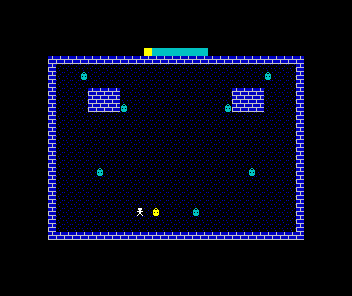
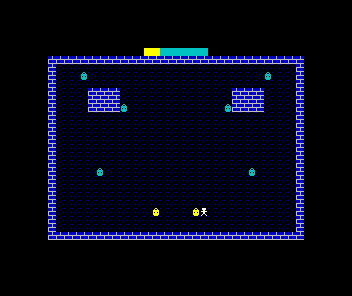
Note what the pips warming left to right actually records: not which lamps are lit, but how many — the third pip warms on your third lamp, whichever lamp that was. The bar is a progress meter, not a map. The map is the square itself, where the state has lived since Unit 12.
When it’s wrong, see why
The tally drifts when the count and the truth disagree, and each drift has a shape:
- Pips never warm.
light_pipisn’t inside the cold-lamp branch. It belongs immediately after theLAMP_LITwrite, behind the samecpguard — outside it, floor steps would count; nowhere, nothing does. - The first lamp warms the second pip. The increment ran before the read —
light_pipmust use the old count as the index, then step it. Off by one at the start means off the end of the bar at the finish. - A pip warms again every time he recrosses a lit lamp — and the warmth marches off the ledge. The call has escaped the
cp LAMP_UNLITguard. The count is only honest because it rides an event that can’t repeat. - All eight pips warm at boot.
draw_pipsis paintingPIP_LIT— the setup draws the cold state; only events warm it. - The bar and the board can’t agree.
NUM_LAMPSdoesn’t match the entries inlamp_data— eight pips over nine lamps leaves the ninth uncounted; over seven, the bar can never fill. A score and the thing it scores must be kept in step, and no code checks this for you.
Before and after
The game began this unit mute and ended it legible: a byte of state, eight cells of readout, and one call placed at the single line where the fact it reports comes true. Nothing was scanned, nothing polled, nothing redrawn per frame — the score updates because the event updates it, and the event can’t lie because Unit 12 made it idempotent. The bar fills left to right toward something: eight of eight. What happens then is the next unit but one — first, the square itself should feel the light arriving.
Try this: break the agreement
Add a ninth lamp to lamp_data and leave NUM_LAMPS at 8. Light everything: the ninth lamp lights fine — and warms a cell just past the bar’s end, where no pip was ever drawn. Now set NUM_LAMPS to 9 with only eight lamps: a bar that can never fill. Five minutes of deliberately-broken scoreboard teaches the maintenance rule better than any warning: the table and the constant are one fact written twice.
Try this: count down instead
Flip the reading: paint the row PIP_LIT in draw_pips, and have light_pip write PIP_UNLIT — lamps remaining, burning down toward zero. Same byte, same event, opposite story. Filling up celebrates progress; running down builds pressure. Which suits a game about holding back the dark? Try both and trust your gut — that’s a real design decision, made the real way.
Try this: a livelier ledge
Recolour the readout. Cold pips in dim blue (%00001000), warm ones flashing (%11110000) — or make the newest pip FLASH and quieten the older ones by rewriting PIP_BASE + index - 1 as you go. The ledge is eight attribute bytes; its personality is yours.
What you’ve learnt
- A HUD is cells outside the playfield — and this one was reserved eleven units ago, for free.
- A coloured-cell readout is pure attribute: PAPER does the showing when there’s no glyph.
- One byte can be count and cursor at once — read it as the index, then step it.
- Hang consequences on events, not scans: the moment cold-became-lit already existed, and it fires exactly once.
- A score is only as honest as its event — idempotence upstream keeps the count true downstream.
What’s next
The tally counts toward eight, but only the ledge knows. In Unit 14 the square itself responds: the walls warm with every lamp — a colour ramp indexed by lit_count, dusk-blue toward gold — so progress stops being a number in the corner and becomes the light changing around you. Atmosphere, driven by the same byte.