The Rules
The title says THE ORACLE STONE but never says what to do. A line or two of instruction turns a mysterious prompt into an invitation — the player knows the game before they're asked to play it.
The title announces the Oracle, but it never tells the player what to do. They face a prompt — “Speak, mortal:” — with no idea they’re meant to ask a yes-or-no question. A couple of lines of instruction fix that.
  10 BORDER 1: PAPER 1: INK 7: CLS
  20 RANDOMIZE
  30 PRINT
  40 PRINT "  *** THE ORACLE STONE ***"
  50 PRINT
  60 PRINT "  Ask any yes-or-no question."
  70 PRINT "  The Oracle will answer."
  80 PRINT
  90 INPUT "  Speak, mortal: "; q$
 100 PRINT
 110 PRINT "  The Oracle ponders..."
 120 BEEP 0.3, 20: BEEP 0.3, 15: BEEP 0.3, 10: BEEP 0.3, 5
 130 PAUSE 25
 140 CLS
 200 LET r = INT (RND * 10) + 1
 210 BEEP 0.1, 24
 230 IF r = 1 THEN PRINT "  YES"
 240 IF r = 2 THEN PRINT "  NO"
 250 IF r = 3 THEN PRINT "  PERHAPS"
 260 IF r = 4 THEN PRINT "  ASK AGAIN LATER"
 270 IF r = 5 THEN PRINT "  THE SIGNS ARE UNCLEAR"
 280 IF r = 6 THEN PRINT "  DEFINITELY NOT"
 290 IF r = 7 THEN PRINT "  THE STARS SAY YES"
 300 IF r = 8 THEN PRINT "  NOT ON A TUESDAY"
 310 IF r = 9 THEN PRINT "  THE ORACLE IS UNSURE"
 320 IF r = 10 THEN PRINT "  WITHOUT A DOUBT"
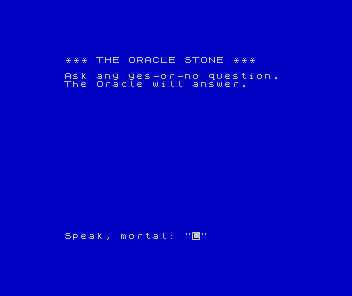
Tell the player the game
Two PRINTs — “Ask any yes-or-no question.” and “The Oracle will answer.” — and a little
spacing (the blank PRINTs on lines 30 and 80). That’s the whole change. No new technique;
it’s a design move.
A game that explains itself in a line or two feels confident and welcoming. A game that drops you at a bare prompt feels like a test you might fail. The instructions aren’t decoration — they’re the difference between a player who plays and a player who stares, unsure what’s wanted. Tell them the game, plainly, before you ask them to play it.
Next: the answer gets a frame worthy of a verdict.