The Caverns
Explore a dark cave you cannot see — the map held as a graph in parallel arrays, and danger sensed only by the clues it leaves in the next room.
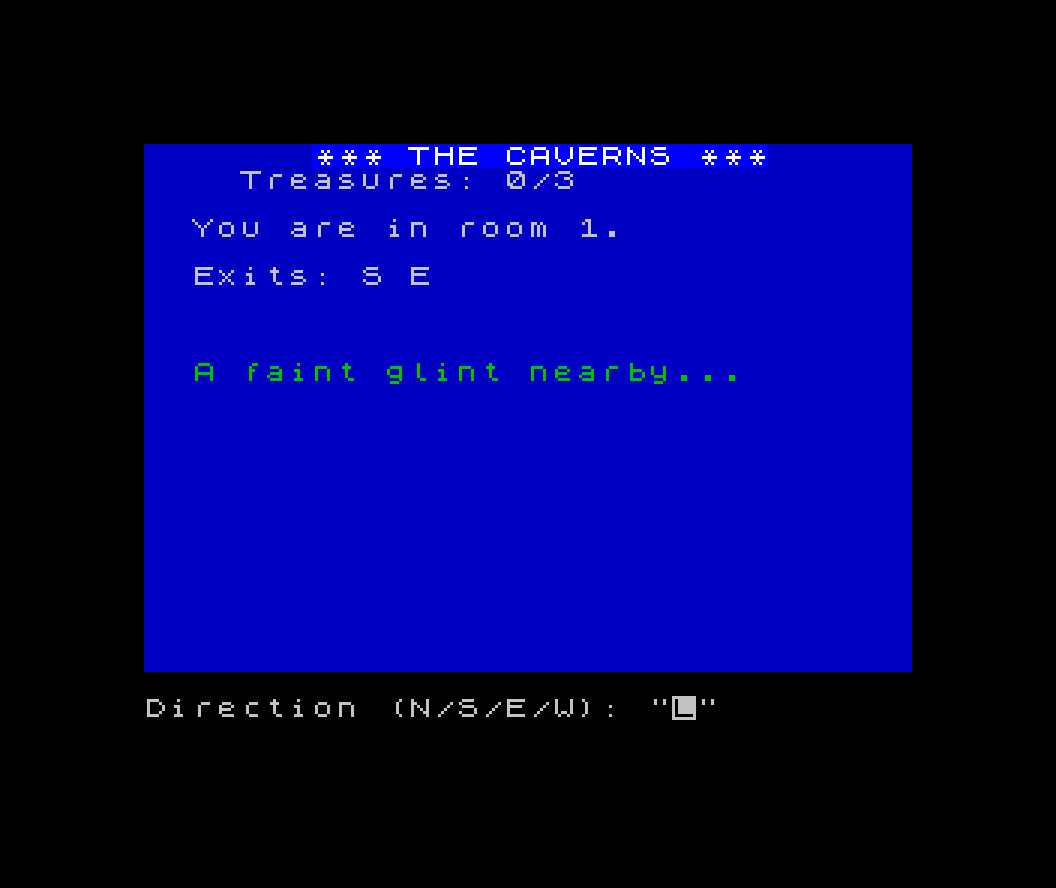
The Caverns is a text adventure where you cannot see. Twenty rooms connected by tunnels. Somewhere in the dark: a bottomless pit, a creature that moves each turn, and three treasures you need to find.
This is the most spatial game in Volume 2 — Patterns of State. Sonar and Three in a Row held their worlds in grids; a cave is not a grid, so its layout needs a different shape of data: a graph, where each room lists which rooms it connects to. That graph is the first new idea. The second is hidden state — the pit, the creature and the treasures are never drawn. You learn they are near only from the clues they leak into the room you are standing in: a cold draft, a terrible smell, a faint glint. Every move is a decision made on indirect evidence.
What you will build:
- The cave as a graph — four parallel arrays loaded from a
DATAtable of 20 rooms (the new idea) - Navigation by compass, following the graph’s links from room to room
- Sensing hidden danger by adjacency — a
GO SUBcheck and the pit’s cold draft (the new idea) - A creature that smells nearby and hunts you, moving each turn
- Three treasures, a glint clue, and the escape
- The finished game: a title, coloured clues, atmosphere, and replay
6 units. About 6–8 hours. This builds on Meet BASIC and Volume 1 — earlier games assumed.
Unit roadmap
The dark
Hidden hazards sensed by adjacency — a pit, then a creature that hunts
The hunt
Treasures to find, a win, and the finished atmospheric game