The Opponent
The computer reads the board and decides: take a winning move if it has one, block yours if you threaten one, otherwise play a random square.
Now the program plays back. The opponent’s move is the heart of the game — and it is built from the same line table you just wrote. The computer scans those eight lines looking for a line it can complete (win now), then a line it must stop (block you), and only if neither exists does it fall back to a random square. That ladder of rules is game AI.
  10 BORDER 0: PAPER 0: INK 7: CLS
  80 RANDOMIZE
  90 DIM b(9)
 100 LET moves = 0
 120 CLS
 130 INVERSE 1: PRINT AT 0, 0; "    *** THREE IN A ROW ***      ": INVERSE 0
 150 INK 7: FOR i = 0 TO 3: PLOT 80 + i * 32, 55: DRAW 0, 96: NEXT i
 160 FOR i = 0 TO 3: PLOT 80, 55 + i * 32: DRAW 96, 0: NEXT i
 170 FOR n = 1 TO 9
 180 LET row = INT ((n - 1) / 3)
 190 LET col = n - 1 - row * 3
 200 LET cx = 100 + col * 32: LET cy = 131 - row * 32
 210 IF b(n) = 0 THEN PRINT AT 5 + row * 4, 12 + col * 4; CHR$ (48 + n)
 220 IF b(n) = 1 THEN INK 5: PLOT cx - 8, cy - 8: DRAW 16, 16: PLOT cx - 8, cy + 8: DRAW 16, -16: INK 7
 230 IF b(n) = 2 THEN INK 2: CIRCLE cx, cy, 8: INK 7
 240 NEXT n
 250 INPUT "Your move (1-9): "; m
 260 IF m < 1 OR m > 9 THEN GO TO 250
 270 IF b(m) <> 0 THEN PRINT AT 18, 4; "Already taken!": PAUSE 30: GO TO 120
 280 LET b(m) = 1
 290 LET moves = moves + 1
 300 GO SUB 420
 310 IF winner = 1 THEN PRINT AT 18, 4; "You win!": STOP
 330 IF moves = 9 THEN PRINT AT 18, 4; "Draw!": STOP
 340 GO SUB 600
 350 LET b(mv) = 2
 360 LET moves = moves + 1
 370 BEEP 0.05, 5
 380 GO SUB 420
 390 IF winner = 2 THEN PRINT AT 18, 4; "Computer wins!": STOP
 410 GO TO 120
 420 REM --- Check winner ---
 430 RESTORE 1200
 440 LET winner = 0
 450 FOR w = 1 TO 8
 460 READ p, q, f
 470 IF b(p) <> 0 AND b(p) = b(q) AND b(q) = b(f) THEN LET winner = b(p)
 480 NEXT w
 490 RETURN
 600 REM --- Computer: win, block, or random ---
 610 LET mv = 0
 620 RESTORE 1200
 630 FOR w = 1 TO 8
 640 READ p, q, f
 650 IF mv = 0 AND b(p) = 2 AND b(q) = 2 AND b(f) = 0 THEN LET mv = f
 660 IF mv = 0 AND b(p) = 2 AND b(f) = 2 AND b(q) = 0 THEN LET mv = q
 670 IF mv = 0 AND b(q) = 2 AND b(f) = 2 AND b(p) = 0 THEN LET mv = p
 680 NEXT w
 690 IF mv > 0 THEN GO TO 800
 700 RESTORE 1200
 710 FOR w = 1 TO 8
 720 READ p, q, f
 730 IF mv = 0 AND b(p) = 1 AND b(q) = 1 AND b(f) = 0 THEN LET mv = f
 740 IF mv = 0 AND b(p) = 1 AND b(f) = 1 AND b(q) = 0 THEN LET mv = q
 750 IF mv = 0 AND b(q) = 1 AND b(f) = 1 AND b(p) = 0 THEN LET mv = p
 760 NEXT w
 770 IF mv > 0 THEN GO TO 800
 780 LET mv = INT (RND * 9) + 1
 790 IF b(mv) <> 0 THEN GO TO 780
 800 RETURN
1200 DATA 1,2,3, 4,5,6, 7,8,9
1210 DATA 1,4,7, 2,5,8, 3,6,9
1220 DATA 1,5,9, 3,5,7
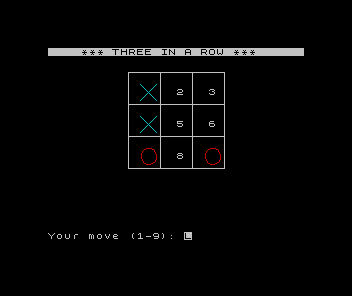
A line with two marks and a gap
The move routine (lines 600–800) reuses the winning-line table. For each line it asks: do two of
the three cells hold the computer’s nought while the third is empty? Lines 650–670 check all three
positions a line’s gap could be in — b(p) = 2 AND b(q) = 2 AND b(f) = 0, and the two other
arrangements. If so, mv is that gap and the computer wins. The same scan run again for the
player’s mark (= 1, lines 700–760) finds a line you are about to complete, and takes the gap to
block it.
Priority is the intelligence
The order is the whole point: win first, block second, random last. Line 690 jumps out the moment a winning move is found, so the computer never blocks when it could win. Only when no line is one-from-complete for either side does it drop to a random empty square (lines 780–790). The computer is not searching ahead or being clever — it is applying three rules in order. That is enough to make it genuinely awkward to beat, and it is the shape almost every small game AI takes: a list of rules, tried in order of strength.
It plays well, but it still wastes its idle moves at random. Next: give those moves a strategy.