Falling
Gravity pulls the lander down — speed accumulates, altitude drops by speed, and the loop runs without ever waiting for you. The real-time core in seven lines.
Every game so far has waited for you — INPUT or INKEY$ paused until you acted. This one
does not wait. The lander is falling the moment it starts, and the loop keeps running whether
you touch a key or not. That continuous loop is the heart of Touchdown, so build its bare
physics first, with no controls at all.
  10 BORDER 0: PAPER 0: INK 7: CLS
  90 CLS
 100 LET alt = 100
 110 LET spd = 0
 150 LET spd = spd + 1
 190 LET alt = alt - spd
 210 PRINT "ALT: "; alt; "  SPD: "; spd
 480 IF alt > 0 THEN GO TO 150
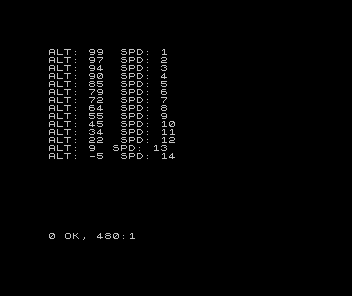
Speed accumulates, position changes by speed
Three lines carry the whole simulation. Line 110 starts spd at 0. Line 150 — `LET spd = spd
- 1
— adds one to the speed *every pass of the loop*: that is gravity. Line 190 —LET alt = alt - spd` — drops the altitude by the current speed. Run it and watch the gap widen: altitude falls by 1, then 3, then 6, then 10, because the speed itself is climbing. Speed accumulates; position changes by speed. That is the simplest physics there is, and every falling, sliding, or drifting object you ever animate works the same way.
A loop that drives itself
Line 480 — IF alt > 0 THEN GO TO 150 — is the loop, and notice what is not in it: any wait
for input. In Bright Spark and Hi-Lo the loop paused for the player; here it just runs, updating
the world each time round. That is the shift from turn-based to real-time. (With no ground check
yet, the altitude overshoots to −5 and stops — the next units add control, a floor, and a
landing. First, the fall.)
Next: give the player a thruster to fight it.