The AMOS Way
Look back at the whole primer in one short program, and at how much AMOS quietly did for you. A bob gliding under a title is a handful of lines here — and a small mountain of work on a bare machine. That gap is the whole point of AMOS, and where you go next.
You’ve arrived. Over sixteen units you went from printing a word to steering a bob, animating it, hearing it, and detecting when it hits something — every piece a game is made of. This last unit isn’t a new idea; it’s a look back. We’ll put a few of those pieces together in one small program, and then notice the thing that’s been true the whole way along: how much AMOS has been doing for you. That gap — between the little you wrote and the lot that happened — is the AMOS way, and understanding it is what tells you where to go next.
What you’ll see by the end
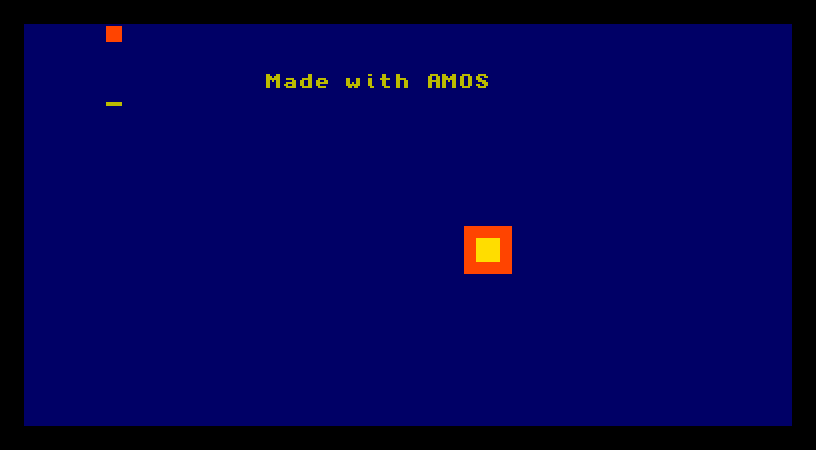
A coloured screen, a title, and an object moving across it by itself. It looks like the opening of a game — and it nearly fits on a postcard.
The whole program
Hide
Screen Open 0,320,200,16,Lowres
Colour 0,$006
Colour 1,$F40
Colour 2,$FD0
Colour 3,$FF0
Cls 0
Ink 1
Bar 0,0 To 23,23
Ink 2
Bar 6,6 To 17,17
Get Bob 1,0,0 To 24,24
Cls 0
Pen 3
Paper 0
Locate 10,3
Print "Made with AMOS"
Bob 1,40,100,1
Channel 1 To Bob 1
Amal 1,"Loop: M 240,0,90 ; M -240,0,90 ; Jump Loop"
Amal On
Do
   Wait Vbl
Loop
Nothing here is new. You open a screen, mix colours, make a bob, print a title, and hand its movement to AMAL — every one of those a thing you learnt earlier. Strung together, they make a small scene that runs itself. Read it and you should recognise all of it; that recognition is the measure of how far you’ve come.
What AMOS did for you
Now the point of the whole course. Count what that short program asked the Amiga to do, and what AMOS handled without you having to think about it:
Screen Openset up a display of a chosen size and depth — laying out screen memory, configuring the Amiga’s display hardware, pointing the chips at the right place. You said the size; AMOS did the wiring.Bobdrew a masked, moving graphic that cleanly redraws as it moves — work the Amiga’s blitter does, programmed for you. On a bare machine, getting one object to move without leaving a trail or flickering is a genuine project.Amalran an animation in the background, timed to the screen’s refresh, while your program did other things. That’s an interrupt-driven routine you’d otherwise write and debug by hand.Colour,Print,Bob Col,Boom— a palette set, text drawn, pixel-exact collision tested, a sampled sound played, each in a word.
On the Amiga without AMOS — in assembly, driving the chips directly — that same scene is hundreds of lines and a deep understanding of the hardware. AMOS took the parts that are the same in every game and made them keywords, so your effort goes into what makes your game yours. That trade — give up some control, gain enormous speed — is the AMOS way, and for making games it’s often the right trade.
Real games shipped this way
If that sounds like a beginner’s compromise, it wasn’t. Games people bought, in boxes, off shelves were written in AMOS. The clearest example is Vulcan Software’s Valhalla series — Valhalla and the Lord of Infinity (1994) and Valhalla: Before the War (1995): isometric adventure games marketed as the Amiga’s first “speech adventures,” with characters who spoke aloud through sampled voices. They were written in AMOS Professional — the same language you’ve just learnt — by newcomers working in a living room with a copy of AMOS and a sampler cartridge.
That’s the detail worth holding onto: not a big studio with a custom engine, but a small team and a friendly tool, shipping a real, reviewed, commercially sold game. AMOS had a reputation as the amateur’s language — and these were exactly the kind of games that quietly proved the reputation didn’t have to be a ceiling. So the point of the keywords you’ve learnt isn’t that they’re effortless; it’s that they’re enough. Enough to make something real and finished, the way real developers did.
When you’d want the other way
It’s worth knowing the trade’s other side. AMOS does things in generally-good ways, not always the fastest-possible way for your exact case. A game that pushes the Amiga to its absolute limit — hundreds of sprites, a specific scroll trick, every cycle counted — sometimes needs the hand control that only assembly gives. That’s not a reason to start there. It’s a reason to know the deeper path exists, for the day a project genuinely needs it. Most games never do, and you’ll build many finished, satisfying ones the AMOS way first. (If that day comes, the Amiga assembly course is where the machine’s chips are waiting.)
Type it and run it
Type the program in and press F1. Your titled scene runs, the bob gliding on its own. Press Esc or reset to stop. Sit with it a moment — every line is something you now understand.
Where you go next
You set out to reach the point where making a game feels like something you can just sit down and do. You’re there. You can open a screen and colour it, draw on it, put a moving object on it and steer it, animate it hands-free, sound it, and tell when things collide — and you can keep your work safe between sessions. That’s not the vocabulary of someone learning to make games; it’s the vocabulary of someone making them.
So make one. Start absurdly small — one bob the player steers, one thing to catch, a point for catching it, a sound when they do. That’s a game, built entirely from what you now know. The AMOS game courses pick up exactly here, turning these pieces into finished things — but you don’t need permission to begin. Open the editor and try something tonight.
What you’ve learnt
This unit was the whole primer in miniature: a screen, a palette, a bob, a title, and hands-free movement, all from keywords you already knew. The deeper lesson is the trade at the heart of AMOS — it handles the work that’s the same in every game (display setup, moving graphics, animation, sound, collision) so your effort goes into what’s unique to yours. That’s why it’s a wonderful place to start making Amiga games, and why the bare-metal path stays open for the rare day a game needs it. You have the pieces. Go and build.