
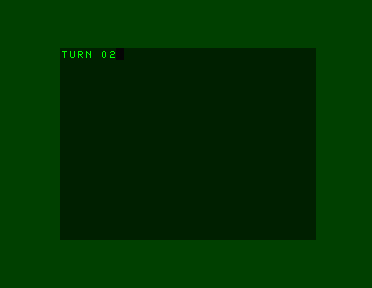
Press G. TURN 00 becomes TURN 01. Press it again for TURN 02. Try X: the counter stays where it is. While you decide what to do, the game rules wait.
That makes a useful starting point for an untimed command game. The reusable piece accepts a character and updates state. Reading the keyboard and drawing the result belong to its caller, so you can replace either without rewriting the rule routine.
Run the complete caller
Choose the full 32 KiB Atom, with the integer BASIC ROM and normal firmware. This executable does not fit the base 2.5 KiB configuration. The loader uses Atom byte indirection (?#2800=...), rather than DATA/READ, which Atom BASIC does not provide.
The 139-byte default executable starts at $2800 and ends before the expanded machine’s BASIC text at $2900. Four context bytes start at $2700; two diagnostic guards follow them. This uses the space normally available to floating-point extensions: leave those extensions out of this layout. Moving the code means changing its origin and loader together, then checking that BASIC text, variables and stack cannot reach it.
Download the caller and shared include at the recorded revision as part of the samples tree, keeping their relative paths. With released Asm198x 0.0.71 available as asm198x, run make in the caller folder. Enter the whole generated build/loader.bas listing, then type RUN. No manufacturer ROM is included in the download.
The firmware caller: initialise once, read, dispatch and draw
!source "settings.inc"
OSRDCH = $ffe3
OSWRCH = $fff4
* = $2800
start:
    cld
    lda #INITIAL
    jsr init_turn
    lda #STEP
    sta TURN+1
    jsr display
next_command:
    jsr OSRDCH
    jsr dispatch
    jsr display
    jmp next_command
!source "dispatch.inc"
!source "../../../../../cross-platform/patterns/framework/command-turns/6502.inc"
display:
    lda #12
    jsr OSWRCH
    ldx #0
print_label:
    lda label,x
    beq print_value
    jsr OSWRCH
    inx
    bne print_label
print_value:
    lda TURN
    lsr
    lsr
    lsr
    lsr
    jsr hex_digit
    lda TURN
    and #15
hex_digit:
    tax
    lda digits,x
    jmp OSWRCH
label: !text "TURN "
    !byte 0
digits: !text "0123456789ABCDEF"
OSRDCH at $FFE3 waits for a delivered character; OSWRCH at $FFF4 writes one. These are Atom vectors. The BBC Micro uses different entry addresses, despite having the same CPU family. Keep the normal firmware environment and enough stack for its calls.
The demo owns the text screen and clears it after every delivered character. That is presentation code, not part of the reusable state update. Its two hexadecimal digits make byte wrap visible: FE → FF → 00 means 254 → 255 → 0.
Include, initialise and call
Define TURN as four private, consecutive writable bytes and ACCEPT_KEY as the character code you want to accept. Include the routine once. Pass the starting counter in A and call init_turn once, before the recurring input path.
The reusable rule update: no keyboard or display ownership
; Caller defines TURN (four writable bytes) and ACCEPT_KEY.
; Binary arithmetic required: CLD before use. A/P clobbered; X/Y preserved.
init_turn:
    sta TURN
    lda #1
    sta TURN+1
    lda #0
    sta TURN+2
    sta TURN+3
    rts
accept_command:
    sta TURN+3
    lda #0
    sta TURN+2
    lda TURN+3
    cmp #ACCEPT_KEY
    bne command_done
    clc
    lda TURN
    adc TURN+1
    sta TURN
    lda #1
    sta TURN+2
command_done:
    rts
init_turn stores the starting counter, sets the step to one and clears the acceptance result and saved input. Set TURN+1 after that call if you want another step. For each delivered character, put it in A and call accept_command.
| Offset | Meaning after a call |
|---|---|
TURN+0 |
Counter; accepted input adds the step modulo 256 |
TURN+1 |
Step; preserved by the update |
TURN+2 |
1 for accepted, 0 for rejected; replaced on every call |
TURN+3 |
Last delivered character; replaced on every call |
Test TURN+2 before another owner reuses the context. A rejected command leaves the counter unchanged. Your game can use the accepted flag to spend a turn or move enemies; the tiny counter is just a visible way to expose that decision.
Clear decimal mode before calling: the complete caller uses CLD. The routine changes A and status flags and preserves X/Y. A direct JSR uses two return-address stack bytes; the caller and firmware need their own stack space too. The code uses absolute context addresses, so it takes no private zero-page bytes.
The two routines occupy 48 code bytes, including their returns, plus the four-byte context. Firmware input and output costs are additional. Keep this context exclusive to one caller at a time; the routine is not safe for concurrent foreground and interrupt calls using the same bytes.
Change the rule without losing the loop
Memory ownership, accepted character, initial value and step
TURN = $2700
ACCEPT_KEY = 71
INITIAL = 0
STEP = 1
Change STEP to 2, rebuild and start the generated program again. Two accepted commands now give 00 → 02 → 04. We changed the amount added, not the number of commands consumed. No extra context byte or routine is required.
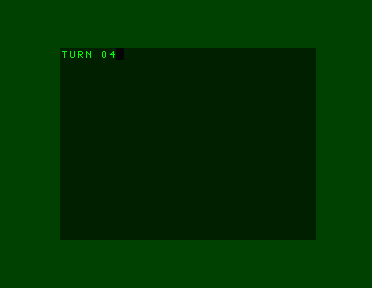
Change INITIAL to 254 to exercise FE → FF → 00. That wrap is the chosen policy. A score or move count that must exceed 255 needs a wider representation; a limited resource may need saturation instead. Those choices change arithmetic and code cost, so make them explicit rather than quietly relying on overflow.
ACCEPT_KEY can select another delivered character. This is a character reader: firmware autorepeat can supply several characters from one held key. Character arrival is not physical press detection. Use held-key sampling and an edge filter if that is the behaviour you need.
Common mistake: erasing the previous move
The next dispatch is deliberately wrong. Replacing dispatch.inc with it resets the counter before every command. The first accepted command looks fine; the second still shows TURN 01. A rejected character can erase progress too.
Broken dispatch: reset state before applying the command
dispatch:
    pha
    lda #0
    sta TURN
    pla
    jmp accept_command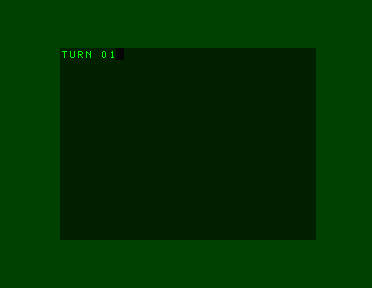
Restore the original dispatch and rebuild. Initialisation stays outside the loop; the same two commands now give 00 → 01 → 02. The repaired caller runs separately from cold firmware in the native checks.
Fixed dispatch: preserve state between commands
dispatch:
    jmp accept_command
When this reader needs more help
The firmware can keep doing its own work while the caller waits. Your game code cannot rely on getting control back in time for an animation, a countdown or regular sound updates. A timed turn needs an explicit deadline and a non-blocking reader, or an independently owned service with a clear contract.
Choose how your game advances explains that distinction. The BASIC command caller demonstrates the same untimed policy in another language; its interpreter and input conventions are different.
What we checked
Code status: firmware-entered and emulator-executed. Released Emu198x 0.44.0 ran the whole typed loader, then real keyboard input. The native record binds the maintained sources, observer, tool binaries, firmware identities and captures.
Six cold cases cover the default, step two, a nonzero start, byte wrap, the faulty reset and a repaired caller. Checks compare installed executable bytes with the assembly output, verify state stays still during idle and rejected commands, and check adjacent guards. A retained-record checker also rejects missing cases, stale inputs and falsified results. It checks saved evidence; the native verifier executes the machines again.
This qualifies the named emulator and firmware configuration. It does not establish original-hardware timing, all ROM revisions or the budget for a complete game.
Primary reference
David Johnson-Davies, Atomic Theory and Practice, sections 13.14 (OS calls), 14.2 (LINK), chapter 26 (memory allocation) and Appendix D (memory map).