
Give an accepted action a sound. The same caller changes its picture and triggers this effect; a second version performs the action with the trigger removed. Listen to both.
Working effect
Trigger omitted
Take the effect
The reusable effect
2000 FOR J=1 TO 200;? #B002=? #B002:4;NEXT J
2010 RETURN
The FOR loop toggles PPI port C bit 2 at #B002. This is a blocking software tone; J is scratch state. Other port-C bits are read and written back. Competing writers still need coordination.
Copy the 2000-range subroutine and call GOSUB 2000 when the game accepts an action. Keep its global scratch variables and any DATA/setup lines with it. A sound call is a consequence of an action, not a substitute for input validation.
Change it and recognise a mistake
Change the iteration count for a longer burst. Its pitch and length depend on interpreter/CPU execution; a tone generator or interrupt driver is a different component.
The omitted-trigger control still accepts the action but fails the same audio guard as the working caller. Keyboard clicks or other machine output are not enough: the BASIC checks compare against a separate rejected-command recording.
Deliberately omitted sound trigger
10 N=0
20 PRINT $12;PRINT "TURN",N'
21 GOSUB 1000
30 GOSUB 3000
40 IF A=1 THEN N=N+1
50 GOTO 20
1000 PRINT "XXX"'
1010 PRINT "X X"'
1020 PRINT "XXX"'
1030 RETURN
2000 FOR J=1 TO 200;? #B002=? #B002:4;NEXT J
2010 RETURN
3000 INPUT A
3010 RETURN
The working implementation above repairs that omission. If an effect instead drones on, check the mute/service path and that its state is initialised. Servicing twice makes a counted effect shorter; servicing only after input can leave it running while the player waits. Those are lifecycle decisions to test when adapting it.
Run the caller
Enter the complete demo.bas in Atom BASIC and RUN. Submit 1, then Return. One accepted command advances the displayed turn; another gives two.
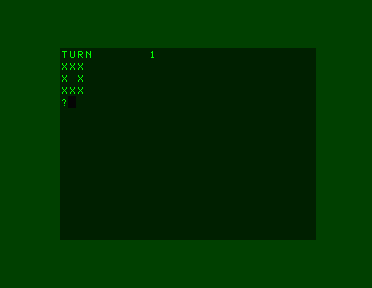
Where setup, trigger and service belong
10 N=0
20 PRINT $12;PRINT "TURN",N'
21 GOSUB 1000
30 GOSUB 3000
40 IF A=1 THEN N=N+1;GOSUB 2000
50 GOTO 20
1000 PRINT "XXX"'
1010 PRINT "X X"'
1020 PRINT "XXX"'
1030 RETURN
2000 FOR J=1 TO 200;? #B002=? #B002:4;NEXT J
2010 RETURN
3000 INPUT A
3010 RETURN
Compare blocking, serviced and queued sound when choosing the next step.
Verification and sources
Target: Atom full BASIC configuration. These callers were executed with released Emu198x 0.44.1; assembly uses Asm198x 0.0.71. The sample folder contains reproduction instructions and retained observations. The independent checker binds source, native captures and actual output; its rejection tests exercise wrong state, missing files and false audio claims.
This qualifies the named emulator/firmware path. Pitch accuracy, original hardware and other peripherals require their own observations.
Acorn, Atom BASIC Manual: INPUT, GOSUB/RETURN, byte indirection and bitwise operators; Atom Technical Manual: 8255 port C and loudspeaker.