
Press Space and the counter advances. Wait, and it stays put. Now press T: you have roughly four seconds before the next turn happens without you. Another T gives you your thinking time back.
The interesting part is the separation. The turn rule does not need a timer. The timer does not need to know what a turn means. A small caller decides how they work together.
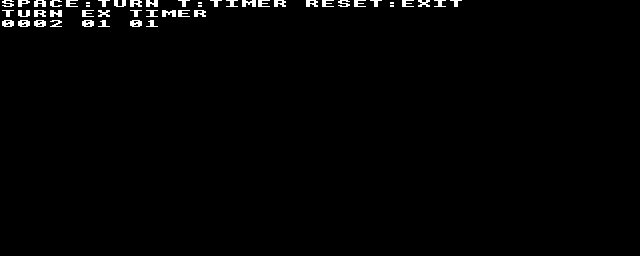
Run it, then take the pieces you need
From the maintained source checkout, run:
make -C acorn-electron/patterns/assembly/framework/turn-deadlineUse Asm198x 0.0.65, the website’s pinned version, or set ASM198X=/path/to/asm198x on that command. Both machines build the shared sources in bbc-micro/patterns/assembly/framework/turn-deadline. Enter that folder’s build/loader.bas into a fresh BASIC program and RUN. Space takes a turn, T toggles the deadline and reset leaves. The checked setup is a stock 32 KiB PAL Electron, MODE 6, with its OS and BASIC ROMs and normal firmware interrupt service.
The loader lowers HIMEM to &2F00 and installs the code at &3000, below the MODE 6 screen at &6000. It does not save the old display or memory layout. Reset or restore your own layout before running another program. Use NEW/reset before entering a different complete variant.
DEADLINE = $2f00
STATE = $2f20
CLOCK = $2f30
DURATION = 400
Include the caller, clock, input, dispatcher and shared helper once each. The caller’s include paths show their order. Keep returning routines outside the main execution path; execution must not fall into an RTS without a matching call. You can omit the input, display and dispatcher when you only want the deadline service.
!source "settings.inc"
OSWRCH = $ffee
* = $3000
start:
    cld
    cli
    lda #0
    ldx #9
clear_state:
    sta STATE,x
    dex
    bpl clear_state
    lda #165
    sta DEADLINE+12
    lda #90
    sta DEADLINE+13
    lda #<DURATION
    sta DEADLINE
    lda #>DURATION
    sta DEADLINE+1
    jsr sample_clock
    jsr deadline_init
    jsr display
next_sample:
    jsr sample_clock
    jsr deadline_poll
    jsr sample_keys
    jsr dispatch
    lda STATE+7
    beq next_sample
    jsr display
    lda #0
    sta STATE+7
    jmp next_sample
commit_turn:
    inc STATE+4
    bne turn_committed
    inc STATE+5
turn_committed:
    inc STATE+7
    rts
!source "clock.inc"
!source "input.inc"
!source "dispatch.inc"
!source "../../../../../cross-platform/patterns/framework/elapsed-deadline/6502.inc"
; Draw only after changes, leaving the service loop free to poll.
display:
    lda #31
    jsr OSWRCH
    lda #0
    jsr OSWRCH
    lda #2
    jsr OSWRCH
    lda STATE+5
    jsr hex_byte
    lda STATE+4
    jsr hex_byte
    lda #32
    jsr OSWRCH
    lda STATE+6
    jsr hex_byte
    lda #32
    jsr OSWRCH
    lda DEADLINE+4
    jsr hex_byte
    rts
hex_byte:
    pha
    lsr
    lsr
    lsr
    lsr
    jsr hex_digit
    pla
    and #15
hex_digit:
    tax
    lda digits,x
    jmp OSWRCH
digits: !text "0123456789ABCDEF"
This extends the MOS game-loop material. That example waits for a display sync; this one polls a clock while waiting for a decision. A frame wait and a deadline solve different problems.
A deadline with twelve bytes of state
; DEADLINE owns 12 bytes. A=clock low, X=clock high; decimal mode clear.
; Poll at least once per 65536 clock ticks. A/X/status clobbered; Y preserved.
deadline_init:
    sta DEADLINE+8
    stx DEADLINE+9
    lda #0
    sta DEADLINE+2
    sta DEADLINE+3
    sta DEADLINE+4
    sta DEADLINE+5
    sta DEADLINE+6
    sta DEADLINE+7
    rts
deadline_start:
    lda DEADLINE
    sta DEADLINE+2
    lda DEADLINE+1
    sta DEADLINE+3
    ora DEADLINE
    beq deadline_off
    lda #1
deadline_off:
    sta DEADLINE+4
    lda #0
    sta DEADLINE+5
    rts
deadline_poll:
    sta DEADLINE+10
    stx DEADLINE+11
    sec
    sbc DEADLINE+8
    sta DEADLINE+6
    txa
    sbc DEADLINE+9
    sta DEADLINE+7
    lda DEADLINE+10
    sta DEADLINE+8
    lda DEADLINE+11
    sta DEADLINE+9
    lda #0
    sta DEADLINE+5
    lda DEADLINE+4
    beq deadline_done
    sec
    lda DEADLINE+2
    sbc DEADLINE+6
    sta DEADLINE+2
    lda DEADLINE+3
    sbc DEADLINE+7
    sta DEADLINE+3
    bcc deadline_expired
    ora DEADLINE+2
    bne deadline_done
deadline_expired:
    lda #0
    sta DEADLINE+2
    sta DEADLINE+3
    sta DEADLINE+4
    lda #1
    sta DEADLINE+5
deadline_done:
rts| Offset from DEADLINE | What lives there |
|---|---|
| 0–1 | Caller-supplied duration, unsigned ticks, little endian; zero disables |
| 2–3 | Remaining ticks, clamped at zero |
| 4 | Active flag, 0 or 1 |
| 5 | Expiry event for this poll, 0 or 1 |
| 6–7 | Elapsed ticks from this poll |
| 8–9 | Previous clock sample |
| 10–11 | Scratch current sample |
Set the duration and supply current time in A low, X high, then JSR deadline_init. It begins disabled. JSR deadline_start copies duration into remaining time and enables a nonzero duration. It uses the latest sampled baseline: sample/poll immediately before starting when that instant matters.
Every service iteration, including while disabled, supply another sample and JSR deadline_poll. Read offset 5 immediately. The next poll or start clears this event. Expiry clamps remaining to zero and disables the helper; the caller chooses whether to advance the world or restart.
The helper clobbers A, X and flags, preserving Y. Clear decimal mode before using it. Give it twelve private writable bytes and an ordinary valid 6502 stack. It makes no nested JSRs, though its caller’s JSR/RTS uses two stack bytes. MOS and interrupts require additional stack space; their maximum use is not isolated here. This absolute-address helper is one mutable context, not re-entrant IRQ code. Multiple contexts need separate state and labels or a deliberately different pointer-based version.
Read a clock without taking it over
; MOS owns the centisecond clock; CLOCK reserves all five result bytes.
; Output A=low clock byte, X=next byte. A/X/Y/flags clobbered.
sample_clock:
    lda #1
    ldx #<CLOCK
    ldy #>CLOCK
    jsr $fff1
    lda CLOCK
    ldx CLOCK+1
    rts
OSWORD 1 writes a five-byte centisecond clock to the buffer addressed by X/Y. Reserve all five bytes even though this adapter only passes the low two to the helper. A two-byte buffer would let firmware overwrite its neighbours. MOS calls may clobber A/X/Y/flags; load the returned sample after the call.
The Electron supplies the same MOS call over different hardware. Its real-time interrupt source is 50 Hz; MOS exposes centiseconds, so do not mistake a firmware clock unit for an independent 100 Hz hardware interrupt. Its display contention also differs from the BBC Micro. This is a separate Electron run, not a BBC capture standing in for it.
Both named runs observed 60 centiseconds during 30 PAL display fields. That establishes this serviced clock in these configurations, not a one-centisecond response guarantee. Keep IRQs enabled and the normal MOS path intact. The routine claims no hardware timer or IRQ vector and never resets the shared clock. Long interrupt blocking can lose clock service; the helper cannot recreate time which was never counted.
The low word wraps after 655.36 seconds. Keep consecutive samples less than 65536 ticks apart. For example, previous=65530 and now=5 means 11 elapsed ticks: subtraction modulo 65536 handles the wrap. A whole missed cycle is indistinguishable from less elapsed time. A clock reset is different again: reinitialise/restart the context after an external clock change.
This is a useful Maths for Games connection: representation, subtraction and units explain the behaviour. Four hundred centiseconds is four seconds; four hundred display fields would mean something else. The maximum duration is a number-format limit, not permission to stop polling for a whole wrap.
Sample a press rather than keyboard repeat
; Physical Space/T samples, no character-buffer consumption or autorepeat.
; STATE+3 previous held, +8 rising edges, +9 current held. A/X/Y/P clobbered.
sample_keys:
    lda #0
    sta STATE+9
    lda #129
    ldx #$9d                 ; INKEY(-99): Space
    ldy #$ff
    jsr $fff4
    txa
    beq space_up
    inc STATE+9
space_up:
    lda #129
    ldx #$dc                 ; INKEY(-36): T
    ldy #$ff
    jsr $fff4
    txa
    beq t_up
    lda STATE+9
    ora #2
    sta STATE+9
t_up:
    lda STATE+3
    eor #255
    and STATE+9
    sta STATE+8
    lda STATE+9
    sta STATE+3
    rts
OSBYTE 129 tests physical keys: X=&9D for Space, X=&DC for T, Y=&FF. These correspond to INKEY(-99) and INKEY(-36). The routine forms a held mask, then pressed = held AND NOT previous: bit 0 is Space, bit 1 T.
A held key gives one observed press. Release must be sampled before another edge appears, and a very short tap between samples may be missed. These physical tests do not consume firmware-delivered characters or drain typeahead. A character reader and a blocking line collector have different contracts; the latter would stop this caller servicing expiry.
Decide what happens at the boundary
; Consume expiry before input; one overdue event, no catch-up turns.
dispatch:
    lda DEADLINE+5
    beq consider_input
    inc STATE+6
    jsr commit_turn
    jmp deadline_start
consider_input:
    lda STATE+8
    and #2
    beq consider_action
    lda DEADLINE+4
    beq enable_timer
    lda #0
    sta DEADLINE+4
    sta DEADLINE+2
    sta DEADLINE+3
    inc STATE+7
    rts
enable_timer:
    inc STATE+7
    jmp deadline_start
consider_action:
    lda STATE+8
    and #1
    beq dispatch_done
    jsr commit_turn
    lda DEADLINE+4
    beq dispatch_done
    jsr deadline_start
dispatch_done:
    rts
Expiry wins over Space and T sampled in the same iteration; those edges are discarded. An automatic turn restarts the deadline. Space restarts only an already active timer: an untimed action stays untimed. T disables and discards remaining time, or enables a fresh duration. This is restart, not pause/resume.
A very late observation produces one turn, not a burst of missed turns. Restarting from observation time can drift. Carrying lateness, fixed-step catch-up, queued commands or preserving pause state can all be useful, but each is another policy to choose and explain.
Customise it and recognise a common mistake
Change DURATION = 400 to 200 in settings.inc, rebuild and enter the new complete loader. Four seconds becomes roughly two. The shorter caller is independently executed with the same helper and dispatcher. Change the dispatcher when you want another turn policy; keep the arithmetic separate.
Deliberately broken: ignore expiry until a key arrives
; WRONG: expiry is a one-poll event. No input means the event is lost.
dispatch:
    lda STATE+8
    beq dispatch_done
    lda DEADLINE+5
    beq consider_input
    inc STATE+6
    jsr commit_turn
    jmp deadline_start
consider_input:
    lda STATE+8
    and #2
    beq consider_action
    lda DEADLINE+4
    beq enable_timer
    lda #0
    sta DEADLINE+4
    sta DEADLINE+2
    sta DEADLINE+3
    inc STATE+7
    rts
enable_timer:
    inc STATE+7
    jmp deadline_start
consider_action:
    lda STATE+8
    and #1
    beq dispatch_done
    jsr commit_turn
    lda DEADLINE+4
    beq dispatch_done
    jsr deadline_start
dispatch_done:
    rts
That early return looks harmless: no input, no work. But expiry is itself work. The helper emits its one-poll event, this dispatcher ignores it, and the next poll clears it. The world never takes its automatic turn.
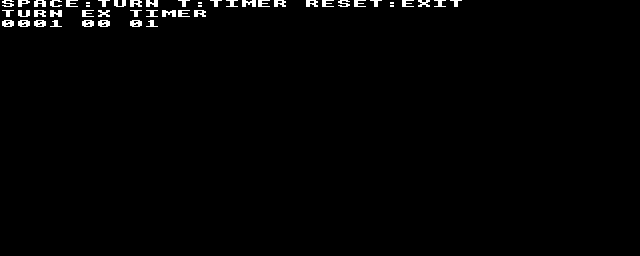
The native clock advances and remaining time reaches zero; guarded state shows active=0, while the display still says 01. Replace the broken include with dispatch.inc. A fresh repaired run advances without input. Keep timer processing outside input-only branches.
Reserve resources and understand the cost
The demonstration owns these writable ranges:
- &2F00–&2F0B: twelve helper bytes; &2F0C–&2F0D: optional guards.
- &2F20–&2F29: ten caller/input bytes, including held/pressed masks, counters and redraw flag.
- &2F30–&2F34: five-byte clock buffer.
Relocate the constants together and reserve those ranges against neighbours. There is no fixed zero-page claim. The loader’s HIMEM reservation is larger than the bytes actually used. MODE 6, firmware keyboard/VDU services and that reservation belong to this caller.
The assembled public executable is 445 bytes, including the 140-byte helper and 16-byte clock adapter. Explicit helper/clock/caller/guard storage is 29 bytes, beyond code. The wrong dispatcher adds five code bytes. These are binary lengths and symbol distances; firmware, interpreter and stack costs are additional.
The helper subtracts once per poll, not once per missed tick. Each clock read asks MOS to copy five bytes; redraw happens only on changes. There is no isolated cycle benchmark or whole-game frame-budget claim. Measure the actual workload on your target: sharing a MOS API does not remove BBC/Electron differences in memory access and firmware work.
What was checked
Code status: assembled and emulator-executed. This machine’s retained record binds sources, observers, firmware and released tools. Emu198x 0.44.1 and Asm198x 0.0.65 were used. Both machines cold-booted their own stock firmware, received the complete loader through the keyboard and had every installed executable byte compared. No debugger writes set up a successful outcome.
The public caller checks untimed idle/action, enabled countdown, expiry without input, active restart, held-key suppression, disabling, a shorter duration and wrong/repaired dispatch. Visible counts are decoded separately from guarded state, including the broken screen’s stale flag. A second caller runs twelve synthetic-clock cases through the same helper on each CPU: zero/max duration, no movement, wrap and exact/overshot expiry. One changed equality branch completes but fails the independent arithmetic oracle.
Those synthetic cases establish arithmetic, not a wall-clock run across an entire rollover. Retained checks reject missing cases, changed inputs and falsified observations. No original-hardware, other-ROM, other-region or minimum-RAM claim is made. See the BBC Micro entry for its separate execution and hardware context.
Primary references: Acorn Electron User Guide, chapter 29, OSWORD A=1 and OSBYTE 129; The Advanced User Guide for the Acorn Electron, printed p.88, OSWORD 1; BBC Micro Advanced User Guide, §9.3 printed p.248 and §8 OSBYTE 129. Captures are Code198x’s own emulator output; native Electron capture geometry is preserved.