
Touching a hazard should not remove every life in one burst. A recovery counter gives the player time to react. This helper owns the health arithmetic and the rule for accepting a hit; your game chooses what counts as a collision and how recovery looks or sounds.
Include and initialise
Combine routines.bas with your numbered caller. Reserve lines 3000–3220, and call 3000 at a new-session boundary. It sets H=3, T=0 and A/O/K/E=0, retaining your chosen recovery period P. Set a different initial H after this call. Put END, STOP or a jump before the helper, so normal execution cannot fall into it. Spectrum spells calls GO SUB; C64 and BBC use GOSUB. The supplied build.py combines numbered source files and rejects duplicate line numbers.
Supply a hit
H is health, T the remaining recovery count, A the proposed damage and P the recovery period. All must be integral; H/T/A are 0–255 and P is 1–255. Set A to zero on an update with no proposed hit, then call 3100 once per simulation update. Calling only when a collision happens would freeze recovery between collisions.
The routine first decrements T towards zero. If H is non-zero, T has reached zero and A is positive, it accepts the hit. It subtracts A, clamps H at zero and returns O=1. A killing hit also returns K=1 and leaves T=0; a surviving hit reloads T=P. Otherwise O/K are zero. E=1 rejects damaged health/recovery/period state; E=2 rejects an invalid amount. Invalid calls clear O/K but leave H/T untouched.
The routine
Reusable numbered routines
3000 LET H=3: LET T=0: LET A=0: LET O=0: LET K=0: LET E=0: RETURN
3100 LET O=0: LET K=0: LET E=1
3110 IF H<0 OR H>255 OR H<>INT (H) THEN RETURN
3120 IF T<0 OR T>255 OR T<>INT (T) THEN RETURN
3130 IF P<1 OR P>255 OR P<>INT (P) THEN RETURN
3140 IF A<0 OR A>255 OR A<>INT (A) THEN LET E=2: RETURN
3150 LET E=0
3160 IF T>0 THEN LET T=T-1
3170 IF H=0 OR T>0 OR A=0 THEN RETURN
3180 LET H=H-A
3190 IF H<0 THEN LET H=0
3200 LET O=1
3210 IF H=0 THEN LET K=1: LET T=0: RETURN
3220 LET T=P: RETURN
What one recovery period means
If P=4, a surviving hit on update zero is followed by three blocked updates; another hit may land on update four. The decrement happens before acceptance. P=1 therefore allows another hit on the following update. The units are calls, not seconds, video frames or hardware timer ticks. Connect this to a timed or fixed-step loop only when that is what the game needs.
The caller below supplies damage on twelve consecutive updates. It counts accepted hits and checks that health reaches zero. Its table before this excerpt covers health/amount boundaries, timer boundaries and invalid zero periods. The complete diagnostic source and observations remain in the source link.
Calls to line 2000 in this excerpt write diagnostic observations; that writer and the mailbox setup are in the complete source. In your own game, omit those observation calls and the final mailbox write. Keep the public helper calls, and supply your game state as described above.
Maintained retained-state caller
70 LET P=4: GOSUB 3000: LET N=0
80 FOR J=1 TO 12: LET A=1
90 GOSUB 3100: LET N=N+O: GOSUB 2000: NEXT J
100 LET Y=0: LET D=0: IF H=0 THEN LET Y=1
110 IF N=3 THEN LET D=1
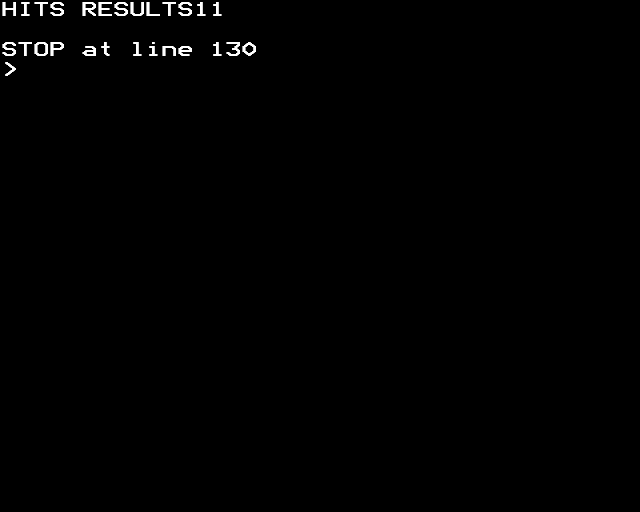
120 PRINT "HITS RESULTS";Y;D
130 ?(W+995)=Y: ?(W+996)=D: ?(W+997)=G: ?(W+998)=Z-256*INT (Z/256): ?(W+999)=INT (Z/256): ?(W+1000)=239: STOP
Ownership and customisation
The helper owns H/T/A/P/O/K/E and no scratch loop variables. Your game owns collision detection, invulnerability flashing, knockback, score, lives and respawn. It neither draws nor reads input. For several actors use separate state variables or a deliberate array-based wrapper; this scalar version holds one actor. Renaming must include every reference, and a second helper instance also needs separate numbered lines.
The custom caller changes P from four to two. It accepts hits sooner, without changing the implementation. Change initial H after initialisation, or choose a different amount for each hazard. A zero amount still ages recovery. A dead actor never accepts another hit or reports another kill. To respawn, initialise deliberately and then restore the actor’s chosen health; do not leave an old recovery count attached to a new actor.
Mistake and repair
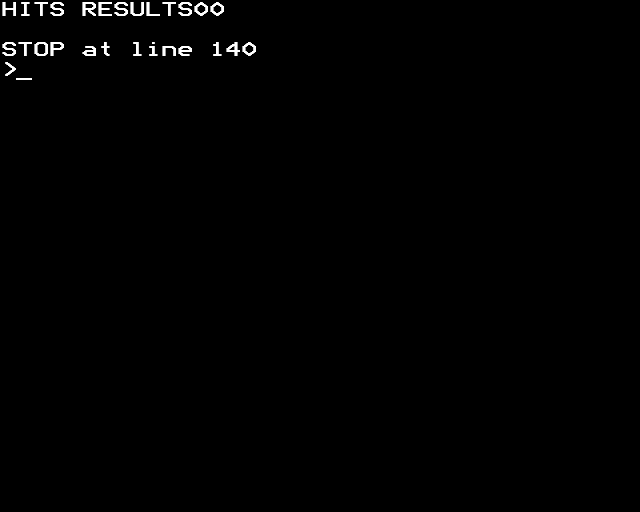
The wrong caller refreshes T=P before every proposed hit. The decrement can never reach zero, so no hit lands. Its saved checks are 0,0: health never reaches zero and the expected three accepted hits never occur. Increasing the damage amount would not repair that ordering error.
The repair lets the helper reload recovery only after an accepted, non-fatal hit. Its source and loaded tokenised program match the working caller exactly.
Costs and alternatives
The update takes a fixed number of scalar checks and branches; it has no object scan. Validation adds interpreter work before the simple subtraction. This helper models one health pool with update-count recovery. A deadline against a clock can fit games whose updates vary in length; per-hazard cooldowns and separate shield/armour layers need different state. The Craft connects the recovery window to player feedback, while Maths for Games explains saturation, discrete steps and bounds.
Machine and measured size
This helper uses scalar variables and needs no array allocation. Its diagnostic uses MODE 7 and HIMEM=&6000 to separate program storage, mailbox and screen. The helper itself changes neither mode nor HIMEM.
The numbered helper occupies 348 tokenised program bytes on this interpreter, including line headers. This excludes the caller, test tables, numeric scalar/array storage, interpreter stacks and ROM. Tokenised size is not machine-code size or a hardware-cycle count. No real-time or whole-game performance budget is inferred from the diagnostic. The caller’s W/Z/G, Y/D and RAM mailbox are observation machinery, not required game state.
Execution evidence
Working, custom, deliberately wrong and exact repaired callers executed through BBC Micro’s stock BASIC interpreter under Emu198x 0.44.2. Build198x 0.2.9 tokenises C64 PRG and Spectrum TAP programs. C64 enters stock RUN, Spectrum uses ROM tape loading, and BBC enters every numbered source line through MOS/BASIC. Actual loaded program bytes, complete state packets, positive completion/count/guards and visible result pixels are checked. Firmware is not distributed.
An independent mathematical/order model checks the trace and rejects altered source, configuration, loaded program, state, completion and image evidence. Host exhaustive checks complement the native boundary/sequential examples; those host ranges are not claimed as natively exhaustive. The wrong caller prints 0,0 and the normal/custom/repaired callers print 1,1.
Public CI checks retained evidence; it does not execute restricted firmware. Refresh with python3 scripts/verify-basic-rules.py damage-rules bbc-micro --tools /path/to/extracted/releases and inspect with python3 scripts/check-basic-rules.py damage-rules.
Explore further
Compare the assembly technique. The BASIC game-flow routine makes session boundaries explicit. Complete source and native evidence.