
A guard reaches one end of a corridor, turns and heads towards the next patrol point. Moving by a fixed amount is easy; reaching each target cleanly needs a little more care. This helper clamps each step to the current target and remembers which point comes next.
Include and initialise
Reserve P(4), numeric globals X/T/C/S/L/A/F/O/E and private I/D/B. Reserve lines 3000–3290, combine the numbered files with build.py and put END, STOP or a jump before the helper. Use GOSUB on C64/BBC or GO SUB on Spectrum. Do not borrow private scratch for an enclosing caller FOR loop.
Set C to an integral count from one to four, S to a speed from one to 255 and L=1 to loop or L=0 for a one-shot. P(1)..P(C) hold byte-valued target positions. Call 3000 to clear X/T/A/F/O/E, retaining that configuration and route. Set the starting X afterwards if it should differ from zero. T is a zero-based target index, so the current point is P(T+1).
Advance one update
Call 3100. It moves X towards the target by at most S and snaps to it rather than passing through it. A=1 pulses on reaching that target. The helper then increments T for a later call; reaching the final point either wraps T to zero or latches F=1. An already-finished route clears A but retains X/T/F. O=1,E=0 reports a valid call, including a finished route.
X and every active point must be integral 0–255. T must be 0..C-1; L/F must be exactly zero or one. E=1 rejects invalid state/configuration before changing X/T/F, with A=0,O=0. The routine checks the active route, not unused points beyond C.
The reusable routine
Reusable numbered routines
3000 LET X=0: LET T=0: LET A=0: LET F=0: LET O=0: LET E=0: RETURN
3100 LET A=0: LET O=0: LET E=1
3110 IF X<0 OR X>255 OR X<>INT (X) THEN RETURN
3120 IF C<1 OR C>4 OR C<>INT (C) THEN RETURN
3130 IF T<0 OR T>=C OR T<>INT (T) THEN RETURN
3140 IF S<1 OR S>255 OR S<>INT (S) THEN RETURN
3150 IF L<>0 AND L<>1 THEN RETURN
3160 IF F<>0 AND F<>1 THEN RETURN
3170 FOR I=1 TO C
3180 IF P(I)<0 OR P(I)>255 OR P(I)<>INT (P(I)) THEN RETURN
3190 NEXT I: LET O=1: LET E=0
3200 IF F=1 THEN RETURN
3210 LET B=P(T+1): LET D=B-X
3220 IF D>S THEN LET D=S
3230 IF D<-S THEN LET D=-S
3240 LET X=X+D
3250 IF X<>B THEN RETURN
3260 LET A=1
3270 IF T<C-1 THEN LET T=T+1: RETURN
3280 IF L=1 THEN LET T=0: RETURN
3290 LET F=1: RETURN
A signed difference gives the direction. Clamping that difference to -S..S bounds the movement and prevents overshoot in either direction. Reaching a point already equal to X still consumes one call and pulses arrival. Several coincident points are not skipped in a single update.
Retain the patrol cursor
The caller follows positions 6,1,9,3 for twelve updates. It records arrivals at the second and final points, including turns in both directions. The full diagnostic also tests overshoot, same-position arrival, large speed, finished state, looping and invalid configuration.
Example calls from the maintained caller
90 LET C=4: LET S=4: LET L=0: GOSUB 3000: LET AA=0: LET BB=0
100 LET P(1)=6: LET P(2)=1: LET P(3)=9: LET P(4)=3
110 FOR JJ=1 TO 12
120 GOSUB 3100: GOSUB 2000
130 IF A=1 AND X=P(2) THEN LET AA=1
140 IF A=1 AND X=P(4) THEN LET BB=1
150 NEXT JJ
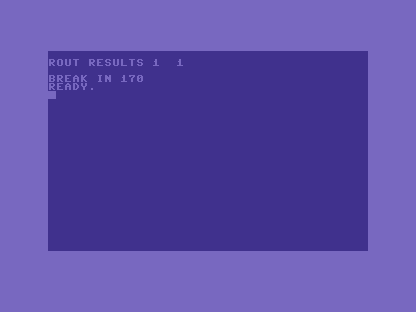
160 PRINT "ROUT RESULTS";AA;BB
170 POKE MB+995,AA: POKE MB+996,BB: POKE MB+997,GD: POKE MB+998,WC-256*INT (WC/256): POKE MB+999,INT (WC/256): POKE MB+1000,239: STOP
Its line 2000 writer, mailbox, AA/BB and JJ/KK (Z/Q on Spectrum) are diagnostic machinery. A game calls 3100 once at its chosen movement update, uses X for its own rendering and handles arrival if A=1.
Customise the route
The custom caller changes speed from four to five and loops instead of finishing. Change P to define another corridor route, or set starting X after initialisation. To replace a route, deliberately reset T/F and establish a valid new C/P configuration. Changing one without the others can leave the cursor outside the active route.
This scalar state belongs to one actor. Independent actors need separate state, or a deliberate wrapper that loads and stores each actor’s X/T/F and route configuration. Separate helper instances also need distinct globals, scratch and numbered references.
These units are calls, not seconds or guaranteed display frames. A variable-length loop changes the actor’s apparent speed unless the game supplies a suitable update policy. S must be positive; pause by withholding movement calls or retaining the state, rather than supplying an invalid zero speed.
This is one-dimensional movement, not pathfinding or collision avoidance. Obstacles can still block the corridor. Two-dimensional waypoints need paired coordinates and a chosen metric: stepping each axis independently changes diagonal speed. The helper owns no sprite, input, collision world, timer or interrupt.
Mistake and repair
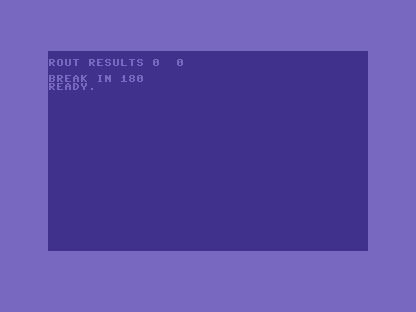
The wrong caller resets T to zero before every update. The actor reaches the first point, then keeps arriving there instead of following the route. Neither the second nor final point is reached, so both saved checks print zero.
The repair retains T until a real restart or route replacement. Repaired source and loaded tokenised program match the working caller exactly.
Cost and Maths for Games
Each call validates up to four points and performs one clamped movement step. It never traverses an unbounded series of coincident targets. P uses interpreter numeric elements rather than four packed machine-code bytes. More points require matching allocation, bounds and tests; a distance-based or two-dimensional route needs more state and arithmetic.
Maths for Games connects signed differences, bounds and clamping to target approach. The Craft is where to choose patrol speed, pauses and anticipation. A movement rule can be mathematically correct and still need better timing to make a character feel convincing.
Machine and measured size
C64 BASIC V2 recognises only the first two significant characters of numeric variable names. Short names make the ownership visible; check for collisions before including another component. Array element zero exists but is unused here. The diagnostic uses a mailbox at $C000, outside the normal BASIC heap.
The numbered helper occupies 498 tokenised program bytes on this interpreter, including line headers. This excludes the caller, test tables, numeric scalar/array storage, interpreter stacks and ROM. Tokenised size is not machine-code size or a hardware-cycle count. No real-time or whole-game performance budget is inferred from the diagnostic. The caller’s AA/BB, JJ/KK and RAM mailbox are observation machinery, not required game state.
Execution evidence
Working, custom, deliberately wrong and exact repaired callers executed through C64’s stock BASIC interpreter under Emu198x 0.44.2. Build198x 0.2.9 tokenises C64 PRG and Spectrum TAP programs. C64 enters stock RUN, Spectrum uses ROM tape loading, and BBC enters every numbered source line through MOS/BASIC. Actual loaded program bytes, complete state packets, positive completion/count/guards and visible result pixels are checked. After the positive completion marker, the observer advances two complete display frames before capturing, so a partially scanned final character cannot masquerade as a finished picture. Firmware is not distributed.
An independent mathematical/order model checks the trace and rejects altered source, configuration, loaded program, state, completion and image evidence. Host exhaustive checks complement the native boundary/sequential examples; those host ranges are not claimed as natively exhaustive. The supplied diagnostic callers deliberately end with STOP; the interpreter report is expected. The wrong caller prints 0,0 and the normal/custom/repaired callers print 1,1.
Public CI checks retained evidence; it does not execute restricted firmware. Refresh with python3 scripts/verify-basic-entities.py waypoint-route commodore-64 --tools /path/to/extracted/releases and inspect with python3 scripts/check-basic-entities.py waypoint-route.
Explore further
Compare the assembly technique. The BASIC game-flow routine makes session boundaries explicit. Complete source and native evidence.