
Three updates from five source ticks cannot be represented by rounding 3/5 down to zero. Keep the fractional credit between calls, and it accumulates into evenly spread opportunities to update.
Include and initialise
Reserve public P/N/D/F/O, private T and lines 3000–3160. There are no arrays. Combine routines.bas and a caller using build.py, with END, STOP or a jump before the helper. C64/BBC use GOSUB; Spectrum uses GO SUB.
Call 3000 at a reset boundary. It clears every public field. Then set numerator N and denominator D: D is one through 255, and N is zero through D. P starts at zero. An intentional nonzero initial phase must remain below D.
Service one source tick
Call 3100 once per source tick. It adds N to retained P. On crossing D it emits F=1 and removes one denominator of credit; otherwise F=0. P is the remainder. O=1 means valid state; N/D survive. At most one event occurs per call because N cannot exceed D.
Reusable numbered routines
3000 LET P=0: LET N=0: LET D=0: LET F=0: LET O=0: RETURN
3100 LET F=0: LET O=0
3110 IF D<1 OR D>255 OR D<>INT (D) THEN RETURN
3120 IF N<0 OR N>D OR N<>INT (N) THEN RETURN
3130 IF P<0 OR P>=D OR P<>INT (P) THEN RETURN
3140 LET T=P+N
3150 IF T>=D THEN LET T=T-D: LET F=1
3160 LET P=T: LET O=1: RETURN| Field | Use |
|---|---|
| P | Retained phase, zero through D−1 |
| N / D | Events per denominator source ticks |
| F / O | Fresh event pulse / valid-input flag |
All values are integral, with byte-sized inputs and a widened temporary sum. N=0 is valid and never fires. N=D fires every call. Invalid bounds, zero denominator or phase outside its range clear F/O without changing P/N/D.
Observe the remainder
The normal caller uses N=3,D=5 for twelve calls, producing seven events with one unit of phase left. The custom caller uses one per three, producing four events with phase zero. Read F on every call; a final phase alone cannot tell you how many events happened.
Example calls from the maintained caller
70 GOSUB 3000: LET AA=0: LET BB=0
80 LET N=3: LET D=5: LET NN=0: FOR KK=1 TO 12
90 GOSUB 3100: GOSUB 2000: LET NN=NN+F: NEXT KK
100 IF NN=7 THEN LET AA=1
110 IF P=1 THEN LET BB=1
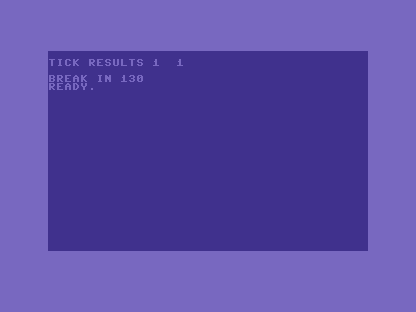
120 PRINT "TICK RESULTS";AA;BB
130 POKE MB+995,AA: POKE MB+996,BB: POKE MB+997,GD: POKE MB+998,WC-256*INT (WC/256): POKE MB+999,INT (WC/256): POKE MB+1000,239: STOP
Line 2000, AA/BB/NN/JJ/KK (Z/Q on Spectrum) and the mailbox are observations. A game supplies the source tick and performs the desired work on F. This helper does not wait for a display frame, read a hardware timer or promise that an interpreted update fits the available time.
Choose the rate policy
A 3/5 divider fed fifty actual source ticks gives thirty opportunities, provided those source ticks are really counted. A slower interpreter that calls it only twenty times has not measured fifty ticks. Keep timing observation and rate conversion separate.
The phase deliberately keeps the remainder rather than introducing long-term rounding drift. Event spacing still alternates: a fractional average cannot make every interval identical. Changing D while P is already retained needs a deliberate reset or rescaling policy. More than one event per source call needs a different accumulator and a bounded catch-up policy.
Mistake and repair
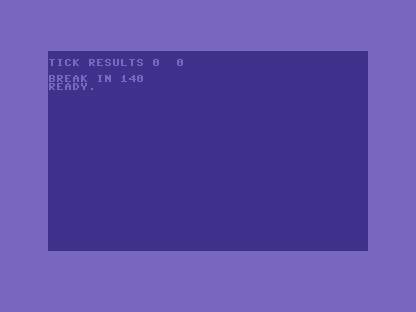
The wrong caller clears P before each call. A fraction smaller than one never accumulates enough credit to fire. Both event-count and final-phase checks fail. Keep P even when F=0. The repaired source and loaded program match normal exactly.
Cost and Maths for Games
Each call uses fixed validation, an addition, a comparison and at most one subtraction. It does no allocation or work loop. A simple countdown is easier when the ratio is exactly one event every fixed number of calls; the accumulator preserves ratios such as three per five.
Maths for Games connects rational numbers, division with remainder and accumulated error. The Craft connects update cadence to animation, enemy decisions and other work that need not run on every source tick.
Global names and line numbers
BASIC numeric names, arrays and numbered lines are global. To combine helpers, rename public and private fields and renumber the helper together with every GO SUB/GO TO reference. Keep each state block under one owner. The maintained build.py rejects duplicate line numbers; it does not automatically namespace or renumber routines.
Machine and measured size
C64 BASIC V2 recognises only the first two significant characters of numeric variable names. Short names make the ownership visible; check for collisions before including another component. This helper uses scalar numeric fields and allocates no arrays. The diagnostic uses a mailbox at $C000, outside the normal BASIC heap.
The numbered helper occupies 214 tokenised program bytes on this interpreter, including line headers. This excludes the caller, test tables, numeric scalar/array storage, interpreter stacks and ROM. Tokenised size is not machine-code size or a hardware-cycle count. No real-time or whole-game performance budget is inferred from the diagnostic. The caller’s AA/BB/NN, JJ/KK and RAM mailbox are observation machinery, not required game state.
Execution evidence
Working, custom, deliberately wrong and exact repaired callers executed through C64’s stock BASIC interpreter under Emu198x 0.44.2. Build198x 0.2.9 tokenises C64 PRG and Spectrum TAP programs. C64 enters stock RUN, Spectrum uses ROM tape loading, and BBC enters every numbered source line through MOS/BASIC. Actual loaded program bytes, complete state packets, positive completion/count/guards and visible result pixels are checked. After the positive completion marker, the observer advances two complete display frames before capturing, so a partially scanned final character cannot masquerade as a finished picture. Firmware is not distributed.
An independent mathematical/order model checks the trace and rejects altered source, configuration, loaded program, state, completion and image evidence. Host exhaustive checks complement the native boundary/sequential examples; those host ranges are not claimed as natively exhaustive. The supplied diagnostic callers deliberately end with STOP; the interpreter report is expected. The wrong caller prints 0,0 and the normal/custom/repaired callers print 1,1.
Public CI checks retained evidence; it does not execute restricted firmware. Refresh with python3 scripts/verify-basic-temporal.py rational-tick-divider commodore-64 --tools /path/to/extracted/releases and inspect with python3 scripts/check-basic-temporal.py rational-tick-divider.
Explore further
Compare the assembly technique. The BASIC game-flow routine makes session boundaries explicit. Complete source and native evidence.