
Type TAKE LAMP. The parser returns verb 3, noun 1 and status 0. GET LIGHT returns the same IDs: aliases belong in the vocabulary, while your game decides what taking that object means. A parser should not need to know which room the lamp is in.
This is a C64 BASIC V2 port of the maintained Spectrum parser’s small vocabulary/result model. It uses the same straightforward INPUT-and-GOSUB shape as the C64 command-loop sample, with a reusable parser replacing its single-letter dispatch. PETSCII, strings, DATA ownership and BASIC V2 loop behaviour are handled separately; this is not a claim that the same BASIC listing runs unchanged everywhere.
Build, load and call
Run make BUILD198X=/path/to/build198x, load build/demo.prg through the stock C64 ROM loader and enter RUN. The Makefile combines caller.bas, parser.bas and vocabulary.bas in numerical line order, then tokenises them with Build198x. There are no new libraries or machine-code extensions.
The caller uses RESTORE before one GOSUB 6000 at startup. Put this vocabulary before any other DATA, or arrange the shared DATA cursor yourself. BASIC V2 has no RESTORE-to-line form. The initializer reads from the caller’s current DATA cursor and DIMs its arrays once. Do not call it again within the same RUN; DIM would raise REDIM’D ARRAY. A dictionary error requires correcting the data and starting a fresh RUN. Missing or mistyped DATA can still raise BASIC’s own OUT OF DATA or TYPE MISMATCH errors: this is a trusted vocabulary, not a sandbox for arbitrary files.
After successful initialization, set A$ and GOSUB 5000. Read S, V and N. V and N start at zero on every parse and are only assigned on success. Your action dispatcher runs after S=0; do not carry a previous successful command through an error. The sample prints the result and loops until QUIT. A real adventure can use those IDs to resolve nearby objects, reject impossible actions and update its world separately.
The complete INPUT and GOSUB caller
10 PRINT CHR$(147);"TWO WORDS, ONE COMMAND"
20 RESTORE:GOSUB 6000
30 IF S<>0 THEN PRINT "BAD VOCABULARY":END
40 INPUT ">";A$
50 GOSUB 5000
60 PRINT "STATUS";S;"VERB";V;"NOUN";N
70 IF S=0 AND V=7 THEN END
80 GOTO 40
Inputs, outputs and owned names
A$ holds at most 63 accepted characters. The grammar allows spaces, digits and letters represented by PETSCII 65–90 or 193–218; the latter range normalises by subtracting 128. Repeated, leading and trailing spaces are ignored. ASCII lowercase 97–122 is deliberately not folded as though this were an ASCII machine. Character-set display choices can change how the same bytes look.
The parser accepts one or two words, with vocabulary words up to 12 characters. Matching is exact. It has no articles, prepositions, quoted object names, conjunctions, pronouns, ambiguity resolution or multi-command input. Those are useful later components, not hidden behaviour in this one.
| S | Result |
|---|---|
| 0 | Success; V and N are canonical IDs |
| 1 | Blank command |
| 2 | More than 63 characters |
| 3 | Unsupported character anywhere in the line |
| 4 | More than two words |
| 5 | Unknown or overlong verb |
| 6 | Unknown or overlong noun |
| 7 | This verb requires a noun |
| 8 | This verb does not take a noun |
| 9 | Parser not initialized |
| 10 | Vocabulary validation failed during initialization |
Validation checks the complete character sequence before splitting/looking up words. Then word count, exact verb, noun policy and exact noun are checked in that order. This makes malformed input predictable and avoids silently executing its first two words.
Reserve scalar names S,V,N,PR,LL,P,TC,WC,IV,F,I,NI,NV,NN,KK,JJ,B,OK,Q, string names A$,W$,O$,T$, and arrays D$(),U(),R(),E$(),Z(). BASIC V2 only distinguishes the first two characters of a name: longer names beginning with these pairs still collide. Arrays and scalars have separate roles here, but other routines must not reuse the same parser names or line ranges. The component occupies lines 5000–6560 and the supplied DATA uses 7000–7090. The small caller and verification variables are separate optional code.
The parser changes its scratch variables and uses BASIC’s normal string heap and FOR/GOSUB stack. It does not poke hardware or own a timer. It is not re-entrant. Return from it before running another command or touching its arrays.
Reusable parser and one-time dictionary initializer
5000 REM PARSE A$: S STATUS, V VERB, N NOUN
5010 S=0: V=0: N=0: W$="": O$=""
5020 IF PR<>1 THEN S=9: RETURN
5030 LL=LEN(A$): IF LL>63 THEN S=2: RETURN
5035 IF LL=0 THEN S=1: RETURN
5040 REM CHECK THE ENTIRE INPUT BEFORE LOOKING UP WORDS
5050 FOR P=1 TO LL
5060 TC=ASC(MID$(A$,P,1)): IF TC>=193 AND TC<=218 THEN TC=TC-128
5070 IF TC<>32 AND (TC<48 OR TC>90 OR (TC>57 AND TC<65)) THEN S=3: RETURN
5080 NEXT P
5090 WC=0: P=1
5100 IF P>LL THEN GOTO 5230
5110 IF MID$(A$,P,1)=" " THEN P=P+1: GOTO 5100
5120 WC=WC+1: IF WC>2 THEN S=4: RETURN
5130 T$=""
5140 IF P>LL THEN GOTO 5190
5150 IF MID$(A$,P,1)=" " THEN GOTO 5190
5160 TC=ASC(MID$(A$,P,1)): IF TC>=193 AND TC<=218 THEN TC=TC-128
5170 T$=T$+CHR$(TC): P=P+1
5180 GOTO 5140
5190 IF WC=1 THEN W$=T$
5200 IF WC=2 THEN O$=T$
5210 GOTO 5100
5230 IF WC=0 THEN S=1: RETURN
5240 IV=0: F=0: IF LEN(W$)>12 THEN S=5: RETURN
5250 FOR I=1 TO NV
5260 IF W$=D$(I) THEN IV=U(I): F=R(I)
5270 NEXT I
5280 IF IV=0 THEN S=5: RETURN
5290 IF WC=1 AND F=1 THEN S=7: RETURN
5300 IF WC=2 AND F=0 THEN S=8: RETURN
5310 NI=0: IF WC=1 THEN GOTO 5360
5315 IF LEN(O$)>12 THEN S=6: RETURN
5317 IF NN=0 THEN GOTO 5350
5320 FOR I=1 TO NN
5330 IF O$=E$(I) THEN NI=Z(I)
5340 NEXT I
5350 IF NI=0 THEN S=6: RETURN
5360 V=IV: N=NI: RETURN
6000 REM INIT ONCE FROM CALLER DATA CURSOR
6010 PR=0: S=10: READ NV,NN
6020 IF NV<1 OR NV>32 OR NV<>INT(NV) OR NN<0 OR NN>32 OR NN<>INT(NN) THEN RETURN
6030 DIM D$(NV): DIM U(NV): DIM R(NV)
6040 DIM E$(NN+1): DIM Z(NN+1)
6050 FOR I=1 TO NV
6060 READ T$,KK,JJ: GOSUB 6500: IF OK=0 THEN RETURN
6070 IF KK<1 OR KK>255 OR KK<>INT(KK) OR JJ<0 OR JJ>2 OR JJ<>INT(JJ) THEN RETURN
6075 IF I=1 THEN GOTO 6120
6080 FOR B=1 TO I-1
6090 IF T$=D$(B) THEN RETURN
6100 IF KK=U(B) AND JJ<>R(B) THEN RETURN
6110 NEXT B
6120 D$(I)=T$: U(I)=KK: R(I)=JJ
6130 NEXT I
6135 IF NN=0 THEN GOTO 6220
6140 FOR I=1 TO NN
6150 READ T$,KK: GOSUB 6500: IF OK=0 THEN RETURN
6160 IF KK<1 OR KK>255 OR KK<>INT(KK) THEN RETURN
6165 IF I=1 THEN GOTO 6200
6170 FOR B=1 TO I-1
6180 IF T$=E$(B) THEN RETURN
6190 NEXT B
6200 E$(I)=T$: Z(I)=KK
6210 NEXT I
6220 PR=1: S=0: RETURN
6500 REM A DICTIONARY WORD IS1..12 UPPERCASE LETTERS/DIGITS
6510 OK=0: IF LEN(T$)<1 OR LEN(T$)>12 THEN RETURN
6520 FOR Q=1 TO LEN(T$)
6530 TC=ASC(MID$(T$,Q,1))
6540 IF TC<48 OR TC>90 OR (TC>57 AND TC<65) THEN RETURN
6550 NEXT Q
6560 OK=1: RETURN
Vocabulary and noun policy
The first DATA pair gives verb-alias and noun-alias counts: 1–32 verbs, 0–32 nouns. Each verb row supplies its uppercase word, ID 1–255 and noun policy: 0 forbids a noun, 1 requires one, 2 permits one. Each noun row supplies its word and ID 1–255. Duplicate words are rejected. Verb aliases sharing an ID must share the same noun policy. IDs denote concepts; they are not indexes into your room’s object array.
custom-vocabulary.bas replaces the vocabulary with LOOK and TURN, plus COG. TURN COG then returns IDs 51 and 52 without changing the parser. To build this variant, combine the same caller/parser with that vocabulary instead of the default one. Keep line numbers unique and start a fresh RUN for the new arrays.
The stock INPUT statement is a small acquisition example, not a complete line editor. Its quoting/comma rules and line-entry limit apply before the parser receives A$. A GET-based editor could provide backspace, a strict length limit, richer prompts and deliberate acceptance of punctuation. The parser’s direct-call fixtures exercise punctuation and overlong strings independently of INPUT. The three native typed tests also check the real maintained caller.
Default vocabulary: aliases, IDs and noun policies
7000 REM COUNTS: VERB ALIASES, NOUN ALIASES
7010 DATA 14,9
7020 REM VERB ALIAS, CANONICAL ID, NOUN POLICY0/1/2
7030 DATA "LOOK",1,0,"L",1,0,"GO",2,1
7040 DATA "TAKE",3,1,"GET",3,1,"DROP",4,1
7050 DATA "INVENTORY",5,0,"I",5,0,"EXAMINE",6,1,"X",6,1
7060 DATA "QUIT",7,0,"HELP",8,0,"WAIT",9,0,"SEARCH",10,2
7070 REM NOUN ALIAS, CANONICAL ID: CONCEPTS, NOT WORLD OBJECT INDEXES
7080 DATA "LAMP",1,"LIGHT",1,"KEY",2,"NORTH",3,"N",3
7090 DATA "SOUTH",4,"S",4,"DOOR",5,"ROCK",6
Common error: accept a prefix instead of a whole word
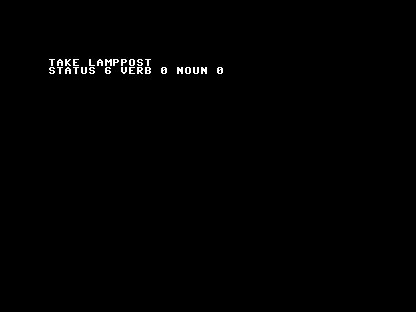
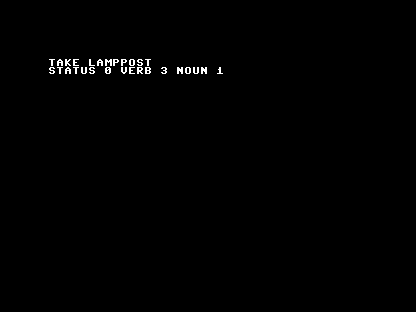
wrong-rule.bas substitutes a prefix comparison for the noun equality at line 5330. That accepts TAKE LAMPPOST as TAKE LAMP. The wrong native caller prints status 0, verb 3, noun 1; the working caller prints status 6 and leaves both IDs zero. Use the exact equality in parser.bas to repair it. The repaired full fixture is byte-identical to the working one.
Truncating every noun to four letters would have the same kind of problem. If you deliberately want abbreviations, represent accepted aliases in DATA or define an explicit ambiguity policy. Do not accidentally turn an unknown word into an action.
Customise the vocabulary without changing the parser
7000 DATA 2,1
7010 DATA "LOOK",1,0,"TURN",51,1
7020 DATA "COG",52
Storage and speed
The reusable parser/initializer occupies 1,794 tokenised BASIC bytes, including its REM lines. The default vocabulary contributes 434 token bytes. In the maintained typed caller, the full program is 2,403 bytes; the observed scalar table is 161 bytes and dictionary arrays are 318 bytes. Strings can point into the tokenised DATA rather than needing duplicate heap text.
The five arrays require 35 + 13*(NV+1) + 8*(NN+2) bytes in this implementation: five seven-byte headers, three-byte string descriptors and five-byte numeric values, including BASIC’s element zero and the noun placeholder. With 14 verb aliases and nine noun aliases that is 318 bytes; the custom 2/1 vocabulary needs 98. This is specific to these one-dimensional BASIC V2 arrays, not a universal string-storage formula.
After native parsing and explicit garbage collection, the large fixture’s string heap is small; the interactive caller’s observed allocated heap also contains temporary strings. Live text, garbage awaiting collection, INPUT’s own state and other game variables add costs. Do not treat one post-collection snapshot as a bound for a whole adventure.
The implementation validates and builds strings, then scans the vocabulary linearly. Longer commands and more aliases cost more interpreter work. The working 62-command fixture took 3,445 KERNAL jiffies; the custom five-command fixture took 244. These deliberately varied workloads include malformed input and long strings, so dividing by the count does not estimate every normal command. The retained guest TI delta measures the named workload, before the final illustrative command and garbage collection; it is a KERNAL-jiffy observation, not a hardware cycle count or a universal per-command latency. Use a larger dictionary only after measuring the pause a player will feel. A sorted/bucketed lookup, packed word table or assembly parser is a useful later trade-off; it adds code/structure and must preserve the same exact-match/error contracts.
Deliberate error: a prefix is accepted as a complete noun
5330 IF LEFT$(O$,LEN(E$(I)))=E$(I) THEN NI=Z(I)Native evidence and limits
The pinned PAL C64/stock-ROM configuration uses Build198x 0.2.9 and Emu198x 0.44.2. Qualification verifies the complete loaded PRG before RUN, 62 independent command cases, custom vocabulary, no-noun vocabulary, six malformed dictionaries, the revealing prefix fault and its exact repair. The maintained caller receives actual typed TAKE LAMP, LOOK and TAKE LAMPPOST commands. A direct caller also checks rejection before initialization.
Checks compare guest-written results with independent command rules, follow native BASIC line links for token costs, compare actual scalar/array allocations, and check native screen pixels against the few ROM glyphs displayed. Corruption controls reject altered code, results, dictionary status, memory counts and captures. Full firmware/font dumps remain private. These are emulator execution checks, not physical-hardware timing measurements or proof of every possible combination of dictionaries and world logic.
The Spectrum BASIC parser provides a larger example of separate world/action logic. The Spectrum assembly parser shows another implementation trade-off; its code is not directly usable on a 6510. Adventure in the Vault explores why a small vocabulary can open a much larger world. The Craft can build on this boundary between interpreting intent and applying game rules without making the parser own the whole game.
Pinned reusable source and complete native evidence. The Craft can build on the separation between interpreting a command and applying the rules of a game.