
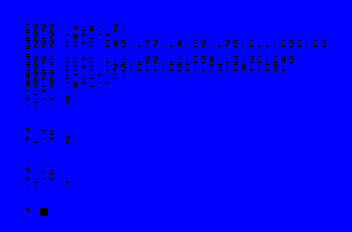
Enter the complete demo.bas in Mattel Aquarius BASIC and RUN. Submit GO, then Return. One accepted command advances the displayed turn; another gives two.
Take the reader
Copy read-command.bas into free line numbers, then call it with GOSUB 4000. It replaces A$; the caller checks that value before updating N. Keep N’s initialisation outside the repeated path. Renumber the GOSUB and routine together.
The reusable reader
4000 INPUT A$
4010 RETURN
GOSUB 4000 replaces A$ with the submitted line. The caller recognises GO. The 4000 range deliberately leaves the existing 3000-range sound DATA intact.
BASIC owns the keyboard buffer, line editor, return stack and variable storage. The global variable and line-number names belong to your program: reserve or rename them consistently. INPUT waits; no animation or deadline code in your main path can run during that wait.
Fit it into a program
The complete numbered program is caller.bas, draw.bas, sound.bas and read-command.bas together. The reader does not accept a move on its own; the IF in the caller does that.
Initialise once, read, validate, then update
1 N=0:W=0:J=0:B=0:X=0:A$=""
2 DIM Z(16)
3 W=PEEK(14552)+256*PEEK(14553)+7
4 FOR J=0 TO 21:READ B:POKE W+J,B:NEXT J
5 POKE 14340,W AND 255:POKE 14341,INT(W/256)
10 N=0
20 PRINT "TURN";N
21 GOSUB 1000
30 GOSUB 4000
40 IF A$="GO" THEN N=N+1:GOSUB 2000
50 GOTO 20
Change it and recognise a mistake
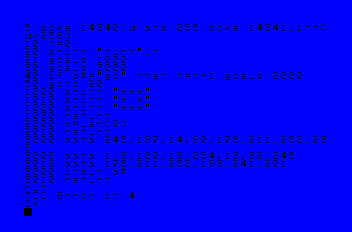
Reserve the complete numbered ranges. Reusing line 3000 for INPUT replaces a sound DATA line; the native fault run fails before the game starts. The repaired program uses 4000/4010.
This deliberately broken caller reuses an accepted command instead of reading another one. The world advances without you. Restore the GOSUB before the validation/update path; the working caller waits at zero until input arrives.
Deliberately broken input/update path
1 N=0:W=0:J=0:B=0:X=0:A$=""
2 DIM Z(16)
3 W=PEEK(14552)+256*PEEK(14553)+7
4 FOR J=0 TO 21:READ B:POKE W+J,B:NEXT J
5 POKE 14340,W AND 255:POKE 14341,INT(W/256)
10 N=0
20 PRINT "TURN";N
21 GOSUB 1000
30 A$="GO"
40 IF A$="GO" THEN N=N+1:GOSUB 2000
50 GOTO 20
1000 PRINT "XXX"
1010 PRINT "X X"
1020 PRINT "XXX"
1030 RETURN
2000 X=USR(0)
2010 RETURN
3000 DATA 245,197,14,80,175,211,252,238
3008 DATA 1,6,100,16,254,13,32,245
3016 DATA 175,211,252,193,241,201
4000 INPUT A$
4010 RETURN
The sound helper already uses DATA lines in the 3000 range. Defining INPUT at 3000 overwrote one of them and produced OD Error in 4 during READ. The repaired reader lives at 4000/4010. A new line number is an integration decision, not spare storage you can assume is free.
The complete caller
Working setup and integration
1 N=0:W=0:J=0:B=0:X=0:A$=""
2 DIM Z(16)
3 W=PEEK(14552)+256*PEEK(14553)+7
4 FOR J=0 TO 21:READ B:POKE W+J,B:NEXT J
5 POKE 14340,W AND 255:POKE 14341,INT(W/256)
10 N=0
20 PRINT "TURN";N
21 GOSUB 1000
30 GOSUB 4000
40 IF A$="GO" THEN N=N+1:GOSUB 2000
50 GOTO 20
1000 PRINT "XXX"
1010 PRINT "X X"
1020 PRINT "XXX"
1030 RETURN
2000 X=USR(0)
2010 RETURN
3000 DATA 245,197,14,80,175,211,252,238
3008 DATA 1,6,100,16,254,13,32,245
3016 DATA 175,211,252,193,241,201
4000 INPUT A$
4010 RETURN
For more responsive controls, compare polling, buffering and press edges in input choices.
Verification and sources
Target: stock Aquarius BASIC with an array-backed USR sound helper. These callers were executed with released Emu198x 0.44.1; assembly uses Asm198x 0.0.71. The sample folder contains reproduction instructions and retained observations. The independent checker binds source, native captures and actual output; its rejection tests exercise wrong state, missing files and false audio claims.
This qualifies the named emulator/firmware path. Pitch accuracy, original hardware and other peripherals require their own observations.
Mattel/Radofin, Aquarius BASIC documentation: INPUT, DATA/READ, DIM and USR; machine-code helper bytes and port behaviour are identified by this configuration’s executed source.