
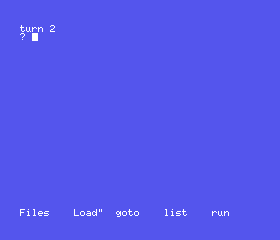
Type GO, then Return. The count moves from zero to one. Submit another GO for two; take your time and the world waits for you. Replace that little update with a room change or a board move, and you have the rhythm of an untimed game.
Put it in your project
Enter reusable.bas and RUN under the recorded MSX1 NTSC BIOS/BASIC. caller.bas followed by routines.bas is the same complete program. The caller selects SCREEN 0 and 40 columns; it owns the whole text redraw. Keep other UI outside that clear, or replace the presentation block with your own status area.
Reuse the rule
Initialise once; collect and handle submitted commands
5 SCREEN 0:WIDTH 40
10 N=0:S=1
20 CLS:PRINT "TURN";N
30 INPUT A$
35 IF A$="Q" THEN END
40 GOSUB 1000
50 GOTO 20
The reusable conditional byte-range update
1000 C=0
1010 IF A$<>"GO" THEN RETURN
1020 N=N+S
1030 IF N>255 THEN N=N-256
1040 C=1
1050 RETURN
Copy lines 1000–1050 into a free line range. Put the submitted string in A$, current whole-number byte value in N and whole-number byte step in S, then GOSUB 1000. C is replaced every call: 1 if accepted, 0 otherwise. GO adds S modulo 256; rejected commands preserve N. A$ and S are preserved. Keep N/S initialisation outside the repeated path.
| Value | Contract |
|---|---|
A$ |
Submitted string; preserved by the update. |
N |
Persistent whole-number count, 0–255; changed only for GO. |
S |
Whole-number step, 0–255; preserved. |
C |
Replaced on every call: 1 for GO, 0 for an ignored command. |
The rule performs no keyboard, screen, clock, sound or fixed-address write. BASIC owns variable storage, GOSUB’s return stack, keyboard scanning, display services and interrupts. Names and line numbers are global to your program: reserve or rename them consistently and update every call target. INPUT blocks until Return. The counter uses ordinary BASIC numeric storage; the byte range is the routine’s contract, not its storage format. Fractional, negative or larger values need another contract.
The maintained sample needs no fixed RAM reservation. For verification only, the runner inserts CLEAR 200,53247 and a VPEEK loop that copies actual SCREEN 0 name-table cells into $D000–$D3BF after PRINT and before INPUT. It copies video output, not N or a host-provided count. This diagnostic allocation is not a general BASIC allocator, and the reusable program does not require it. The older demo.bas retains its separate historical counter-mirror probe and record.
Customise and diagnose
customise.bas uses S=3: two actions give 0 → 3 → 6. One action still invokes the rule once. The byte contract needs a whole-number starting value and step from 0 through 255. Adding them gives at most 510, so one subtraction of 256 suffices in BASIC; the CPU’s byte addition wraps naturally in assembly. The nonzero check starts at 100 with step 255 and reaches 99 then 98.
Three progress units for one accepted action
5 SCREEN 0:WIDTH 40
10 N=0:S=3
20 CLS:PRINT "TURN";N
30 INPUT A$
35 IF A$="Q" THEN END
40 GOSUB 1000
50 GOTO 20
1000 C=0
1010 IF A$<>"GO" THEN RETURN
1020 N=N+S
1030 IF N>255 THEN N=N-256
1040 C=1
1050 RETURN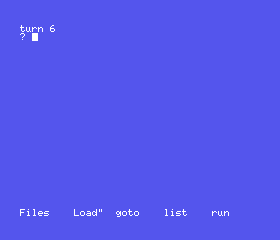
mistakes/reset-each-command.bas is deliberately broken: initialisation runs inside the repeated path, so the next iteration erases progress. Keep initialisation at startup and jump back to the command/update path to repair it. The repaired caller is checked in a separate cold start.
Deliberately broken: reset inside the repeated path
5 SCREEN 0:WIDTH 40
10 N=0:S=1
20 CLS:PRINT "TURN";N
30 INPUT A$
35 IF A$="Q" THEN END
40 GOSUB 1000
50 GOTO 10
1000 C=0
1010 IF A$<>"GO" THEN RETURN
1020 N=N+S
1030 IF N>255 THEN N=N-256
1040 C=1
1050 RETURN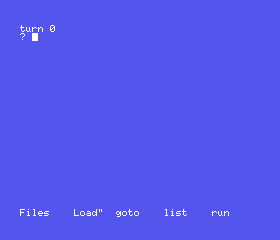
An untimed world waits for an accepted action. A timed turn needs its own clock, expiry policy and ordering when a command arrives at the deadline. Display refresh or firmware interrupt activity does not automatically advance game rules. Blocking input is useful when nothing else needs main-loop service; continuing animation, music or deadlines require a different input/service policy.
Related choices
Compare the MSX assembly caller when you want physical press edges and BIOS-facing code.
The loop choices explain untimed actions, timed turns and display servicing as separate decisions.
Verification
Native-emulator executed: Emu198x 0.44.1, on the named MSX1 firmware configuration. The source README gives the reproduction command; the retained record identifies the exact inputs and tools.
The six common cold starts check normal use, step three, reset fault/repair, wraparound and nonzero initialisation. Idle, first accepted action, waiting/holding, ignored input and a second accepted action are retained as native captures and actual observations. BASIC verification reads the actual VPEEK-derived text cells and finds one displayed TURN count; its held stage is an idle wait after a submitted line, not an assembly physical-key edge test.
scripts/check-msx-gameboy-loops.py independently decodes the records; falsification tests reject missing cases/stages, altered source/capture/payload/counts and false repairs. The additive three-route inventory does not expand the broad input/drawing/sound probe count or qualify new audio. No original-hardware, cassette-transfer, other model/firmware or whole-emulator claim follows.
The maintained source includes the complete caller, settings, customisation and deliberate fault. The retained record binds the executed source, observations, native images and released-tool identities.
Primary references
ASCII/Microsoft, MSX Technical Data Book: BASIC Reference Guide entries SCREEN, WIDTH, CLEAR, INPUT, VPEEK and GOSUB/RETURN; Advanced Programming Guide, BIOS interface policy. Use the actual firmware and language configuration named by the retained record.