
Type 256 into a byte-sized setting. Wrapping it around to zero would be a nasty surprise. This parser keeps the accepted prefix and tells the caller which character failed, so the interface can explain or correct the input.
Include and initialise
Reserve public V/C/S and private T. Reserve lines 3000–3170, combine routines.bas and your caller with build.py, and put END, STOP or a jump before the helper. C64/BBC use GOSUB; Spectrum uses GO SUB. Keep T private while the call runs.
Call 3000 at the start of a new number. It clears accepted value V, character C and status S. V starts at zero. This routine does not read the keyboard, draw a prompt or decide when input ends.
Feed a character
Supply ASCII character code C and call 3100. A digit 0..9 extends the accepted value only if the mathematical result stays in 0..255. Leading zeroes are accepted.
| Status S | Meaning |
|---|---|
| 1 | Digit accepted and V updated |
| 2 | Non-digit rejected; V preserved |
| 3 | Would overflow 255; V preserved |
| 4 | Invalid non-byte/non-integral V or C; V preserved |
C survives every call. Status 4 is the BASIC port’s explicit numeric-input guard; the assembly routine receives byte-valued bindings. A rejection does not cancel the number or consume an implicit terminator. The caller chooses whether to ignore it, show an error or restart.
The reusable routine
Reusable numbered routines
3000 LET V=0: LET C=0: LET S=0: RETURN
3100 LET S=4
3110 IF V<0 OR V>255 OR V<>INT (V) THEN RETURN
3120 IF C<0 OR C>255 OR C<>INT (C) THEN RETURN
3130 LET S=2
3140 IF C<48 OR C>57 THEN RETURN
3150 LET S=3: LET T=10*V+C-48
3160 IF T>255 THEN RETURN
3170 LET V=T: LET S=1: RETURN
The private candidate T is ten times V plus the digit. The helper checks T before assigning V. BASIC has enough numeric range for this intermediate value; it does not let an eight-bit result wrap and then try to detect the damage afterwards.
Keep a valid prefix
The normal caller feeds 2,5,6,5. It accepts 2 then 25, rejects the 6 because 256 would overflow, then accepts the final 5 to reach 255. That is intentional incremental behaviour: rejecting a character leaves the last accepted prefix available.
Example calls from the maintained caller
  70 GO SUB 3000: LET AA=0: LET BB=0
  80 LET SS=0
  90 LET C=50
 100 GO SUB 3100: GO SUB 2000: LET SS=SS+V
 110 LET C=53
 120 GO SUB 3100: GO SUB 2000: LET SS=SS+V
 130 LET C=54
 140 GO SUB 3100: GO SUB 2000: LET SS=SS+V
 150 LET C=53
 160 GO SUB 3100: GO SUB 2000: LET SS=SS+V
 170 IF V=255 THEN LET AA=1
 180 IF SS=307 THEN LET BB=1
 190 PRINT "READ RESULTS";AA;BB
 200 POKE MB+995,AA: POKE MB+996,BB: POKE MB+997,GD: POKE MB+998,WC-256*INT (WC/256): POKE MB+999,INT (WC/256): POKE MB+1000,239: STOP
The table also covers zero,255, invalid characters and values immediately either side of a valid final digit. Line 2000, AA/BB/SS/JJ (Z on Spectrum) and mailbox writes observe those results. A game needs only V/C/S, private T and its own input policy.
Customise the input policy
The custom caller reads 104 instead. Map machine-specific keyboard values to ASCII before calling. Backspace, signs, spaces, decimal points and an Enter key are not digits here. Your editor can retain a character buffer or a stack of accepted values if it needs to undo input.
BASIC’s VAL is useful for converting a complete string, but its syntax, trailing-input rules and errors differ by interpreter. This helper exposes one-character acceptance and a shared byte-sized limit. Wider numbers need a deliberate limit/intermediate-range change and corresponding tests; do not just remove the overflow check.
Mistake and repair
The wrong caller clears V before every character. The final digit replaces the number instead of extending it, and both saved checks fail. Initialise once per new entry; retain V through subsequent accepted and rejected characters. The repair matches the normal source and loaded program exactly.
Cost and Maths for Games
Each character uses fixed range checks and at most one multiply/add candidate. There are no arrays, strings or allocation in the helper. BASIC numeric storage and interpreter overhead still apply, and no cycle budget is inferred.
Maths for Games connects decimal place value, bounds and overflow. The Craft connects those errors to the feedback a player needs when changing a setting or entering a number.
Machine and measured size
Spectrum FOR variables must be single letters: this diagnostic uses Z instead of the other callers’ JJ. The helper uses scalar numeric fields and allocates no arrays. AND/OR in these listings join comparisons; neither is being used as a bitwise operator. The diagnostic reserves its mailbox above CLEAR 59999.
The numbered helper occupies 251 tokenised program bytes on this interpreter, including line headers. This excludes the caller, test tables, numeric scalar/array storage, interpreter stacks and ROM. Tokenised size is not machine-code size or a hardware-cycle count. No real-time or whole-game performance budget is inferred from the diagnostic. The caller’s AA/BB, Z and RAM mailbox are observation machinery, not required game state.
Execution evidence
Working, custom, deliberately wrong and exact repaired callers executed through Spectrum’s stock BASIC interpreter under Emu198x 0.44.2. Build198x 0.2.9 tokenises C64 PRG and Spectrum TAP programs. C64 enters stock RUN, Spectrum uses ROM tape loading, and BBC enters every numbered source line through MOS/BASIC. Actual loaded program bytes, complete state packets, positive completion/count/guards and visible result pixels are checked. After the positive completion marker, the observer advances two complete display frames before capturing, so a partially scanned final character cannot masquerade as a finished picture. Firmware is not distributed.
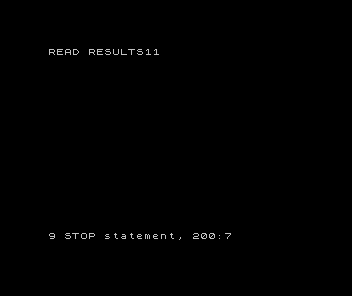
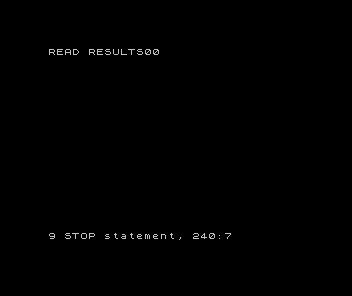
An independent mathematical/order model checks the trace and rejects altered source, configuration, loaded program, state, completion and image evidence. Host exhaustive checks complement the native boundary/sequential examples; those host ranges are not claimed as natively exhaustive. The supplied diagnostic callers deliberately end with STOP; the interpreter report is expected. The wrong caller prints 0,0 and the normal/custom/repaired callers print 1,1.
Public CI checks retained evidence; it does not execute restricted firmware. Refresh with python3 scripts/verify-basic-records.py decimal-parser sinclair-zx-spectrum --tools /path/to/extracted/releases and inspect with python3 scripts/check-basic-records.py decimal-parser.
Explore further
Compare the assembly technique. The BASIC game-flow routine makes session boundaries explicit. Complete source and native evidence.