
Press Up just before a junction and the turn should happen when the route opens. Throwing that request away because it was blocked for one update makes a maze feel needlessly fussy.
Include and initialise
DIM B(16). Reserve public C/D/P/M/O/R, private I/T/N/X/Y and lines 3000–3550. Private I must not be the caller’s outer FOR variable. Combine routines.bas with the caller using build.py and prevent fall-through with END, STOP or a jump. C64/BBC use GOSUB; Spectrum uses GO SUB.
Call 3000 at a reset boundary. It clears every public field and all sixteen map elements. Fill the map afterwards: zero is walkable, any nonzero byte blocks. C is a zero-based row-major cell in a four-by-four map; B(C+1) holds that cell. Direction codes are zero still, one left, two right, three up and four down.
Offer a turn at a cell-step boundary
Set R to a new direction, or zero for no new request, then call 3100. A nonzero R replaces pending turn P. The routine tries P first. If it can enter that neighbour it moves C, sets D to the successful turn, clears P and returns M=1. If blocked, it keeps P and tries current direction D instead. At most one cell is moved.
Reusable numbered routines
3000 LET C=0: LET D=0: LET P=0: LET M=0: LET O=0: LET R=0
3010 FOR I=1 TO 16: LET B(I)=0: NEXT I: RETURN
3100 LET M=0: LET O=0
3110 IF C<0 OR C>15 OR C<>INT (C) THEN RETURN
3120 IF D<0 OR D>4 OR D<>INT (D) THEN RETURN
3130 IF P<0 OR P>4 OR P<>INT (P) THEN RETURN
3140 IF R<0 OR R>4 OR R<>INT (R) THEN RETURN
3150 FOR I=1 TO 16
3160 IF B(I)<0 OR B(I)>255 OR B(I)<>INT (B(I)) THEN RETURN
3170 NEXT I
3180 IF B(C+1)<>0 THEN RETURN
3190 LET O=1
3200 IF R<>0 THEN LET P=R
3210 IF P=0 THEN GO TO 3250
3220 LET T=P: GO SUB 3500
3230 IF N<0 THEN GO TO 3250
3240 IF B(N+1)=0 THEN LET C=N: LET D=P: LET P=0: LET M=1: RETURN
3250 IF D=0 THEN RETURN
3260 LET T=D: GO SUB 3500
3270 IF N<0 THEN RETURN
3280 IF B(N+1)<>0 THEN RETURN
3290 LET C=N: LET M=1: RETURN
3500 LET N=-1: LET X=C-4*INT (C/4): LET Y=INT (C/4)
3510 IF T=1 AND X>0 THEN LET N=C-1: RETURN
3520 IF T=2 AND X<3 THEN LET N=C+1: RETURN
3530 IF T=3 AND Y>0 THEN LET N=C-4: RETURN
3540 IF T=4 AND Y<3 THEN LET N=C+4: RETURN
3550 RETURN| Fields | Use |
|---|---|
| C / D / P | Retained cell / current direction / pending turn |
| R | New request, or zero to retain the old request |
| M / O | Moved this call / valid state and map |
| B(1)..B(16) | Caller-owned read-only map during service |
The current cell must be walkable. Indices/directions are integral and bounded, and every map value is an integral byte. Invalid input or a blocked current cell clears M/O and preserves movement, inputs and the map. Valid service returns O=1 even when no route is available. R and the map survive.
Follow the buffered route
The normal map has cell four blocked, so a character starting at eight cannot turn up immediately. It moves right to nine, then up to five and one. The row-major cells are:
 0  1  2  3
 #  5  6  7
 8  9 10 11
12 13 14 15
The custom map also blocks five, keeping the turn pending for another step: nine, ten, six, two. Both later supply a new downward request. The native table also exercises edges, blocked cells, replacement requests and invalid directions.
Example calls from the maintained caller
  90 GO SUB 3000: LET AA=0: LET BB=0
 100 LET B(1)=0: LET B(2)=0: LET B(3)=0: LET B(4)=0: LET B(5)=1: LET B(6)=0: LET B(7)=0: LET B(8)=0: LET B(9)=0: LET B(10)=0: LET B(11)=0: LET B(12)=0: LET B(13)=0: LET B(14)=0: LET B(15)=0: LET B(16)=0
 110 LET C=8: LET D=2
 120 LET R=3: GO SUB 3100: GO SUB 2000
 130 LET R=0: GO SUB 3100: GO SUB 2000
 140 LET R=0: GO SUB 3100: GO SUB 2000
 150 IF C=1 THEN LET AA=1
 160 IF D=3 THEN LET BB=1
 170 LET R=4: GO SUB 3100: GO SUB 2000
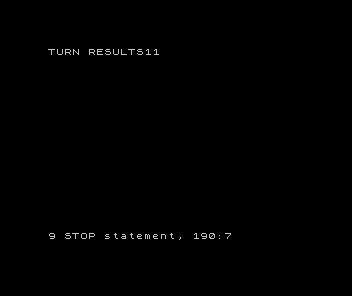
 180 PRINT "TURN RESULTS";AA;BB
 190 POKE MB+995,AA: POKE MB+996,BB: POKE MB+997,GD: POKE MB+998,WC-256*INT (WC/256): POKE MB+999,INT (WC/256): POKE MB+1000,239: STOP
Line 2000, AA/BB, JJ/KK (Z/Q on Spectrum) and the mailbox are diagnostics. A game calls at a logical cell-step boundary and animates between positions separately. This helper does not interpolate pixels, scan input or choose a movement clock. A zero R means no new request, not cancellation. Set P=0 deliberately at an intended cancellation boundary if that is the game’s rule.
Keep geometry and policy clear
Row and column checks happen before adding a neighbour offset. Moving right from column three must not wrap to the next row. The neighbour routine returns a checked result before any array lookup; the code does not rely on a compound AND expression to avoid an invalid subscript.
Larger maps need declared dimensions, a suitable index range, allocation, stride and edge checks changed together. Merely enlarging DIM does not change this four-by-four contract. A timed turn buffer needs an expiry policy; this one remembers until success, replacement or deliberate cancellation. Separate actors need separate movement/history fields while a read-only map can be shared under a clear owner.
Mistake and repair
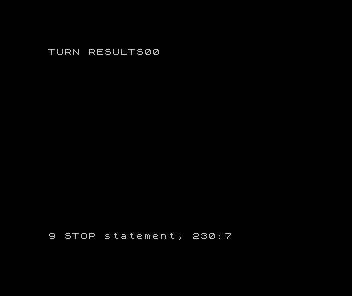
The wrong caller clears P between cells. After the first blocked Up request, it keeps moving right instead of turning when the next junction opens. Both saved final-cell and direction checks fail in normal and custom traces. Retain the pending request until its intended lifetime ends. Repaired source and loaded program match normal exactly.
Cost and Maths for Games
Full data validation visits sixteen map values. Movement then checks at most two neighbouring candidates, independent of how long a turn has been waiting. There is no search over a route, allocation or rendering. A trusted-map variant can reduce repeated validation, but needs a different loading/mutation contract and matching proof.
Maths for Games connects coordinates, row-major indices and graph neighbours. The Craft connects buffered intentions and legal movement to a maze that feels forgiving without ignoring its walls.
Global names and line numbers
BASIC numeric names, arrays and numbered lines are global. To combine helpers, rename public and private fields and renumber the helper together with every GO SUB/GO TO reference. Keep each state block under one owner. The maintained build.py rejects duplicate line numbers; it does not automatically namespace or renumber routines.
Machine and measured size
Spectrum FOR variables must be single letters: this diagnostic uses Z/Q instead of the other callers’ JJ/KK. Numeric arrays start at one. AND/OR in these listings join comparisons; neither is being used as a bitwise operator. The diagnostic reserves its mailbox above CLEAR 59999.
The numbered helper occupies 882 tokenised program bytes on this interpreter, including line headers. This excludes the caller, test tables, numeric scalar/array storage, interpreter stacks and ROM. Tokenised size is not machine-code size or a hardware-cycle count. No real-time or whole-game performance budget is inferred from the diagnostic. The caller’s AA/BB, Z/Q and RAM mailbox are observation machinery, not required game state.
Execution evidence
Working, custom, deliberately wrong and exact repaired callers executed through Spectrum’s stock BASIC interpreter under Emu198x 0.44.2. Build198x 0.2.9 tokenises C64 PRG and Spectrum TAP programs. C64 enters stock RUN, Spectrum uses ROM tape loading, and BBC enters every numbered source line through MOS/BASIC. Actual loaded program bytes, complete state packets, positive completion/count/guards and visible result pixels are checked. After the positive completion marker, the observer advances two complete display frames before capturing, so a partially scanned final character cannot masquerade as a finished picture. Firmware is not distributed.
An independent mathematical/order model checks the trace and rejects altered source, configuration, loaded program, state, completion and image evidence. Host exhaustive checks complement the native boundary/sequential examples; those host ranges are not claimed as natively exhaustive. The supplied diagnostic callers deliberately end with STOP; the interpreter report is expected. The wrong caller prints 0,0 and the normal/custom/repaired callers print 1,1.
Public CI checks retained evidence; it does not execute restricted firmware. Refresh with python3 scripts/verify-basic-decisions.py grid-turn-buffer sinclair-zx-spectrum --tools /path/to/extracted/releases and inspect with python3 scripts/check-basic-decisions.py grid-turn-buffer.
Explore further
Compare the assembly technique. The BASIC game-flow routine makes session boundaries explicit. Complete source and native evidence.