
A particle update can leave holes where objects have expired. Packing the survivors into a live prefix lets later work visit them directly. This helper keeps survivors in their original order and moves each flag with its payload value.
Include and initialise
Reserve F(8)/P(8), C/R/O/E and private I/N/W. Reserve lines 3000–3280, combine numbered source using build.py and put END, STOP or a jump before the helper. Use GOSUB on C64/BBC or GO SUB on Spectrum. The private globals must not be borrowed by an enclosing caller FOR loop.
Call 3000 to clear every field and array element. Set C to the number of owned entries, from zero to eight, then fill F/P. A zero flag is dead; any nonzero flag is live and its exact value is retained. P holds a byte-valued payload such as an object ID; zero is a valid payload. The flag, not the payload value, decides liveness.
Compact the owned prefix
Call 3100. It keeps live F/P pairs from entries 1..old C in order, moves them to the front and returns the new C. R counts removed entries, O=1 and E=0. The vacated part of the original prefix is cleared to zero in both arrays. Entries beyond the original C are untouched.
C=0 is a valid empty operation and leaves the arrays unchanged. E=1 rejects a non-integral/out-of-range count or an invalid active byte value before any array/count mutation, with R=0,O=0. Only the owned prefix is validated. Capacity is not a promise that all eight entries currently belong to this live collection.
The reusable routine
Reusable numbered routines
3000 LET C=0: LET R=0: LET O=0: LET E=0
3010 FOR I=1 TO 8: LET F(I)=0: LET P(I)=0: NEXT I: RETURN
3100 LET R=0: LET O=0: LET E=1
3110 IF C<0 OR C>8 OR C<>INT (C) THEN RETURN
3120 IF C=0 THEN LET O=1: LET E=0: RETURN
3130 FOR I=1 TO C
3140 IF F(I)<0 OR F(I)>255 OR F(I)<>INT (F(I)) THEN RETURN
3150 IF P(I)<0 OR P(I)>255 OR P(I)<>INT (P(I)) THEN RETURN
3160 NEXT I: LET O=1: LET E=0: LET N=C: LET W=0
3200 FOR I=1 TO N
3210 IF F(I)=0 THEN GO TO 3260
3220 LET W=W+1: LET F(W)=F(I): LET P(W)=P(I)
3260 NEXT I: LET R=N-W: LET C=W
3270 IF W=N THEN RETURN
3280 FOR I=W+1 TO N: LET F(I)=0: LET P(I)=0: NEXT I: RETURN
The read cursor visits each old entry. The write cursor advances only for a survivor and never overtakes the read cursor, so a move cannot destroy a future unread pair. A second pass clears only the vacated old prefix. The routine explicitly guards empty ranges rather than relying on every BASIC dialect treating a zero-trip FOR the same way.
Preserve the unused tail
The working caller owns four entries and leaves a flagged sentinel beyond that prefix. It compacts, kills one survivor, compacts again and submits an invalid count before recovering. The custom caller uses a different three-entry prefix. The complete earlier table also covers empty, all-dead, all-live, mixed flags and invalid counts.
Example calls from the maintained caller
 100 GO SUB 3000
 110 LET F(1)=1: LET F(2)=0: LET F(3)=2: LET F(4)=0: LET F(5)=1: LET F(6)=0: LET F(7)=0: LET F(8)=0
 120 LET P(1)=10: LET P(2)=11: LET P(3)=12: LET P(4)=13: LET P(5)=99: LET P(6)=0: LET P(7)=0: LET P(8)=0
 130 LET C=4: GO SUB 3100: GO SUB 2000: LET AA=0: LET BB=0
 140 IF C=2 THEN LET AA=1
 150 IF P(5)=99 THEN LET BB=1
 160 LET F(1)=0: GO SUB 3100: GO SUB 2000: LET NN=C
 170 LET C=9: GO SUB 3100: GO SUB 2000
 180 LET C=NN: GO SUB 3100: GO SUB 2000
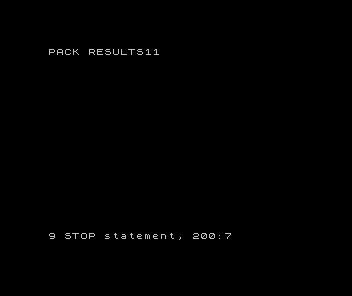
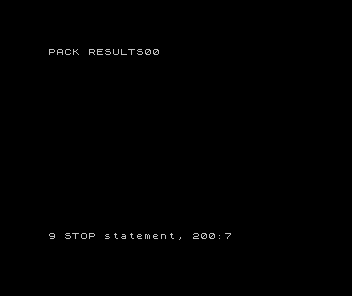
 190 PRINT "PACK RESULTS";AA;BB
 200 POKE MB+995,AA: POKE MB+996,BB: POKE MB+997,GD: POKE MB+998,WC-256*INT (WC/256): POKE MB+999,INT (WC/256): POKE MB+1000,239: STOP
Line 2000, the mailbox, AA/BB/NN and JJ/KK (Z/Q on Spectrum) serve the diagnostic. A game calls 3100 with its current owned count and then traverses the returned prefix.
Customise payloads carefully
The custom caller changes the active prefix and arrangement without changing the implementation or allocated arrays. If an object has position, velocity, image and lifetime arrays, every field must follow the same move. Extending only F/P while leaving another payload in its old slot attaches data to the wrong survivor. Qualify the complete extended record, not just the new count.
Nonzero means live here; a more elaborate bitfield may need a chosen live-bit test instead. Identifiers are payload values, not a uniqueness guarantee. The helper does not allocate IDs, destroy resources, update external references or draw objects.
Moving records also moves their slot indices. A reference to old slot three may no longer mean the same object after compaction. Stable slots with live flags, generation-checked handles or a separate ID-to-storage mapping are alternatives with different costs. Choose the identity rule before combining storage techniques. Independent collections also need separate globals, arrays, scratch and numbered references.
Mistake and repair
The wrong caller supplies capacity eight instead of its actual prefix length. A flagged entry in unused capacity is pulled into the survivor set, and the later cleanup clears its old sentinel. Both saved checks print zero: the live count is wrong and data outside the intended owned prefix was changed.
The repair passes the actual owned C. Repaired source and loaded tokenised program match the working caller exactly.
Cost and Maths for Games
Validation scans the active prefix, filtering scans it again and cleanup visits only vacated entries. Work grows linearly with the old count, with no second object buffer. F/P are interpreter numeric arrays rather than sixteen packed bytes. Copying a larger payload adds work to each move.
Stable filtering preserves draw/update order, which can matter when objects interact. Swap-removal can avoid shifting a suffix when removing one object, but changes order; sparse stable slots avoid moves but require live tests during traversal. Maths for Games connects filtering, order preservation and count conservation. The Craft helps decide which ordering changes players would notice.
Machine and measured size
Spectrum FOR variables must be single letters: this diagnostic uses Z/Q instead of the other callers’ JJ/KK. Numeric arrays start at one. AND/OR in these listings join comparisons; neither is being used as a bitwise operator. The diagnostic reserves its mailbox above CLEAR 59999.
The numbered helper occupies 540 tokenised program bytes on this interpreter, including line headers. This excludes the caller, test tables, numeric scalar/array storage, interpreter stacks and ROM. Tokenised size is not machine-code size or a hardware-cycle count. No real-time or whole-game performance budget is inferred from the diagnostic. The caller’s AA/BB, Z/Q and RAM mailbox are observation machinery, not required game state.
Execution evidence
Working, custom, deliberately wrong and exact repaired callers executed through Spectrum’s stock BASIC interpreter under Emu198x 0.44.2. Build198x 0.2.9 tokenises C64 PRG and Spectrum TAP programs. C64 enters stock RUN, Spectrum uses ROM tape loading, and BBC enters every numbered source line through MOS/BASIC. Actual loaded program bytes, complete state packets, positive completion/count/guards and visible result pixels are checked. After the positive completion marker, the observer advances two complete display frames before capturing, so a partially scanned final character cannot masquerade as a finished picture. Firmware is not distributed.
An independent mathematical/order model checks the trace and rejects altered source, configuration, loaded program, state, completion and image evidence. Host exhaustive checks complement the native boundary/sequential examples; those host ranges are not claimed as natively exhaustive. The supplied diagnostic callers deliberately end with STOP; the interpreter report is expected. The wrong caller prints 0,0 and the normal/custom/repaired callers print 1,1.
Public CI checks retained evidence; it does not execute restricted firmware. Refresh with python3 scripts/verify-basic-entities.py stable-compaction sinclair-zx-spectrum --tools /path/to/extracted/releases and inspect with python3 scripts/check-basic-entities.py stable-compaction.
Explore further
Compare the assembly technique. The BASIC game-flow routine makes session boundaries explicit. Complete source and native evidence.