
Press Jump just before landing and it feels poor when the press disappears. Leave a ledge a fraction before pressing and a little forgiveness may still feel fair. These two windows let a game make those choices without turning its input reader into a movement system.
Include and initialise
Reserve public J/C/B/G/P/W/X/O. There are no arrays or private scratch fields. Reserve lines 3000–3230, combine routines.bas and a caller with build.py and keep END, STOP or a jump before the helper. C64/BBC use GOSUB; Spectrum uses GO SUB.
Call 3000 at a session/reset boundary. It clears every public field, including configuration. Set coyote reload W and buffer reload X afterwards, each from one through 255 service calls. The normal caller uses four for both, the custom caller two.
Supply ground state and a new press
G is grounded state; P must mean a new press, not the held button level. Use 0/1 for flags. Any nonzero byte is treated as true; if a dialect’s comparison returns −1, ABS can normalise that numeric result to 1. Normalising a held level does not turn it into a new-press edge.
Call 3100 once per simulation update. It first decrements positive C/B, then reloads C from W while grounded and B from X on a new press. If both are now positive, J=1 grants one jump and consumes both timers. Otherwise J=0. O=1 reports valid input; G/P/W/X survive.
| Field | Use |
|---|---|
| C / B | Retained coyote / buffered-press counters |
| G / P | Grounded state / new-press byte |
| W / X | Positive reload values |
| J / O | Fresh jump pulse / valid-input flag |
C/B and inputs must be integral bytes, with positive W/X. Invalid input clears J/O and preserves both timers and request/configuration fields. A timer of one expires at the start of this call unless the corresponding current input reloads it. A one-call window therefore does not promise an extra future update of forgiveness.
The reusable routine
Reusable numbered routines
3000 LET J=0: LET C=0: LET B=0: LET G=0: LET P=0: LET W=0: LET X=0: LET O=0: RETURN
3100 LET J=0: LET O=0
3110 IF C<0 OR C>255 OR C<>INT (C) THEN RETURN
3120 IF B<0 OR B>255 OR B<>INT (B) THEN RETURN
3130 IF G<0 OR G>255 OR G<>INT (G) THEN RETURN
3140 IF P<0 OR P>255 OR P<>INT (P) THEN RETURN
3150 IF W<1 OR W>255 OR W<>INT (W) THEN RETURN
3160 IF X<1 OR X>255 OR X<>INT (X) THEN RETURN
3170 IF C>0 THEN LET C=C-1
3180 IF B>0 THEN LET B=B-1
3190 IF G<>0 THEN LET C=W
3200 IF P<>0 THEN LET B=X
3210 LET O=1
3220 IF C>0 AND B>0 THEN LET J=1: LET C=0: LET B=0
3230 RETURN
The service order is part of the technique. It gives same-update ground/press an immediate grant, preserves a short earlier press for a later landing, and stops one grant being reused through an unconsumed timer. The helper grants permission; it does not set vertical velocity or decide whether collision really found ground.
Observe pulses, not just the final row
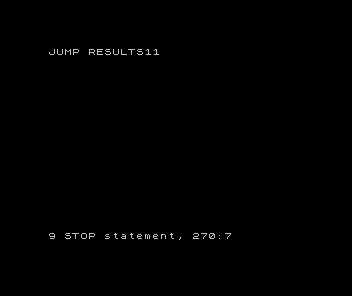
The maintained caller runs three short traces: one press while continually grounded, a press three calls before landing, and a press after leaving a ledge. Four-call windows preserve the two forgiving opportunities; two-call windows have expired in those traces. Both configurations accept the fresh grounded press once.
Example calls from the maintained caller
  70 GO SUB 3000: LET AA=0: LET BB=0
  80 GO SUB 3000: LET W=4: LET X=4: LET NN=0
  90 LET G=1: LET P=1: GO SUB 3100: GO SUB 2000: LET NN=NN+J
 100 LET G=1: LET P=0: GO SUB 3100: GO SUB 2000: LET NN=NN+J
 110 LET G=1: LET P=0: GO SUB 3100: GO SUB 2000: LET NN=NN+J
 120 LET G=1: LET P=0: GO SUB 3100: GO SUB 2000: LET NN=NN+J
 130 IF NN=1 THEN LET AA=1
 140 GO SUB 3000: LET W=4: LET X=4: LET SS=0
 150 LET G=0: LET P=1: GO SUB 3100: GO SUB 2000: LET SS=SS+J
 160 LET G=0: LET P=0: GO SUB 3100: GO SUB 2000: LET SS=SS+J
 170 LET G=0: LET P=0: GO SUB 3100: GO SUB 2000: LET SS=SS+J
 180 LET G=1: LET P=0: GO SUB 3100: GO SUB 2000: LET SS=SS+J
 190 LET G=1: LET P=0: GO SUB 3100: GO SUB 2000: LET SS=SS+J
 200 GO SUB 3000: LET W=4: LET X=4
 210 LET G=1: LET P=0: GO SUB 3100: GO SUB 2000: LET SS=SS+J
 220 LET G=0: LET P=0: GO SUB 3100: GO SUB 2000: LET SS=SS+J
 230 LET G=0: LET P=1: GO SUB 3100: GO SUB 2000: LET SS=SS+J
 240 LET G=0: LET P=0: GO SUB 3100: GO SUB 2000: LET SS=SS+J
 250 IF SS=2 THEN LET BB=1
 260 PRINT "JUMP RESULTS";AA;BB
 270 POKE MB+995,AA: POKE MB+996,BB: POKE MB+997,GD: POKE MB+998,WC-256*INT (WC/256): POKE MB+999,INT (WC/256): POKE MB+1000,239: STOP
Line 2000, AA/BB/NN/SS/JJ (Z on Spectrum) and the mailbox are diagnostics. Their counts record earlier pulses that a final J=0 would not reveal. The first trace deliberately keeps G true to isolate the new-press contract. A real game applies the jump and updates movement/grounded state when J grants it.
Customise forgiveness
Choose W/X in simulation calls, not seconds. Physical duration depends on the caller’s update rate. Changing reload values does not retroactively resize an already retained timer; reset or adjust that state deliberately if the design needs it.
A double jump, variable held-jump height, release-cut velocity and wall jumps need extra state or distinct policies. Keep those choices separate from a forgiving first jump. The input reader still supplies edges; the collision/movement code still supplies G and applies the result.
Mistake and repair
The wrong caller supplies P=1 on every call as though a held button were a new press. Permission is repeatedly granted on grounded updates and the saved pulse counts fail. Retain timers and feed a genuine press edge; also update the caller’s movement state when accepting a grant. The repair matches normal source and loaded program exactly.
Cost and Maths for Games
Each call performs fixed validation, two bounded decrements, possible reloads and one grant decision. There is no clock read, input polling or allocation. BASIC numeric variables are not eight packed native bytes, and no frame-time budget is claimed.
Maths for Games connects discrete time, expiry boundaries and counted events. The Craft connects input forgiveness to responsive play without hiding which component owns the jump.
Global names and line numbers
BASIC numeric names, arrays and numbered lines are global. To combine helpers, rename public and private fields and renumber the helper together with every GO SUB/GO TO reference. Keep each state block under one owner. The maintained build.py rejects duplicate line numbers; it does not automatically namespace or renumber routines.
Machine and measured size
Spectrum FOR variables must be single letters: this diagnostic uses Z instead of the other callers’ JJ. The helper uses scalar numeric fields and allocates no arrays. AND/OR in these listings join comparisons; neither is being used as a bitwise operator. The diagnostic reserves its mailbox above CLEAR 59999.
The numbered helper occupies 511 tokenised program bytes on this interpreter, including line headers. This excludes the caller, test tables, numeric scalar/array storage, interpreter stacks and ROM. Tokenised size is not machine-code size or a hardware-cycle count. No real-time or whole-game performance budget is inferred from the diagnostic. The caller’s AA/BB/NN/SS, Z and RAM mailbox are observation machinery, not required game state.
Execution evidence
Working, custom, deliberately wrong and exact repaired callers executed through Spectrum’s stock BASIC interpreter under Emu198x 0.44.2. Build198x 0.2.9 tokenises C64 PRG and Spectrum TAP programs. C64 enters stock RUN, Spectrum uses ROM tape loading, and BBC enters every numbered source line through MOS/BASIC. Actual loaded program bytes, complete state packets, positive completion/count/guards and visible result pixels are checked. After the positive completion marker, the observer advances two complete display frames before capturing, so a partially scanned final character cannot masquerade as a finished picture. Firmware is not distributed.
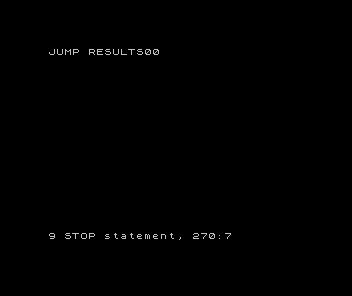
An independent mathematical/order model checks the trace and rejects altered source, configuration, loaded program, state, completion and image evidence. Host exhaustive checks complement the native boundary/sequential examples; those host ranges are not claimed as natively exhaustive. The supplied diagnostic callers deliberately end with STOP; the interpreter report is expected. The wrong caller prints 0,0 and the normal/custom/repaired callers print 1,1.
Public CI checks retained evidence; it does not execute restricted firmware. Refresh with python3 scripts/verify-basic-platforms.py jump-windows sinclair-zx-spectrum --tools /path/to/extracted/releases and inspect with python3 scripts/check-basic-platforms.py jump-windows.
Explore further
Compare the assembly technique. The BASIC game-flow routine makes session boundaries explicit. Complete source and native evidence.