
Enter the complete demo.bas in Spectravideo SVI-328 BASIC and RUN. Submit GO, then Return. One accepted command advances the displayed turn; another gives two.
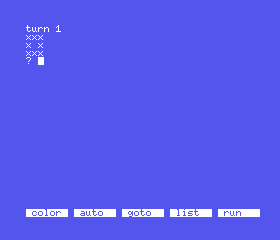
Take the reader
Copy read-command.bas into free line numbers, then call it with GOSUB 3000. It replaces A$; the caller checks that value before updating N. Keep N’s initialisation outside the repeated path. Renumber the GOSUB and routine together.
The reusable reader
3000 INPUT A$
3010 RETURN
INPUT A$ returns a line. The caller accepts GO and stores its byte count above BASIC’s lowered allocation ceiling. The mirror is diagnostic state, not an input API.
BASIC owns the keyboard buffer, line editor, return stack and variable storage. The global variable and line-number names belong to your program: reserve or rename them consistently. INPUT waits; no animation or deadline code in your main path can run during that wait.
Fit it into a program
The complete numbered program is caller.bas, draw.bas, sound.bas and read-command.bas together. The reader does not accept a move on its own; the IF in the caller does that.
Initialise once, read, validate, then update
10 CLEAR 200,39999
20 N=0:POKE 40000,0
30 CLS:PRINT "TURN";N
31 GOSUB 1000
40 GOSUB 3000
50 IF A$="GO" THEN N=(N+1) AND 255:GOSUB 2000
60 POKE 40000,N
70 GOTO 30
Change it and recognise a mistake
Connect the returned string to a larger command dispatcher. Keep CLEAR’s reserved address and any machine-code or asset allocations consistent.
This deliberately broken caller reuses an accepted command instead of reading another one. The world advances without you. Restore the GOSUB before the validation/update path; the working caller waits at zero until input arrives.
Deliberately broken input/update path
10 CLEAR 200,39999
20 N=0:POKE 40000,0
30 CLS:PRINT "TURN";N
31 GOSUB 1000
40 A$="GO"
50 IF A$="GO" THEN N=(N+1) AND 255:GOSUB 2000
60 POKE 40000,N
70 GOTO 30
1000 PRINT "XXX"
1010 PRINT "X X"
1020 PRINT "XXX"
1030 RETURN
2000 SOUND 0,100:SOUND 1,0:SOUND 7,62:SOUND 8,15
2010 FOR J=1 TO 200:NEXT J
2020 SOUND 8,0
2030 RETURN
3000 INPUT A$
3010 RETURN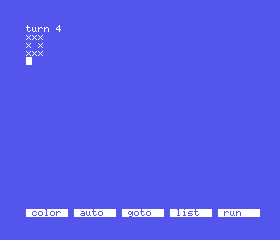
The complete caller
Working setup and integration
10 CLEAR 200,39999
20 N=0:POKE 40000,0
30 CLS:PRINT "TURN";N
31 GOSUB 1000
40 GOSUB 3000
50 IF A$="GO" THEN N=(N+1) AND 255:GOSUB 2000
60 POKE 40000,N
70 GOTO 30
1000 PRINT "XXX"
1010 PRINT "X X"
1020 PRINT "XXX"
1030 RETURN
2000 SOUND 0,100:SOUND 1,0:SOUND 7,62:SOUND 8,15
2010 FOR J=1 TO 200:NEXT J
2020 SOUND 8,0
2030 RETURN
3000 INPUT A$
3010 RETURN
For more responsive controls, compare polling, buffering and press edges in input choices.
Verification and sources
Target: SVI-328 NTSC, stock BASIC. These callers were executed with released Emu198x 0.44.1; assembly uses Asm198x 0.0.71. The sample folder contains reproduction instructions and retained observations. The independent checker binds source, native captures and actual output; its rejection tests exercise wrong state, missing files and false audio claims.
This qualifies the named emulator/firmware path. Pitch accuracy, original hardware and other peripherals require their own observations.
Spectravideo, SVI BASIC documentation: CLEAR, INPUT, SOUND, GOSUB/RETURN and PSG sound control.