Light and Shadow
The keep is a finished game — but lit like a warehouse, every cell the same cold blue. Hang a torch and let the dithering you met in Unit 2 become lighting: pick each floor cell's shade by its distance from the flame, so a pool of light fades into the dark.
The keep is a game now. You want the gold, the Wardens threaten it, and every run ends in THE KEEP STANDS or THE KEEP SLEEPS. Everything that makes it play is in place. What is missing is everything that makes it a place — because it is lit like an office, every cell the same even blue, no dark corners, no sense of nightfall. From here on we stop adding mechanics and start adding atmosphere, and atmosphere starts with light. This unit hangs a torch in each room and lets it throw a pool of light into the gloom the Wardens patrol.
You have made light before — but not this way, and the difference is the lesson. In The Long Night, every lamp you lit warmed a pool around it: you made light by recolouring attributes, cobble turning to glow. That is one of the two ways this machine makes light, and you own it cold. Here is the other, and it could hardly be more different: not colour, but density. Back in Unit 2 you learned that dither density is shade — sparse pixels read light, dense read dark. Lighting is choosing that density by distance from a flame: close to the torch, sparse and bright; far, dense and near-black. The keep has no glow attributes to spare — its walls are already cold stone, its cells already spent on shape — so it lights the only way left to it: in the bitmap. Two independent routes to the same feeling, and a real Spectrum artist keeps both on the bench.
What you’ll see by the end
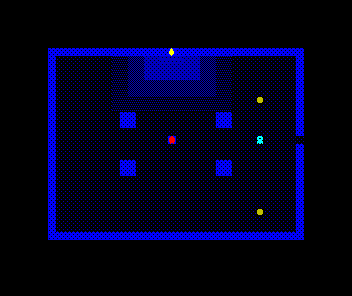
A torch burns in the top wall, and the floor beneath it is lit — nearly all blue, the stone catching the flame. Step away and the dither thickens: half-and-half slate, then darker, then the far corners almost black. The thief, the Warden, the coins all move through the gradient; nothing about the game changed, but the keep became a place with a dark in it. Same rooms as last unit; an entirely different place to be in.
A torch is a glyph
A torch is just another tile in the palette — T, a yellow flame in its sconce — placed in the room map like any wall, and clear of the coins and the Wardens’ routes:
defb "###############T################" ; the Hall's top wallIt’s drawn bright, so wall_at already treats it as solid stone — a fixture on the wall, not something you walk through. When a room is drawn, we first find its torch:
find_torch:
            ; ... scan the room map for 'T', record (torch_col, torch_row) ...
            ; ... or NO_TORCH if the room has none ...
Distance becomes shade
For each floor cell, how lit it is depends on how far it sits from that flame. We measure the distance — the larger of the row gap and the column gap, which gives a neat square-ish pool — halve it, and clamp it to give a shade from 0 (right by the flame) to 4 (deep dark):
shade_for_cell:                     ; row in B, column in C -> shade 0..4 in A
            ; ... |row - torch_row| and |col - torch_col| ...
            ; ... A = the larger of the two (the distance) ...
            srl     a               ; distance / 2 — a gentle falloff
            cp      MAX_SHADE + 1
            jr      c, .sf_done
            ld      a, MAX_SHADE     ; clamp to the darkest
.sf_done:
            ret
And the five shades are five floor tiles, the same blue and black at thickening densities — shade0 nearly all blue, shade2 the half-and-half slate from Unit 2, shade4 nearly all black.
Lighting as the room draws
draw_room now does the choosing as it paints. A floor cell is shaded by distance; a wall, torch, coin or Warden is drawn as before. And the same choice powers one more thing: when a coin is lifted, the cell it leaves is repainted with its lit shade, not flat floor — so the treasure vanishes into the lighting it sat in, seamlessly:
.room_col:
            ld      a, (hl)          ; the glyph here
            cp      '.'
            jr      nz, .not_floor
            call    shade_for_cell   ; floor: pick a shade by distance
            ; ... point tile_ptr at shade_tiles[shade] ...
            call    draw_tile
The light is baked — worked out once, when the room is drawn. The torch doesn’t move, so the pool doesn’t either. And it costs nothing as the thief walks: his save-and-restore already preserves whatever’s beneath him, lit shade and all — and so does the Warden’s. Both figures move through the gradient and leave it untouched.
Milestone — light the keep
find_torch scans each room’s map for a T; shade_for_cell turns a floor cell’s
distance from that flame into a shade 0–4; and draw_room now picks a floor tile
from a five-step density ramp as it paints, walls and torches flat. The collect
repaint is lit too, so lifted coins vanish into the gradient. The light is baked
once — and the thief’s and Warden’s save/restore carry each shade for free.
| 1 | 1 | ; Shadowkeep — Unit 13: Light and Shadow | |
| 2 | 2 | ; Cumulative build; every step runs on its own. Narrative: the unit page. | |
| 3 | - | ; step-00 = Unit 12's end: the game entire, but flatly lit — no atmosphere yet. | |
| 3 | + | ; step-01 hangs a torch in each room and shades the floor by distance from the flame. | |
| 4 | 4 | | |
| 5 | 5 | org 32768 | |
| 6 | 6 | | |
| 7 | 7 | WALL_ATTR equ %01001000 | |
| 8 | 8 | FLOOR_ATTR equ %00001000 | |
| 9 | 9 | MARK_ATTR equ %00001111 | |
| 10 | + | TORCH_ATTR equ %01001110 ; BRIGHT, blue paper, yellow ink — a lit sconce | |
| 11 | + | NO_TORCH equ $FF | |
| 12 | + | MAX_SHADE equ 4 | |
| 10 | 13 | THIEF equ %01001010 | |
| 11 | 14 | GOLD_ATTR equ %00000110 ; yellow ink, no BRIGHT -> walkable gold | |
| 12 | 15 | TOTAL_GOLD equ 6 | |
| ... | |||
| 141 | 144 | add hl, hl | |
| 142 | 145 | ld de, rooms | |
| 143 | 146 | add hl, de | |
| 147 | + | ret | |
| 148 | + | | |
| 149 | + | | |
| 150 | + | ; ---------------------------------------------------------------------------- | |
| 151 | + | ; find_torch — scan the current room's map for 'T', remember where it is (or | |
| 152 | + | ; NO_TORCH if the room is unlit). | |
| 153 | + | ; ---------------------------------------------------------------------------- | |
| 154 | + | find_torch: | |
| 155 | + | ld a, NO_TORCH | |
| 156 | + | ld (torch_col), a | |
| 157 | + | ld (torch_row), a | |
| 158 | + | call room_entry_addr | |
| 159 | + | ld a, (hl) | |
| 160 | + | inc hl | |
| 161 | + | ld h, (hl) | |
| 162 | + | ld l, a | |
| 163 | + | ld b, 0 | |
| 164 | + | .ft_row: | |
| 165 | + | ld c, 0 | |
| 166 | + | .ft_col: | |
| 167 | + | ld a, (hl) | |
| 168 | + | cp 'T' | |
| 169 | + | jr nz, .ft_skip | |
| 170 | + | ld a, c | |
| 171 | + | ld (torch_col), a | |
| 172 | + | ld a, b | |
| 173 | + | ld (torch_row), a | |
| 174 | + | .ft_skip: | |
| 175 | + | inc hl | |
| 176 | + | inc c | |
| 177 | + | ld a, c | |
| 178 | + | cp 32 | |
| 179 | + | jr nz, .ft_col | |
| 180 | + | inc b | |
| 181 | + | ld a, b | |
| 182 | + | cp 24 | |
| 183 | + | jr nz, .ft_row | |
| 184 | + | ret | |
| 185 | + | | |
| 186 | + | ; ---------------------------------------------------------------------------- | |
| 187 | + | ; shade_for_cell — row in B, column in C. Returns a shade 0..4 in A: the | |
| 188 | + | ; Chebyshev distance to the torch, halved and clamped. Near the flame = 0 | |
| 189 | + | ; (lightest); far away = 4 (darkest). No torch = darkest everywhere. | |
| 190 | + | ; ---------------------------------------------------------------------------- | |
| 191 | + | shade_for_cell: | |
| 192 | + | ld a, (torch_col) | |
| 193 | + | cp NO_TORCH | |
| 194 | + | jr z, .sf_dark | |
| 195 | + | ld a, b | |
| 196 | + | ld hl, torch_row | |
| 197 | + | sub (hl) | |
| 198 | + | jr nc, .sf_rpos | |
| 199 | + | neg | |
| 200 | + | .sf_rpos: | |
| 201 | + | ld d, a ; |row - torch_row| | |
| 202 | + | ld a, c | |
| 203 | + | ld hl, torch_col | |
| 204 | + | sub (hl) | |
| 205 | + | jr nc, .sf_cpos | |
| 206 | + | neg | |
| 207 | + | .sf_cpos: | |
| 208 | + | cp d ; A = |dc|; max(|dc|, |dr|) | |
| 209 | + | jr nc, .sf_max | |
| 210 | + | ld a, d | |
| 211 | + | .sf_max: | |
| 212 | + | srl a ; distance / 2 | |
| 213 | + | cp MAX_SHADE + 1 | |
| 214 | + | jr c, .sf_done | |
| 215 | + | ld a, MAX_SHADE | |
| 216 | + | .sf_done: | |
| 217 | + | ret | |
| 218 | + | .sf_dark: | |
| 219 | + | ld a, MAX_SHADE | |
| 144 | 220 | ret | |
| 145 | 221 | | |
| 146 | 222 | draw_room: | |
| 223 | + | call find_torch | |
| 147 | 224 | call room_entry_addr | |
| 148 | 225 | ld a, (hl) | |
| 149 | 226 | inc hl | |
| ... | |||
| 156 | 233 | .room_col: | |
| 157 | 234 | ld hl, (map_ptr) | |
| 158 | 235 | ld a, (hl) | |
| 236 | + | cp '.' | |
| 237 | + | jr nz, .not_floor | |
| 238 | + | call shade_for_cell | |
| 239 | + | add a, a | |
| 240 | + | ld e, a | |
| 241 | + | ld d, 0 | |
| 242 | + | ld hl, shade_tiles | |
| 243 | + | add hl, de | |
| 244 | + | ld e, (hl) | |
| 245 | + | inc hl | |
| 246 | + | ld d, (hl) | |
| 247 | + | ld (tile_ptr), de | |
| 248 | + | ld a, FLOOR_ATTR | |
| 249 | + | ld (tile_attr), a | |
| 250 | + | call draw_tile | |
| 251 | + | jr .cell_done | |
| 252 | + | .not_floor: | |
| 159 | 253 | call lookup_tile | |
| 160 | 254 | call draw_tile | |
| 255 | + | .cell_done: | |
| 161 | 256 | ld hl, (map_ptr) | |
| 162 | 257 | inc hl | |
| 163 | 258 | ld (map_ptr), hl | |
| ... | |||
| 588 | 683 | ; draw_floor_cell — paint the floor tile at (row B, col C). Lighting (Unit 13) | |
| 589 | 684 | ; will replace this with a shade chosen by distance from the nearest torch. | |
| 590 | 685 | draw_floor_cell: | |
| 591 | - | ld hl, floor_tile | |
| 592 | - | ld (tile_ptr), hl | |
| 686 | + | call shade_for_cell | |
| 687 | + | add a, a | |
| 688 | + | ld e, a | |
| 689 | + | ld d, 0 | |
| 690 | + | ld hl, shade_tiles | |
| 691 | + | add hl, de | |
| 692 | + | ld e, (hl) | |
| 693 | + | inc hl | |
| 694 | + | ld d, (hl) | |
| 695 | + | ld (tile_ptr), de | |
| 593 | 696 | ld a, FLOOR_ATTR | |
| 594 | 697 | ld (tile_attr), a | |
| 595 | 698 | call draw_tile | |
| ... | |||
| 634 | 737 | defb %01111110 | |
| 635 | 738 | defb %01111110 | |
| 636 | 739 | defb %00111100 | |
| 740 | + | defb %00000000 | |
| 741 | + | | |
| 742 | + | ; The shade ramp: lightest (lit) to darkest (deep shadow), all blue/black dither. | |
| 743 | + | shade_tiles: | |
| 744 | + | defw shade0_tile | |
| 745 | + | defw shade1_tile | |
| 746 | + | defw shade2_tile | |
| 747 | + | defw shade3_tile | |
| 748 | + | defw shade4_tile | |
| 749 | + | | |
| 750 | + | shade0_tile: ; lit — nearly all blue | |
| 751 | + | defb %00000000 | |
| 752 | + | defb %00100010 | |
| 753 | + | defb %00000000 | |
| 754 | + | defb %00000000 | |
| 755 | + | defb %00000000 | |
| 756 | + | defb %10001000 | |
| 757 | + | defb %00000000 | |
| 758 | + | defb %00000000 | |
| 759 | + | shade1_tile: | |
| 760 | + | defb %00100010 | |
| 761 | + | defb %00000000 | |
| 762 | + | defb %10001000 | |
| 763 | + | defb %00000000 | |
| 764 | + | defb %00100010 | |
| 765 | + | defb %00000000 | |
| 766 | + | defb %10001000 | |
| 637 | 767 | defb %00000000 | |
| 768 | + | shade2_tile: ; the half-and-half slate from Unit 2 | |
| 769 | + | defb %10101010 | |
| 770 | + | defb %01010101 | |
| 771 | + | defb %10101010 | |
| 772 | + | defb %01010101 | |
| 773 | + | defb %10101010 | |
| 774 | + | defb %01010101 | |
| 775 | + | defb %10101010 | |
| 776 | + | defb %01010101 | |
| 777 | + | shade3_tile: | |
| 778 | + | defb %10101010 | |
| 779 | + | defb %11111111 | |
| 780 | + | defb %01010101 | |
| 781 | + | defb %11111111 | |
| 782 | + | defb %10101010 | |
| 783 | + | defb %11111111 | |
| 784 | + | defb %01010101 | |
| 785 | + | defb %11111111 | |
| 786 | + | shade4_tile: ; deep shadow — nearly all black | |
| 787 | + | defb %11111111 | |
| 788 | + | defb %11101110 | |
| 789 | + | defb %11111111 | |
| 790 | + | defb %10111011 | |
| 791 | + | defb %11111111 | |
| 792 | + | defb %11101110 | |
| 793 | + | defb %11111111 | |
| 794 | + | defb %10111011 | |
| 795 | + | | |
| 796 | + | torch_tile: ; a flame in its sconce | |
| 797 | + | defb %00010000 | |
| 798 | + | defb %00111000 | |
| 799 | + | defb %00111000 | |
| 800 | + | defb %01111100 | |
| 801 | + | defb %01111100 | |
| 802 | + | defb %01111100 | |
| 803 | + | defb %00111000 | |
| 804 | + | defb %00010000 | |
| 638 | 805 | | |
| 639 | 806 | ; ---------------------------------------------------------------------------- | |
| 640 | 807 | ; show_title — black screen, the keep's name and a prompt; wait for SPACE (and | |
| ... | |||
| 864 | 1031 | defb 'G' | |
| 865 | 1032 | defw gold_tile | |
| 866 | 1033 | defb GOLD_ATTR | |
| 1034 | + | defb 'T' | |
| 1035 | + | defw torch_tile | |
| 1036 | + | defb TORCH_ATTR | |
| 867 | 1037 | | |
| 868 | 1038 | ; ---------------------------------------------------------------------------- | |
| 869 | 1039 | ; The keep: three rooms. Hall -east-> Gallery -north-> Vault, and back. | |
| ... | |||
| 879 | 1049 | | |
| 880 | 1050 | ; The Great Hall — four pillars, east door at row 11. | |
| 881 | 1051 | room0_template: | |
| 882 | - | defb "################################" | |
| 1052 | + | defb "###############T################" | |
| 883 | 1053 | defb "#..............................#" | |
| 884 | 1054 | defb "#..............................#" | |
| 885 | 1055 | defb "#..............................#" | |
| ... | |||
| 930 | 1100 | defb "#.......................G......#" | |
| 931 | 1101 | defb "#..............................#" | |
| 932 | 1102 | defb "#..............................#" | |
| 933 | - | defb "################################" | |
| 1103 | + | defb "###############T################" | |
| 934 | 1104 | | |
| 935 | 1105 | ; The Vault — a great altar of stone in the middle, south door (column 15) | |
| 936 | 1106 | ; down to the Gallery. | |
| 937 | 1107 | room2_template: | |
| 938 | - | defb "################################" | |
| 1108 | + | defb "###############T################" | |
| 939 | 1109 | defb "#..............................#" | |
| 940 | 1110 | defb "#..............................#" | |
| 941 | 1111 | defb "#..............................#" | |
| ... | |||
| 1036 | 1206 | defb WARDEN_GATHER | |
| 1037 | 1207 | caught: | |
| 1038 | 1208 | defb 0 | |
| 1209 | + | torch_col: | |
| 1210 | + | defb NO_TORCH | |
| 1211 | + | torch_row: | |
| 1212 | + | defb NO_TORCH | |
| 1039 | 1213 | | |
| 1040 | 1214 | room0_state: | |
| 1041 | 1215 | defs 768 |
The complete program
; Shadowkeep — Unit 13: Light and Shadow
; Cumulative build; every step runs on its own. Narrative: the unit page.
; step-01 hangs a torch in each room and shades the floor by distance from the flame.
org 32768
WALL_ATTR equ %01001000
FLOOR_ATTR equ %00001000
MARK_ATTR equ %00001111
TORCH_ATTR equ %01001110 ; BRIGHT, blue paper, yellow ink — a lit sconce
NO_TORCH equ $FF
MAX_SHADE equ 4
THIEF equ %01001010
GOLD_ATTR equ %00000110 ; yellow ink, no BRIGHT -> walkable gold
TOTAL_GOLD equ 6
WARDEN equ %01000101 ; BRIGHT cyan on black — the sentinel
WARDEN_COL0 equ 26 ; the Hall's gold column
WARDEN_ROW0 equ 11
WARDEN_SPEED equ 10 ; frames between patrol steps
WARDEN_GATHER equ 50 ; a beat before it begins to move
AXIS_HORIZ equ 0 ; the Warden varies its column (walks a row)
AXIS_VERT equ 1 ; the Warden varies its row (walks a column)
WALL_BIT equ 6
START_COL equ 15
START_ROW equ 11
NO_EXIT equ $FF
KEYS_OP equ $DFFE
KEYS_Q equ $FBFE
KEYS_A equ $FDFE
KEYS_SPACE equ $7FFE
start:
ld a, 0
out ($FE), a
im 1
; --- TITLE -> PLAY -> WIN -> TITLE ------------------------------------------
main_title:
call show_title ; returns (interrupts off) when SPACE pressed
call new_game ; reset the keep, place the gold, draw
ei
.game_loop:
halt
ld a, (won)
or a
jr nz, .won
call player_step
call warden_step ; every room has its Warden now
ld a, (caught)
or a
jr nz, .lost
call mark_step
jr .game_loop
.lost:
call show_lose ; "THE KEEP SLEEPS", the sting, wait for SPACE
jr main_title
.won:
call show_win ; "THE KEEP STANDS", flourish, wait for SPACE
jr main_title ; round again
; new_game — copy the room templates back into working state (so collected gold
; returns), reset the thief, the gold counter and the win flag, draw the keep.
new_game:
ld hl, room0_template
ld de, room0_state
ld bc, 768
ldir
ld hl, room1_template
ld de, room1_state
ld bc, 768
ldir
ld hl, room2_template
ld de, room2_state
ld bc, 768
ldir
xor a
ld (current_room), a
ld (won), a
ld (caught), a
ld a, TOTAL_GOLD
ld (gold_remaining), a
ld a, START_COL
ld (thief_col), a
ld a, START_ROW
ld (thief_row), a
call draw_room
call save_under
call draw_thief
call warden_enter ; this room's Warden, from the table
call save_warden
call draw_warden
ret
mark_step:
ld bc, KEYS_SPACE
in a, (c)
bit 0, a
ret nz
call cell_state_addr
ld (hl), '+'
ld hl, mark_tile
ld de, under_thief
ld bc, 8
ldir
ld a, MARK_ATTR
ld (under_thief + 8), a
ret
cell_state_addr:
call room_entry_addr
ld a, (hl)
inc hl
ld h, (hl)
ld l, a
push hl
ld a, (thief_row)
ld l, a
ld h, 0
add hl, hl
add hl, hl
add hl, hl
add hl, hl
add hl, hl
ld a, (thief_col)
ld e, a
ld d, 0
add hl, de
pop de
add hl, de
ret
room_entry_addr:
ld a, (current_room)
ld l, a
ld h, 0
ld d, h
ld e, l
add hl, hl
add hl, de
add hl, hl
ld de, rooms
add hl, de
ret
; ----------------------------------------------------------------------------
; find_torch — scan the current room's map for 'T', remember where it is (or
; NO_TORCH if the room is unlit).
; ----------------------------------------------------------------------------
find_torch:
ld a, NO_TORCH
ld (torch_col), a
ld (torch_row), a
call room_entry_addr
ld a, (hl)
inc hl
ld h, (hl)
ld l, a
ld b, 0
.ft_row:
ld c, 0
.ft_col:
ld a, (hl)
cp 'T'
jr nz, .ft_skip
ld a, c
ld (torch_col), a
ld a, b
ld (torch_row), a
.ft_skip:
inc hl
inc c
ld a, c
cp 32
jr nz, .ft_col
inc b
ld a, b
cp 24
jr nz, .ft_row
ret
; ----------------------------------------------------------------------------
; shade_for_cell — row in B, column in C. Returns a shade 0..4 in A: the
; Chebyshev distance to the torch, halved and clamped. Near the flame = 0
; (lightest); far away = 4 (darkest). No torch = darkest everywhere.
; ----------------------------------------------------------------------------
shade_for_cell:
ld a, (torch_col)
cp NO_TORCH
jr z, .sf_dark
ld a, b
ld hl, torch_row
sub (hl)
jr nc, .sf_rpos
neg
.sf_rpos:
ld d, a ; |row - torch_row|
ld a, c
ld hl, torch_col
sub (hl)
jr nc, .sf_cpos
neg
.sf_cpos:
cp d ; A = |dc|; max(|dc|, |dr|)
jr nc, .sf_max
ld a, d
.sf_max:
srl a ; distance / 2
cp MAX_SHADE + 1
jr c, .sf_done
ld a, MAX_SHADE
.sf_done:
ret
.sf_dark:
ld a, MAX_SHADE
ret
draw_room:
call find_torch
call room_entry_addr
ld a, (hl)
inc hl
ld h, (hl)
ld l, a
ld (map_ptr), hl
ld b, 0
.room_row:
ld c, 0
.room_col:
ld hl, (map_ptr)
ld a, (hl)
cp '.'
jr nz, .not_floor
call shade_for_cell
add a, a
ld e, a
ld d, 0
ld hl, shade_tiles
add hl, de
ld e, (hl)
inc hl
ld d, (hl)
ld (tile_ptr), de
ld a, FLOOR_ATTR
ld (tile_attr), a
call draw_tile
jr .cell_done
.not_floor:
call lookup_tile
call draw_tile
.cell_done:
ld hl, (map_ptr)
inc hl
ld (map_ptr), hl
inc c
ld a, c
cp 32
jr nz, .room_col
inc b
ld a, b
cp 24
jr nz, .room_row
ret
lookup_tile:
ld hl, palette
.scan:
cp (hl)
jr z, .found
inc hl
inc hl
inc hl
inc hl
jr .scan
.found:
inc hl
ld e, (hl)
inc hl
ld d, (hl)
ld (tile_ptr), de
inc hl
ld a, (hl)
ld (tile_attr), a
ret
draw_tile:
push bc
call attr_addr_cr
ld a, (tile_attr)
ld (hl), a
call scr_addr_cr
ld de, (tile_ptr)
ld b, 8
.tile_row:
ld a, (de)
ld (hl), a
inc de
inc h
djnz .tile_row
pop bc
ret
player_step:
ld a, (thief_col)
ld (tcol), a
ld a, (thief_row)
ld (trow), a
ld bc, KEYS_OP
in a, (c)
bit 1, a
jr z, .left
bit 0, a
jr z, .right
ld bc, KEYS_Q
in a, (c)
bit 0, a
jr z, .up
ld bc, KEYS_A
in a, (c)
bit 0, a
jr z, .down
ret
.left:
ld hl, tcol
dec (hl)
jr .move
.right:
ld hl, tcol
inc (hl)
jr .move
.up:
ld hl, trow
dec (hl)
jr .move
.down:
ld hl, trow
inc (hl)
.move:
ld a, (trow)
ld b, a
ld a, (tcol)
ld c, a
call wall_at
ret nz
call restore_under
ld a, (tcol)
ld (thief_col), a
ld a, (trow)
ld (thief_row), a
call collect_gold ; the new cell might be gold — lift it first
call save_under
call draw_thief
call check_exit
ret
wall_at:
call attr_addr_cr
bit WALL_BIT, (hl)
ret
check_exit:
ld a, (thief_col)
or a
jr z, .west
cp 31
jr z, .east
ld a, (thief_row)
or a
jr z, .north
cp 23
jr z, .south
ret
.east:
call room_entry_addr
ld de, 4
add hl, de
ld a, (hl)
cp NO_EXIT
ret z
ld (current_room), a
ld a, 1
ld (thief_col), a
jr .enter
.west:
call room_entry_addr
ld de, 5
add hl, de
ld a, (hl)
cp NO_EXIT
ret z
ld (current_room), a
ld a, 30
ld (thief_col), a
jr .enter
.north:
call room_entry_addr
inc hl
inc hl
ld a, (hl)
cp NO_EXIT
ret z
ld (current_room), a
ld a, 22
ld (thief_row), a
jr .enter
.south:
call room_entry_addr
inc hl
inc hl
inc hl
ld a, (hl)
cp NO_EXIT
ret z
ld (current_room), a
ld a, 1
ld (thief_row), a
.enter:
call draw_room
call save_under
call draw_thief
call warden_enter ; this room's Warden, clear of the entry cell
call save_warden
call draw_warden
ret
pos_bc:
ld a, (thief_row)
ld b, a
ld a, (thief_col)
ld c, a
ret
save_under:
call pos_bc
call scr_addr_cr
ld de, under_thief
ld b, 8
.save_row:
ld a, (hl)
ld (de), a
inc de
inc h
djnz .save_row
call pos_bc
call attr_addr_cr
ld a, (hl)
ld (under_thief + 8), a
ret
restore_under:
call pos_bc
call scr_addr_cr
ld de, under_thief
ld b, 8
.restore_row:
ld a, (de)
ld (hl), a
inc de
inc h
djnz .restore_row
call pos_bc
call attr_addr_cr
ld a, (under_thief + 8)
ld (hl), a
ret
draw_thief:
call pos_bc
call attr_addr_cr
ld (hl), THIEF
call pos_bc
call scr_addr_cr
ld de, thief
ld b, 8
.thief_row:
ld a, (de)
ld (hl), a
inc de
inc h
djnz .thief_row
ret
; ----------------------------------------------------------------------------
; The Warden — something shares the keep. A second mover, drawn exactly like the
; thief: a private under-buffer and its own save / draw, a spectral hooded
; sentinel. First we simply give it a body (it neither moves nor harms yet).
; ----------------------------------------------------------------------------
wpos_bc:
ld a, (warden_row)
ld b, a
ld a, (warden_col)
ld c, a
ret
save_warden:
call wpos_bc
call scr_addr_cr
ld de, under_warden
ld b, 8
.svw_row:
ld a, (hl)
ld (de), a
inc de
inc h
djnz .svw_row
call wpos_bc
call attr_addr_cr
ld a, (hl)
ld (under_warden + 8), a
ret
draw_warden:
call wpos_bc
call attr_addr_cr
ld (hl), WARDEN
call wpos_bc
call scr_addr_cr
ld de, warden_glyph
ld b, 8
.drw_row:
ld a, (de)
ld (hl), a
inc de
inc h
djnz .drw_row
ret
; A spectral hooded sentinel: a cowl with dark eye-slits over a robe that frays
; at the hem. Cold, faceless, unmistakably a figure.
warden_glyph:
defb %00111100
defb %01111110
defb %01100110
defb %01111110
defb %00111100
defb %01111110
defb %01111110
defb %01011010
restore_warden:
call wpos_bc
call scr_addr_cr
ld de, under_warden
ld b, 8
.rsw_row:
ld a, (de)
ld (hl), a
inc de
inc h
djnz .rsw_row
call wpos_bc
call attr_addr_cr
ld a, (under_warden + 8)
ld (hl), a
ret
; warden_step — the patrol. Walks its column one cell every WARDEN_SPEED frames,
; after a WARDEN_GATHER beat, reversing at walls. Deterministic: a route you learn
; and time. It reads the thief's cell as a wall (his attribute has WALL_BIT set),
; so it turns aside at him for now — the catch is Unit 11.
warden_step:
ld a, (warden_timer)
dec a
ld (warden_timer), a
ret nz
ld a, WARDEN_SPEED
ld (warden_timer), a
; propose the next cell along the patrol axis, in the current dir
ld a, (warden_axis)
or a
jr nz, .ws_vert
.ws_horiz:
ld a, (warden_row)
ld b, a ; B = row (fixed)
ld a, (warden_dir)
ld hl, warden_col
add a, (hl)
ld c, a ; C = next col
jr .ws_have
.ws_vert:
ld a, (warden_col)
ld c, a ; C = col (fixed)
ld a, (warden_dir)
ld hl, warden_row
add a, (hl)
ld b, a ; B = next row
.ws_have:
ld a, b ; the thief there? caught — check BEFORE
ld hl, thief_row ; wall_at, because his own cell reads as wall
cp (hl)
jr nz, .ws_wall
ld a, c
ld hl, thief_col
cp (hl)
jr nz, .ws_wall
ld a, 1
ld (caught), a
ret
.ws_wall:
push bc
call wall_at
pop bc
jr z, .ws_commit ; floor ahead — step onto it
ld a, (warden_dir) ; wall ahead — reverse, wait a beat
neg
ld (warden_dir), a
ret
.ws_commit:
push bc ; keep the proposed (row B, col C)
call restore_warden
pop bc
ld a, c
ld (warden_col), a
ld a, b
ld (warden_row), a
call save_warden ; photograph the new cell's ground
call draw_warden
ret
; ----------------------------------------------------------------------------
; warden_enter — instantiate the current room's Warden from warden_table: place
; it at the route-start (chosen clear of the entry cell), set its axis, and start
; its gather. Called on new_game and on every room change. A second mover is a
; table entry — like the torches and the gold.
; ----------------------------------------------------------------------------
warden_enter:
ld a, (current_room)
add a, a
add a, a ; * 4 bytes per table row
ld e, a
ld d, 0
ld hl, warden_table
add hl, de
ld a, (hl)
ld (warden_col), a
inc hl
ld a, (hl)
ld (warden_row), a
inc hl
ld a, (hl)
ld (warden_dir), a
inc hl
ld a, (hl)
ld (warden_axis), a
ld a, WARDEN_GATHER
ld (warden_timer), a
ret
; warden_table — one row per room: start col, start row, dir (+1/-1), axis.
; Each route crosses that room's gold and starts clear of the entry cell.
warden_table:
defb WARDEN_COL0, WARDEN_ROW0, -1, AXIS_VERT ; Hall — the gold's column
defb 24, 15, -1, AXIS_VERT ; Gallery — column 24, lower chamber
defb 15, 20, -1, AXIS_HORIZ ; Vault — row 20, between the coins
; ----------------------------------------------------------------------------
; The gold — the keep's goal. Step onto a coin and it lifts: the map cell turns
; to floor (gone for good), the cell repaints as plain floor (no lighting yet),
; a chime sounds, and the counter ticks down.
; ----------------------------------------------------------------------------
collect_gold:
call cell_state_addr ; HL -> map cell at the thief's position
ld a, (hl)
cp 'G'
ret nz
ld (hl), '.' ; the gold is taken — floor from now on
call pos_bc ; B = row, C = col
call draw_floor_cell ; repaint the cell as plain floor
call sfx_pickup
ld hl, gold_remaining
dec (hl)
ld a, (hl)
or a
call z, win ; the last coin — the keep stands
ret
; draw_floor_cell — paint the floor tile at (row B, col C). Lighting (Unit 13)
; will replace this with a shade chosen by distance from the nearest torch.
draw_floor_cell:
call shade_for_cell
add a, a
ld e, a
ld d, 0
ld hl, shade_tiles
add hl, de
ld e, (hl)
inc hl
ld d, (hl)
ld (tile_ptr), de
ld a, FLOOR_ATTR
ld (tile_attr), a
call draw_tile
ret
; ----------------------------------------------------------------------------
; beep — the one tone primitive (the tiny game's blip, reused). B = cycles,
; C = the delay between speaker toggles (the pitch; larger C = lower).
; ----------------------------------------------------------------------------
beep:
.bp_cycle:
ld a, %00010000
out ($FE), a
ld e, c
.bp_hi:
dec e
jr nz, .bp_hi
xor a
out ($FE), a
ld e, c
.bp_lo:
dec e
jr nz, .bp_lo
djnz .bp_cycle
ret
; sfx_pickup — a bright two-blip chime: the sound of gold.
sfx_pickup:
ld b, 8
ld c, 20
call beep
ld b, 8
ld c, 14
call beep
ret
gold_tile:
defb %00000000
defb %00111100
defb %01111110
defb %01111110
defb %01111110
defb %01111110
defb %00111100
defb %00000000
; The shade ramp: lightest (lit) to darkest (deep shadow), all blue/black dither.
shade_tiles:
defw shade0_tile
defw shade1_tile
defw shade2_tile
defw shade3_tile
defw shade4_tile
shade0_tile: ; lit — nearly all blue
defb %00000000
defb %00100010
defb %00000000
defb %00000000
defb %00000000
defb %10001000
defb %00000000
defb %00000000
shade1_tile:
defb %00100010
defb %00000000
defb %10001000
defb %00000000
defb %00100010
defb %00000000
defb %10001000
defb %00000000
shade2_tile: ; the half-and-half slate from Unit 2
defb %10101010
defb %01010101
defb %10101010
defb %01010101
defb %10101010
defb %01010101
defb %10101010
defb %01010101
shade3_tile:
defb %10101010
defb %11111111
defb %01010101
defb %11111111
defb %10101010
defb %11111111
defb %01010101
defb %11111111
shade4_tile: ; deep shadow — nearly all black
defb %11111111
defb %11101110
defb %11111111
defb %10111011
defb %11111111
defb %11101110
defb %11111111
defb %10111011
torch_tile: ; a flame in its sconce
defb %00010000
defb %00111000
defb %00111000
defb %01111100
defb %01111100
defb %01111100
defb %00111000
defb %00010000
; ----------------------------------------------------------------------------
; show_title — black screen, the keep's name and a prompt; wait for SPACE (and
; release). Silent for now — the composed theme arrives in Unit 18. Words use the
; ROM's own 8x8 font at $3D00.
; ----------------------------------------------------------------------------
show_title:
di
call clear_screen
ld hl, str_title
ld b, 8
ld c, 11
call print_string
ld hl, str_prompt
ld b, 16
ld c, 6
call print_string
.tt_wait:
ld bc, KEYS_SPACE
in a, (c)
bit 0, a
jr nz, .tt_wait
.tt_rel:
ld bc, KEYS_SPACE
in a, (c)
bit 0, a
jr z, .tt_rel
ret
; show_win — the keep is cleared. Black screen, the words, the flourish, then
; wait for SPACE (and release) to return to the title.
show_win:
di
call clear_screen
ld hl, str_won
ld b, 9
ld c, 8
call print_string
ld hl, str_again
ld b, 15
ld c, 5
call print_string
call sfx_win
.sw_wait:
ld bc, KEYS_SPACE
in a, (c)
bit 0, a
jr nz, .sw_wait
.sw_rel:
ld bc, KEYS_SPACE
in a, (c)
bit 0, a
jr z, .sw_rel
ret
; win — the last coin is gone. Flourish, and raise the flag the loop watches.
win:
ld a, 1
ld (won), a
call sfx_win
ret
; sfx_win — an ascending flourish: a low note climbing in steps to a high one.
sfx_win:
ld c, 60
.swf_loop:
ld b, 12
push bc
call beep
pop bc
ld a, c
sub 8
ld c, a
cp 16
jr nc, .swf_loop
ret
; clear_screen — fill bitmap and attributes with zero: a black screen.
clear_screen:
ld hl, $4000
ld (hl), 0
ld de, $4001
ld bc, 6911
ldir
ret
; print_string — HL -> zero-terminated text, B = row, C = col.
print_string:
.ps_loop:
ld a, (hl)
or a
ret z
push hl
call print_char
pop hl
inc hl
inc c
jr .ps_loop
; print_char — A = character (32..127), B = row, C = col. Copies the ROM font
; glyph at $3D00 + (char-32)*8 to the screen, bright white.
print_char:
push bc
sub 32
ld l, a
ld h, 0
add hl, hl
add hl, hl
add hl, hl
ld de, $3D00
add hl, de
push hl
call scr_addr_cr
pop de
ld b, 8
.pc_row:
ld a, (de)
ld (hl), a
inc de
inc h
djnz .pc_row
pop bc
call attr_addr_cr
ld (hl), %01000111
ret
str_title:
defb "SHADOWKEEP", 0
str_prompt:
defb "PRESS SPACE TO ENTER", 0
str_won:
defb "THE KEEP STANDS", 0
str_again:
defb "PRESS SPACE TO RETURN", 0
; ----------------------------------------------------------------------------
; show_lose — the mirror of show_win. Black screen, the words, the freezing
; sting, then wait for SPACE (and release) to return to the title.
; ----------------------------------------------------------------------------
show_lose:
di
call clear_screen
ld hl, str_lost
ld b, 9
ld c, 8
call print_string
ld hl, str_again
ld b, 15
ld c, 5
call print_string
call sfx_caught
.slo_wait:
ld bc, KEYS_SPACE
in a, (c)
bit 0, a
jr nz, .slo_wait
.slo_rel:
ld bc, KEYS_SPACE
in a, (c)
bit 0, a
jr z, .slo_rel
ret
; sfx_caught — the plunge into stasis: a quick fall, then a deep, long toll as
; the stone closes over you. The opposite of the win flourish.
sfx_caught:
ld c, 16
.sca_fall:
ld b, 5
push bc
call beep
pop bc
ld a, c
add a, 7
ld c, a
cp 100
jr c, .sca_fall
ld b, 60
ld c, 130
call beep
ret
str_lost:
defb "THE KEEP SLEEPS", 0
scr_addr_cr:
ld a, b
and %00011000
or %01000000
ld h, a
ld a, b
and %00000111
rrca
rrca
rrca
or c
ld l, a
ret
attr_addr_cr:
ld a, b
ld l, a
ld h, 0
add hl, hl
add hl, hl
add hl, hl
add hl, hl
add hl, hl
ld de, $5800
add hl, de
ld a, c
ld e, a
ld d, 0
add hl, de
ret
palette:
defb '.'
defw floor_tile
defb FLOOR_ATTR
defb '#'
defw wall_tile
defb WALL_ATTR
defb '+'
defw mark_tile
defb MARK_ATTR
defb 'G'
defw gold_tile
defb GOLD_ATTR
defb 'T'
defw torch_tile
defb TORCH_ATTR
; ----------------------------------------------------------------------------
; The keep: three rooms. Hall -east-> Gallery -north-> Vault, and back.
; entry: map ptr, North, South, East, West
; ----------------------------------------------------------------------------
rooms:
defw room0_state
defb NO_EXIT, NO_EXIT, 1, NO_EXIT ; Hall: east -> Gallery
defw room1_state
defb 2, NO_EXIT, NO_EXIT, 0 ; Gallery: north -> Vault, west -> Hall
defw room2_state
defb NO_EXIT, 1, NO_EXIT, NO_EXIT ; Vault: south -> Gallery
; The Great Hall — four pillars, east door at row 11.
room0_template:
defb "###############T################"
defb "#..............................#"
defb "#..............................#"
defb "#..............................#"
defb "#..............................#"
defb "#..............................#"
defb "#.........................G....#"
defb "#..............................#"
defb "#........##..........##........#"
defb "#........##..........##........#"
defb "#..............................#"
defb "#..............................."
defb "#..............................#"
defb "#..............................#"
defb "#........##..........##........#"
defb "#........##..........##........#"
defb "#..............................#"
defb "#..............................#"
defb "#..............................#"
defb "#..............................#"
defb "#.........................G....#"
defb "#..............................#"
defb "#..............................#"
defb "################################"
; The Gallery — a dividing wall with one gap (column 15). West door (row 11)
; back to the Hall; north door (column 15) up to the Vault.
room1_template:
defb "###############.################"
defb "#..............................#"
defb "#..............................#"
defb "#..............................#"
defb "#..............................#"
defb "#..............................#"
defb "#..............................#"
defb "#..............................#"
defb "###############.################"
defb "#..............................#"
defb "#..............................#"
defb "........................G......#"
defb "#..............................#"
defb "#..............................#"
defb "#..............................#"
defb "#..............................#"
defb "#..............................#"
defb "#..............................#"
defb "#..............................#"
defb "#..............................#"
defb "#.......................G......#"
defb "#..............................#"
defb "#..............................#"
defb "###############T################"
; The Vault — a great altar of stone in the middle, south door (column 15)
; down to the Gallery.
room2_template:
defb "###############T################"
defb "#..............................#"
defb "#..............................#"
defb "#..............................#"
defb "#..............................#"
defb "#..............................#"
defb "#..............................#"
defb "#..............................#"
defb "#..............................#"
defb "#..............................#"
defb "#.............####.............#"
defb "#.............####.............#"
defb "#.............####.............#"
defb "#.............####.............#"
defb "#..............................#"
defb "#..............................#"
defb "#..............................#"
defb "#..............................#"
defb "#..............................#"
defb "#..............................#"
defb "#.........G.........G..........#"
defb "#..............................#"
defb "#..............................#"
defb "###############.################"
floor_tile:
defb %10101010
defb %01010101
defb %10101010
defb %01010101
defb %10101010
defb %01010101
defb %10101010
defb %01010101
wall_tile:
defb %00010001
defb %00000000
defb %01000100
defb %00000000
defb %00010001
defb %00000000
defb %01000100
defb %00000000
mark_tile:
defb %00000000
defb %00011000
defb %00011000
defb %01111110
defb %01111110
defb %00011000
defb %00011000
defb %00000000
thief:
defb %00011000
defb %00111100
defb %01111110
defb %01111110
defb %01111110
defb %01111110
defb %00111100
defb %00100100
current_room:
defb 0
thief_col:
defb START_COL
thief_row:
defb START_ROW
tcol:
defb 0
trow:
defb 0
map_ptr:
defw 0
tile_ptr:
defw 0
tile_attr:
defb 0
under_thief:
defb 0, 0, 0, 0, 0, 0, 0, 0, 0
gold_remaining:
defb TOTAL_GOLD
won:
defb 0
under_warden:
defb 0, 0, 0, 0, 0, 0, 0, 0, 0
warden_col:
defb WARDEN_COL0
warden_row:
defb WARDEN_ROW0
warden_dir:
defb -1
warden_axis:
defb AXIS_VERT
warden_timer:
defb WARDEN_GATHER
caught:
defb 0
torch_col:
defb NO_TORCH
torch_row:
defb NO_TORCH
room0_state:
defs 768
room1_state:
defs 768
room2_state:
defs 768
end start
Stand in the lit pool under the Hall’s torch, then walk down into the dark — the floor thickens to shadow around you, and the gradient closes behind you untouched, the Warden pacing through it all the while:
Try this: move the flame
Shift the T in a room map to a side wall, or into a corner. The pool moves with it — the lit area is wherever the torch is, computed fresh. Light is data now: you place a flame by typing a letter, and the room lights itself around it. (Keep it clear of a Warden’s route, or you will light the danger and not the gold.)
Try this: a brighter, wider torch
The falloff is srl a — distance halved. Change it: srl a twice (distance / 4) makes a huge soft pool that barely reaches dark; remove the srl entirely (distance itself) and the light collapses to a tight, harsh ring. One shift instruction is the difference between a candle and a bonfire — and next unit but one, that one byte becomes a per-room dial.
Try this: light the walls too
Only floor is shaded here; the walls stay uniformly lit. Extend the idea: give # a shade ramp of its own and shade walls by distance to the torch as well. The far walls sink into the dark with the floor, and the pool becomes a true bubble of light in a black room — a big step toward Knight Lore’s gloom.
When it’s wrong, see why
- The whole floor is darkest. No torch was found — check the room map contains a
T, and thatfind_torchruns before the draw.NO_TORCHmeans everything clamps to shade 4. - The pool is the wrong shape or off-centre.
shade_for_cellmixed up rows and columns, or isn’t taking the larger of the two gaps. Distance ismax(|dr|, |dc|). - Floor cells are solid / the thief is trapped. A shade tile was given a bright attribute. All five shades share
FLOOR_ATTR(dim); only the pattern changes, so they stay walkable. - A lifted coin leaves a flat pale patch. The collect repaint isn’t using
shade_for_cell— it’s laying plain floor into a shaded room. Repaint the lifted cell with its distance-shade. - The lit area is a hard-edged block. That’s the square (Chebyshev) distance showing its corners. It’s fine, and true to the machine; for a rounder pool, sum the gaps (a diamond) or their squares (a circle, more maths).
Before and after
You started with a finished game lit like a warehouse — every cell the same flat blue — and finished with rooms that have a pool of light and a dark to step into. Nothing new drew the change: it’s the dither-is-shade idea from Unit 2, with the density now chosen by distance from a flame. A torch is a glyph you type into the map; the light bakes itself as the room paints; and both movers carry each shade beneath them without a line of extra code. The keep stopped being evenly lit and started having somewhere to hide — the first real stroke of atmosphere, over a game that was already whole.
What you’ve learnt
- Light is dither density chosen by distance. The shading technique from Unit 2, driven by how far a cell is from a flame — no new drawing, only a new choice.
- A light source is data. A glyph in the map; place it, move it, and the room re-lights around it.
- Bake what doesn’t change. Static light is computed once as the room draws, costing nothing per frame — and both figures’ save/restore carry the shade for free.
- Falloff is a feel knob. How fast light fades — one shift — sets whether the keep feels candle-lit or floodlit.
What’s next
The keep has light and dark now, but its rooms are bare — stone, pillars, and not much else. A place you believe in has things in it: an altar, a statue, banners, a scatter of rubble. In Unit 14, “Furnishings,” we add decorative objects — scenery the thief walks past, not into — that turn a lit room into a room with a story. Atmosphere is light and the things the light falls on.