Bright Spark
A Simon memory game — the computer flashes a growing sequence, you repeat it from memory. The new idea: holding that sequence in a string you can grow, index, and replay.
Bright Spark is Simon on the Spectrum. Four coloured panels, each with its own tone. The computer plays a sequence that grows by one each round; you repeat it from memory. Miss a step and it is game over — your score is how far you got.
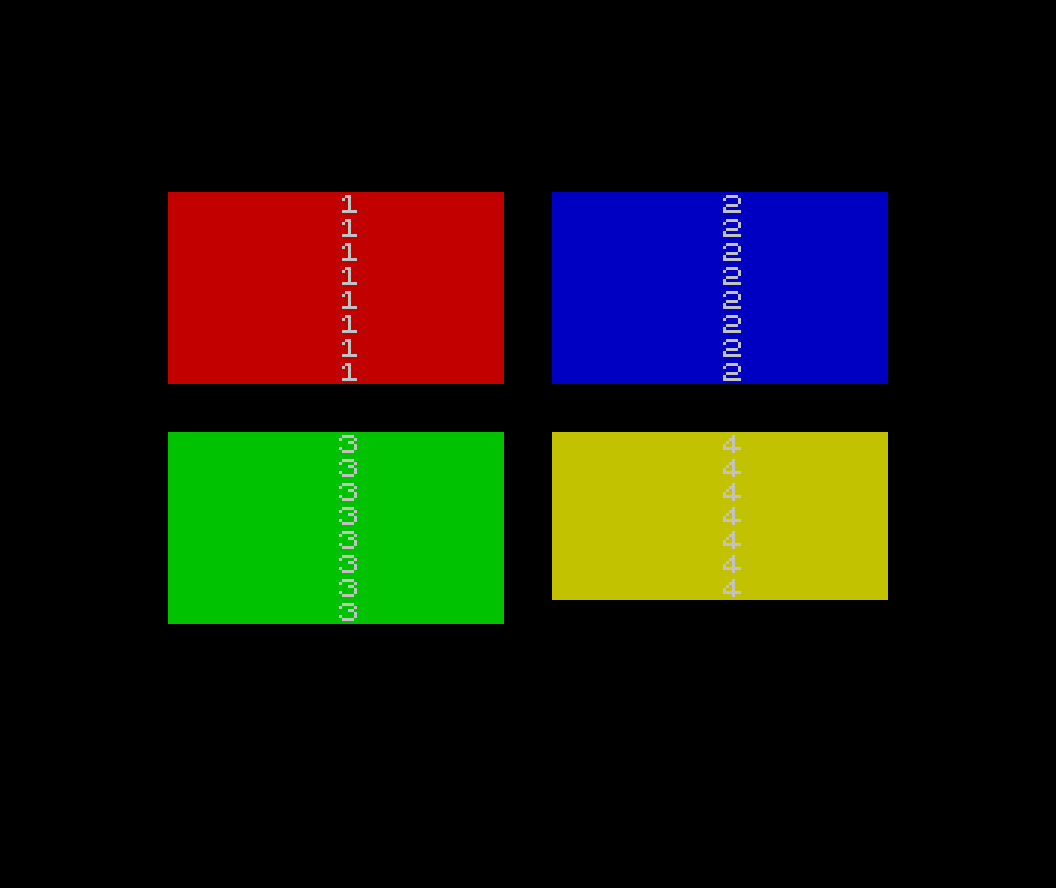
This is the most complete game in Volume 1, and it leans on nearly everything you have:
PAPER panels and PRINT AT from Meet BASIC, BRIGHT and BEEP for the flash, INKEY$
from Reflex for the taps, GO SUB subroutines from Oracle Stone, ratings from Lucky Number.
Almost none of it is new.
The one genuinely new idea is how the game remembers the sequence: a string used as a
list. A panel is a digit, so the whole sequence is just a string of digits like "1421".
You grow it by sticking another digit on the end (STR$), read back the nth panel by indexing
into it (s$(i)), and ask how long it is with LEN. That trio — build, index, measure — is
the backbone of the game, and a pattern you will reuse any time a program needs to remember a
list of things.
What you will build:
- A board of four coloured panels, drawn by a subroutine
- A flash — one panel lit
BRIGHTwith its own tone - A growing sequence held in a string:
STR$to extend it,s$(i)to replay it,LENto size it (the new idea) - The player’s turn —
INKEY$taps, echoed and checked against the sequence - A game-over screen with a score and a rating, and a play-again loop
- The design concept: pattern — recognise it, reproduce it, extend it
6 units. About 5–7 hours. This builds on Meet BASIC — start there if you haven’t.
Unit roadmap
The board
Four coloured panels, and the flash that lights one
The sequence
A growing string of panels, shown then echoed back
The game
Losing, scoring, and the title that wraps it