Your Turn
Read the player's taps with INKEY$, echo each as a flash, check it against the stored sequence, and grow the sequence when they get it right — the whole game in one loop.
The computer shows the sequence; now the player answers. That means reading taps with
INKEY$ (the real-time key read from Reflex), flashing each tapped panel so it feels alive,
and — the heart of it — checking each tap against the stored string. Get the round right and
the sequence grows by one. That loop is the game.
  10 BORDER 0: PAPER 0: INK 7: CLS
  20 RANDOMIZE
 110 CLS
 120 GO SUB 540
 140 LET s$ = ""
 150 LET s$ = s$ + STR$ (INT (RND * 4) + 1)
 170 PAUSE 25
 180 FOR i = 1 TO LEN s$
 190 LET p = VAL s$(i)
 200 GO SUB 640
 210 PAUSE 15
 220 NEXT i
 240 PRINT AT 21, 1; "Your turn!               "
 250 FOR i = 1 TO LEN s$
 260 IF INKEY$ <> "" THEN GO TO 260
 270 IF INKEY$ = "" THEN GO TO 270
 280 LET k$ = INKEY$
 290 IF k$ < "1" OR k$ > "4" THEN GO TO 260
 300 LET p = VAL k$
 310 GO SUB 640
 320 IF k$ <> s$(i) THEN PRINT AT 21, 1; "Wrong!": STOP
 340 NEXT i
 350 PRINT AT 21, 1; "Correct!                 "
 360 PAUSE 25
 370 GO TO 150
 540 REM --- Draw all panels ---
 550 PAPER 2
 560 FOR r = 2 TO 9: PRINT AT r, 1; "       1      ": NEXT r
 570 PAPER 1
 580 FOR r = 2 TO 9: PRINT AT r, 17; "       2      ": NEXT r
 590 PAPER 4
 600 FOR r = 12 TO 19: PRINT AT r, 1; "       3      ": NEXT r
 610 PAPER 6
 620 FOR r = 12 TO 19: PRINT AT r, 17; "       4      ": NEXT r
 630 PAPER 0: RETURN
 640 REM --- Flash panel p ---
 650 IF p = 1 THEN PAPER 2: LET pr = 2: LET pc = 1: LET note = 5
 660 IF p = 2 THEN PAPER 1: LET pr = 2: LET pc = 17: LET note = 10
 670 IF p = 3 THEN PAPER 4: LET pr = 12: LET pc = 1: LET note = 15
 680 IF p = 4 THEN PAPER 6: LET pr = 12: LET pc = 17: LET note = 20
 690 BRIGHT 1
 700 FOR r = pr TO pr + 7: PRINT AT r, pc; "              ": NEXT r
 710 BEEP 0.3, note
 720 BRIGHT 0
 730 FOR r = pr TO pr + 7: PRINT AT r, pc; "              ": NEXT r
 740 PAPER 0: RETURN
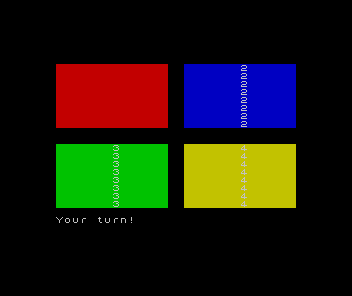
Reading a clean tap
Lines 250–320 are the player’s turn, one FOR pass per panel in the sequence. Reading a key
takes care: line 260 waits for any held key to be released (INKEY$ <> "" loops until the
keyboard is clear), then line 270 waits for a fresh press. That two-step — wait for release,
wait for press — stops one long press registering as several taps. Line 290 ignores anything
that is not 1–4, and line 310 flashes the tapped panel through the same subroutine the computer
used, so the player’s input looks identical to the machine’s.
Check, then grow
Line 320 is the judgement: IF k$ <> s$(i) — does the tapped character match the ith
character of the sequence? If not, the round is lost (for now, “Wrong!” and STOP). If the
whole FOR loop finishes with every tap matching, the player has repeated the sequence: line
350 says “Correct!”, and line 370 loops back to line 150, which appends one more random panel
and replays the longer sequence.
That is the entire game mechanic — show, repeat, check, extend — and notice it leans on the
string at every turn: LEN s$ sets how many taps to expect, s$(i) is what each tap is judged
against. The string you built last unit is doing all the remembering.
Next: a proper game-over screen instead of a bare STOP.