Targets
A crate on a target is a fifth cell state with its own colour and behaviour — and the puzzle is won when no bare target is left.
Pushing works; now it needs a point. Targets are the goal cells, and a crate pushed onto one becomes a new combined state — which means the grid must track crate-on-target separately, and the player must remember what they are standing on. When no bare target remains, the puzzle is solved.
  90 RESTORE 900
 100 READ w, h
 120 LET sr = INT ((22 - h) / 2) + 1
 130 LET sc = INT ((32 - w) / 2)
 140 LET ps = 0
 150 DIM g(h, w)
 160 CLS
 170 PRINT AT 0, 10; "*** CRATES ***"
 200 FOR r = 1 TO h
 210 READ r$
 220 FOR c = 1 TO w
 230 LET q$ = r$(c TO c)
 240 IF q$ = "W" THEN LET g(r,c) = 1: PRINT AT sr+r-1, sc+c-1; PAPER 1; INK 0; " "
 250 IF q$ = " " THEN PRINT AT sr+r-1, sc+c-1; PAPER 7; INK 0; " "
 260 IF q$ = "." THEN LET g(r,c) = 2: PRINT AT sr+r-1, sc+c-1; PAPER 2; INK 0; " "
 270 IF q$ = "C" THEN LET g(r,c) = 3: PRINT AT sr+r-1, sc+c-1; PAPER 6; INK 0; " "
 280 IF q$ = "P" THEN LET pr = r: LET pc = c: PRINT AT sr+r-1, sc+c-1; PAPER 7; INK 4; "P"
 290 NEXT c
 300 NEXT r
 320 IF INKEY$ <> "" THEN GO TO 320
 330 LET k$ = INKEY$: IF k$ = "" THEN GO TO 330
 350 LET dy = 0: LET dx = 0
 360 IF k$ = "i" OR k$ = "I" THEN LET dy = -1
 370 IF k$ = "k" OR k$ = "K" THEN LET dy = 1
 380 IF k$ = "j" OR k$ = "J" THEN LET dx = -1
 390 IF k$ = "l" OR k$ = "L" THEN LET dx = 1
 400 IF dy = 0 AND dx = 0 THEN GO TO 320
 410 LET nr = pr + dy: LET nc = pc + dx
 420 LET v = g(nr, nc)
 430 IF v = 1 THEN GO TO 320
 440 IF v = 3 OR v = 4 THEN GO TO 510
 450 IF v <> 0 AND v <> 2 THEN GO TO 320
 460 PRINT AT sr+pr-1, sc+pc-1; PAPER (7-ps*5); INK 0; " "
 470 LET ps = 0: IF v = 2 THEN LET ps = 1
 480 LET pr = nr: LET pc = nc
 490 PRINT AT sr+pr-1, sc+pc-1; PAPER (7-ps*5); INK 4; "P"
 500 GO TO 320
 510 REM --- Push crate ---
 520 LET br = nr + dy: LET bc = nc + dx
 530 LET bv = g(br, bc)
 540 IF bv <> 0 AND bv <> 2 THEN GO TO 320
 550 IF bv = 0 THEN LET g(br,bc) = 3: PRINT AT sr+br-1, sc+bc-1; PAPER 6; INK 0; " "
 560 IF bv = 2 THEN LET g(br,bc) = 4: PRINT AT sr+br-1, sc+bc-1; PAPER 4; INK 0; " "
 570 PRINT AT sr+pr-1, sc+pc-1; PAPER (7-ps*5); INK 0; " "
 580 LET ps = 0: IF v = 4 THEN LET ps = 1
 590 IF v = 3 THEN LET g(nr,nc) = 0
 600 IF v = 4 THEN LET g(nr,nc) = 2
 610 LET pr = nr: LET pc = nc
 620 PRINT AT sr+pr-1, sc+pc-1; PAPER (7-ps*5); INK 4; "P"
 650 REM --- All targets covered? ---
 660 LET win = 1
 670 FOR r = 1 TO h
 680 FOR c = 1 TO w
 690 IF g(r, c) = 2 THEN LET win = 0
 700 NEXT c
 710 NEXT r
 720 IF win = 0 THEN GO TO 320
 730 PRINT AT 20, 4; "Level complete!"
 740 PAUSE 0: STOP
 900 DATA 5,5
 901 DATA "WWWWW"
 902 DATA "W . W"
 903 DATA "W C W"
 904 DATA "W P W"
 905 DATA "WWWWW"
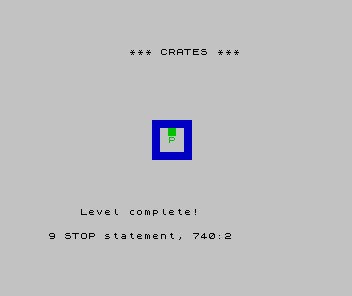
Five states in one grid
The array now holds 0 floor, 1 wall, 2 target, 3 crate and 4 crate-on-target. State 4 is
the interesting one: a crate on a target is not “a crate and a target together” but a single value with
its own green PAPER and its own behaviour. The push routine grows to match — lines 550–560 land a
crate as 3 on floor or 4 on a target, and lines 590–600 leave behind 0 or 2 depending on what
it sat on. Encoding the combination as one number keeps the array the single source of truth, the same
multi-meaning-per-cell idea you used in Sonar, taken one step further.
Remembering the floor underneath
The player can now stand on a target, so line 140 adds ps — what the player is standing on, 0 or
1. When the player moves off, the cell must be repainted the right colour, and PAPER (7 - ps*5)
does it without an IF: ps = 0 gives PAPER 7 (white floor), ps = 1 gives PAPER 2 (red target).
One expression, two colours, used everywhere the player is drawn or erased.
Knowing when it is solved
Winning is a sweep of the grid (lines 660–720): assume win = 1, then scan every cell, and any bare
target still showing (g(r,c) = 2) sets win = 0. If none remain, every target has a crate on it and
the level is complete. It is the same whole-grid scan Sonar used to find targets and The Caverns used
to reveal the cave — here it asks one question of the finished board: is anything left uncovered?
The puzzle is complete. The last unit turns one room into a game of three.