Pushing
The one rule the whole game is built on — walk into a crate and it slides, but only if the cell beyond it is clear. A two-cell lookahead does it.
This is the rule that makes Crates a game. Walking into a crate pushes it one cell — but only if there is room on the far side. From that single constraint every puzzle in the game grows, and in code it is a two-cell lookahead: check the crate, then check the space beyond it.
  90 RESTORE 900
 100 READ w, h
 120 LET sr = INT ((22 - h) / 2) + 1
 130 LET sc = INT ((32 - w) / 2)
 150 DIM g(h, w)
 160 CLS
 170 PRINT AT 0, 10; "*** CRATES ***"
 200 FOR r = 1 TO h
 210 READ r$
 220 FOR c = 1 TO w
 230 LET q$ = r$(c TO c)
 240 IF q$ = "W" THEN LET g(r,c) = 1: PRINT AT sr+r-1, sc+c-1; PAPER 1; INK 0; " "
 250 IF q$ = " " THEN PRINT AT sr+r-1, sc+c-1; PAPER 7; INK 0; " "
 260 IF q$ = "." THEN LET g(r,c) = 2: PRINT AT sr+r-1, sc+c-1; PAPER 2; INK 0; " "
 270 IF q$ = "C" THEN LET g(r,c) = 3: PRINT AT sr+r-1, sc+c-1; PAPER 6; INK 0; " "
 280 IF q$ = "P" THEN LET pr = r: LET pc = c: PRINT AT sr+r-1, sc+c-1; PAPER 7; INK 4; "P"
 290 NEXT c
 300 NEXT r
 320 IF INKEY$ <> "" THEN GO TO 320
 330 LET k$ = INKEY$: IF k$ = "" THEN GO TO 330
 350 LET dy = 0: LET dx = 0
 360 IF k$ = "i" OR k$ = "I" THEN LET dy = -1
 370 IF k$ = "k" OR k$ = "K" THEN LET dy = 1
 380 IF k$ = "j" OR k$ = "J" THEN LET dx = -1
 390 IF k$ = "l" OR k$ = "L" THEN LET dx = 1
 400 IF dy = 0 AND dx = 0 THEN GO TO 320
 410 LET nr = pr + dy: LET nc = pc + dx
 420 LET v = g(nr, nc)
 430 IF v = 1 THEN GO TO 320
 440 IF v = 3 THEN GO TO 510
 450 IF v <> 0 THEN GO TO 320
 460 PRINT AT sr+pr-1, sc+pc-1; PAPER 7; INK 0; " "
 480 LET pr = nr: LET pc = nc
 490 PRINT AT sr+pr-1, sc+pc-1; PAPER 7; INK 4; "P"
 500 GO TO 320
 510 REM --- Push crate ---
 520 LET br = nr + dy: LET bc = nc + dx
 530 LET bv = g(br, bc)
 540 IF bv <> 0 THEN GO TO 320
 550 LET g(br,bc) = 3: PRINT AT sr+br-1, sc+bc-1; PAPER 6; INK 0; " "
 570 PRINT AT sr+pr-1, sc+pc-1; PAPER 7; INK 0; " "
 590 LET g(nr,nc) = 0
 610 LET pr = nr: LET pc = nc
 620 PRINT AT sr+pr-1, sc+pc-1; PAPER 7; INK 4; "P"
 630 GO TO 320
 900 DATA 5,5
 901 DATA "WWWWW"
 902 DATA "W   W"
 903 DATA "W C W"
 904 DATA "W P W"
 905 DATA "WWWWW"
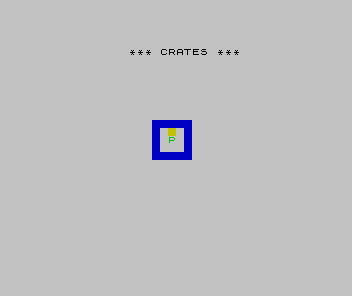
Looking two cells ahead
When the destination holds a crate (v = 3), line 440 branches to the push routine. Lines 520–530
find the cell beyond the crate by stepping the same direction again — br = nr + dy, bc = nc + dx
— and line 540 is the rule: IF bv <> 0 THEN GO TO 320, the push fails unless that far cell is empty
floor. The offsets dy, dx do double duty, locating both the crate and the space behind it. Walls
need a one-cell lookahead; pushing needs two, and that second look is the entire mechanic.
One rule, every puzzle
Everything Sokoban is famous for falls out of this one check. You cannot pull — the routine only ever moves a crate ahead of you. You cannot push two crates at once — the cell beyond the first would hold the second, not floor, so the push fails. You cannot shove a crate into a wall. And a crate pushed into a corner is stuck forever, because neither of its remaining exits is clear. No special cases encode those rules; they are all consequences of “the far cell must be empty”.
Array first, screen second
On a successful push the order is deliberate: line 550 writes the crate into its new cell in g, line
590 clears its old cell, and the player advances into the gap — each change made to the array first,
then mirrored to the screen with PRINT AT. The array is the truth; the display follows it. Keep that
order and the picture can never disagree with the state.
Next: targets, crates-on-targets, and knowing when the puzzle is solved.