Walls
Make walls solid with a single array lookup — the grid that draws the level also answers every collision question.
The player walks through walls because nothing checks the grid. Now that the world is the array, stopping them is one lookup: before moving, read the destination cell and refuse if it is solid.
  90 RESTORE 900
 100 READ w, h
 120 LET sr = INT ((22 - h) / 2) + 1
 130 LET sc = INT ((32 - w) / 2)
 150 DIM g(h, w)
 160 CLS
 170 PRINT AT 0, 10; "*** CRATES ***"
 200 FOR r = 1 TO h
 210 READ r$
 220 FOR c = 1 TO w
 230 LET q$ = r$(c TO c)
 240 IF q$ = "W" THEN LET g(r,c) = 1: PRINT AT sr+r-1, sc+c-1; PAPER 1; INK 0; " "
 250 IF q$ = " " THEN PRINT AT sr+r-1, sc+c-1; PAPER 7; INK 0; " "
 260 IF q$ = "." THEN LET g(r,c) = 2: PRINT AT sr+r-1, sc+c-1; PAPER 2; INK 0; " "
 270 IF q$ = "C" THEN LET g(r,c) = 3: PRINT AT sr+r-1, sc+c-1; PAPER 6; INK 0; " "
 280 IF q$ = "P" THEN LET pr = r: LET pc = c: PRINT AT sr+r-1, sc+c-1; PAPER 7; INK 4; "P"
 290 NEXT c
 300 NEXT r
 320 IF INKEY$ <> "" THEN GO TO 320
 330 LET k$ = INKEY$: IF k$ = "" THEN GO TO 330
 350 LET dy = 0: LET dx = 0
 360 IF k$ = "i" OR k$ = "I" THEN LET dy = -1
 370 IF k$ = "k" OR k$ = "K" THEN LET dy = 1
 380 IF k$ = "j" OR k$ = "J" THEN LET dx = -1
 390 IF k$ = "l" OR k$ = "L" THEN LET dx = 1
 400 IF dy = 0 AND dx = 0 THEN GO TO 320
 410 LET nr = pr + dy: LET nc = pc + dx
 420 LET v = g(nr, nc)
 430 IF v = 1 THEN GO TO 320
 450 IF v <> 0 AND v <> 2 THEN GO TO 320
 460 PRINT AT sr+pr-1, sc+pc-1; PAPER 7; INK 0; " "
 480 LET pr = nr: LET pc = nc
 490 PRINT AT sr+pr-1, sc+pc-1; PAPER 7; INK 4; "P"
 500 GO TO 320
 900 DATA 5,5
 901 DATA "WWWWW"
 902 DATA "W . W"
 903 DATA "W C W"
 904 DATA "W P W"
 905 DATA "WWWWW"
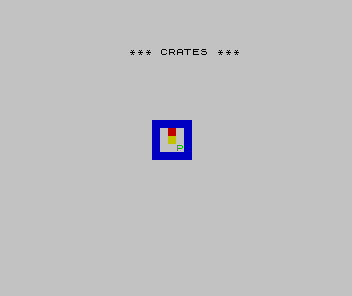
Collision is a lookup
Lines 420–450 do it. Line 410 already worked out the destination nr, nc; line 420 reads what is
there — LET v = g(nr, nc) — and line 430 blocks a wall: IF v = 1 THEN GO TO 320, returning to the
input loop without moving. Line 450 is stricter still: IF v <> 0 AND v <> 2 THEN GO TO 320 blocks
anything that is not floor or target, which catches crates and any cell type added later. Only when the
cell is clear does the player step onto it.
Why this is so cheap
Earlier games checked boundaries with arithmetic — IF x < 1 OR x > 30, one condition per edge. Here
collision is a single array read, because the level data already records what each cell is. “Can I move
here?” becomes “what number is in this cell?” That is the payoff for building the world as an array in
unit one: the same structure that draws the screen answers movement, with no separate wall list and no
special case for corners. Checking what is walkable instead of what is blocked also means a new
cell type is safely solid until you decide otherwise.
Next: the one rule the whole game is built on — pushing.