The Telegraph Bar
Trade the blind PAUSE for a bar that fills to a random length inside a drawn frame — PLOT and DRAW turned into suspense.
The reaction core works, but the wait is blind: the player stares at “Get ready…” and a
random PAUSE, with nothing on screen telling them the signal is building. You drew with
PLOT and DRAW in Meet BASIC — here they earn their keep, turning that dead pause into a
bar that creeps across the screen.
  10 BORDER 0: PAPER 0: INK 7: CLS
  20 RANDOMIZE
 100 CLS
 110 PRINT "Get ready..."
 120 PRINT
 130 PLOT 26, 90: DRAW 204, 0: DRAW 0, -6: DRAW -204, 0: DRAW 0, 6
 140 PLOT 28, 88
 150 DRAW 200, 0
 155 LET e = INT (RND * 140) + 88
 160 FOR x = 28 TO e
 170 PLOT x, 87
 190 NEXT x
 220 PRINT "NOW!"
 230 LET t = 0
 240 IF INKEY$ <> "" THEN GO TO 300
 250 LET t = t + 1
 260 GO TO 240
 300 PRINT "Your time: "; t
 310 PRINT
 320 IF t < 5 THEN INK 4: PRINT "Lightning!"
 330 IF t >= 5 AND t < 15 THEN INK 5: PRINT "Quick!"
 340 IF t >= 15 AND t < 30 THEN INK 6: PRINT "OK"
 350 IF t >= 30 THEN INK 2: PRINT "Slow..."
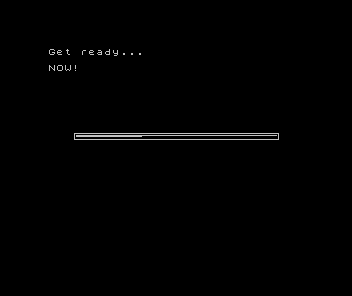
A frame, then a fill
Line 130 draws the frame in one chain: PLOT 26, 90 sets the pen, then four DRAWs trace a
thin rectangle around where the bar will sit. Lines 140–150 draw the bar’s baseline. Then the
fill: line 155 picks a random endpoint e between 88 and 227, and the FOR loop on lines
160–190 runs x from 28 up to e, plotting one pixel per step. The bar grows left to right
and stops at e — a different length every run.
None of these commands are new. PLOT x, y lights one pixel (the screen is 256×176, with
(0, 0) at the bottom-left); DRAW dx, dy draws a line relative to the pen’s position; the
FOR loop repeats. Meet BASIC introduced all three. What’s new is the job you’ve given
them: the blind wait has become a visible one.
Telegraphing
The randomness moved out of the PAUSE and into the bar. The player watches it grow, knowing
the signal is near — but because line 155 chose the stopping point at random, they cannot see
where it will stop, so they cannot guess when the round fires. That is the trick: the bar
telegraphs the event (something is building) without giving away the moment (it could stop
anywhere).
A fixed-length bar would betray the timing the instant the player learned its length. The random endpoint is what keeps the test honest — visible tension, hidden trigger.