Distance
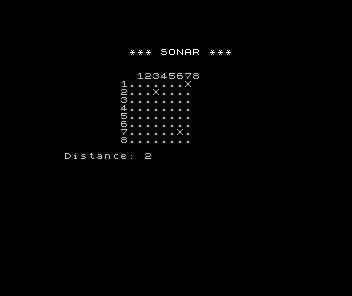
A miss should tell the player how close they came — sweep the whole grid, measure the gap to every target, and report the nearest with Manhattan distance.
A hit marks a star; a miss, so far, says nothing. The clue that makes Sonar a game is the distance — when the player misses, the program tells them how far the probe was from the nearest target. Cold means keep searching; a small number means you are almost on it.
  10 BORDER 0: PAPER 0: INK 7: CLS
 110 RANDOMIZE
 120 DIM g(8,8)
 130 FOR i = 1 TO 3
 140 LET r = INT (RND * 8) + 1: LET c = INT (RND * 8) + 1
 150 IF g(r,c) = 9 THEN GO TO 140
 160 LET g(r,c) = 9
 170 NEXT i
 190 CLS
 200 LET a$ = "*** SONAR ***": LET y = 0: GO SUB 9000
 240 PRINT AT 3, 11; "12345678"
 250 FOR r = 1 TO 8
 260 PRINT AT 3 + r, 9; r;
 270 FOR c = 1 TO 8
 280 LET v = g(r,c)
 290 IF v = 9 THEN PRINT "X";
 300 IF v = 0 THEN PRINT ".";
 310 IF v = -1 THEN PRINT "*";
 320 IF v >= 1 AND v < 9 THEN PRINT v;
 330 NEXT c
 370 NEXT r
 380 INPUT "Row (1-8): "; r
 390 INPUT "Col (1-8): "; c
 400 IF r < 1 OR r > 8 OR c < 1 OR c > 8 THEN GO TO 380
 460 IF g(r,c) = 9 THEN PRINT AT 13, 2; "HIT!       ": LET g(r,c) = -1: PAUSE 30: GO TO 190
 470 LET dist = 99
 480 FOR a = 1 TO 8: FOR b = 1 TO 8
 490 IF g(a,b) <> 9 THEN GO TO 520
 500 LET d = ABS (r - a) + ABS (c - b)
 510 IF d < dist THEN LET dist = d
 520 NEXT b: NEXT a
 530 IF dist > 8 THEN LET dist = 8
 540 LET g(r,c) = dist
 550 PRINT AT 13, 2; "Distance: "; dist; "  "
 560 PAUSE 30
 570 GO TO 190

9000 PRINT AT y, (32 - LEN a$) / 2; BRIGHT 1; a$
9010 RETURN
Sweep the whole grid
When the probe misses, lines 480–540 look at every cell to find the targets. The same nested
loop that drew the grid — FOR a over rows, FOR b over columns — now reads it, checking
IF g(a,b) = 9 for a hidden target. Drawing the grid and searching the grid are the same walk
over the same array; only what you do at each cell changes. This is the move that a 2D array
makes natural: the state is a grid, so the algorithm is a grid sweep.
Manhattan distance
For each target found, line 510 measures the gap: LET d = ABS(r - a) + ABS(c - b). That is the
Manhattan distance — the row difference plus the column difference, each made positive with
ABS (which you met in Lucky Number). It counts steps along the grid, not a diagonal line, which
is exactly how a player moves between cells. Line 520 keeps the smallest: IF d < dist THEN LET dist = d, starting dist at a large number (line 470) so the first target always replaces it.
After the sweep, dist is the distance to the nearest target — the clue the player needs.
The number is the clue, but a bare number is hard to read at a glance. Next: colour it, so warm and cold are visible without reading.