Warmer and Colder
Store each miss's distance back into the grid and colour it on redraw — red when close, blue when far — so the board itself shows the trail of clues.
The distance is a number, and a number you have to read and remember. Sonar makes it visible: each miss leaves its distance on the grid, coloured by how close it was — warm reds near a target, cold blues far away. The board becomes a heat map of everywhere you have searched.
  10 BORDER 0: PAPER 0: INK 7: CLS
 110 RANDOMIZE
 120 DIM g(8,8)
 130 FOR i = 1 TO 3
 140 LET r = INT (RND * 8) + 1: LET c = INT (RND * 8) + 1
 150 IF g(r,c) = 9 THEN GO TO 140
 160 LET g(r,c) = 9
 170 NEXT i
 190 CLS
 200 LET a$ = "*** SONAR ***": LET y = 0: GO SUB 9000
 240 PRINT AT 3, 11; "12345678"
 250 FOR r = 1 TO 8
 260 PRINT AT 3 + r, 9; r;
 270 FOR c = 1 TO 8
 280 LET v = g(r,c)
 290 IF v = 9 OR v = 0 THEN INK 7: PRINT ".";
 300 IF v = -1 THEN INK 4: PRINT "*";

 310 IF v >= 1 AND v <= 2 THEN INK 2: PRINT v;
 320 IF v >= 3 AND v <= 4 THEN INK 6: PRINT v;
 330 IF v >= 5 AND v < 9 THEN INK 5: PRINT v;
 340 NEXT c
 350 INK 7
 370 NEXT r
 380 INPUT "Row (1-8): "; r
 390 INPUT "Col (1-8): "; c
 400 IF r < 1 OR r > 8 OR c < 1 OR c > 8 THEN GO TO 380
 460 IF g(r,c) = 9 THEN PRINT AT 13, 2; "HIT!       ": LET g(r,c) = -1: PAUSE 30: GO TO 190
 470 LET dist = 99
 480 FOR a = 1 TO 8: FOR b = 1 TO 8
 490 IF g(a,b) <> 9 THEN GO TO 520
 500 LET d = ABS (r - a) + ABS (c - b)
 510 IF d < dist THEN LET dist = d
 520 NEXT b: NEXT a
 530 IF dist > 8 THEN LET dist = 8
 540 LET g(r,c) = dist
 550 PRINT AT 13, 2; "Distance: "; dist; "  "
 560 PAUSE 30
 570 GO TO 190

9000 PRINT AT y, (32 - LEN a$) / 2; BRIGHT 1; a$
9010 RETURN
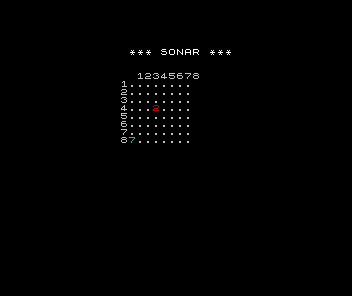
Write the clue into the grid
Line 540 is the key change: LET g(r,c) = dist. The probed cell, which was 0, now holds the
distance to the nearest target. The grid already carried 0, 9 and -1; now a cell can also
hold 1 to 8. One array, several meanings — and because the value persists, the clue stays on
the board through every later redraw. Line 530 caps the distance at 8 so it always fits a single
character.
Colour by warmth
The drawing loop now reads each value and chooses an INK to match (lines 290–330). A dot is
white; a found target (*) is the same red as a hit; and a distance is coloured by how warm it
is — 1–2 red (you are close), 3–4 yellow, 5+ blue (cold). INK you used in earlier
games for a splash of colour; here it carries information — the colour is the clue, readable
without even reading the number. The player scans the board and the reds pull the eye toward the
targets.
The clue system is complete. What is missing is the end of the game — finding all three targets, and counting the guesses it took. That is next.