Winning
Count the hits, end the game on the third, and guard against probing a cell twice — plus a guess counter and a status line so the board reads as a game.
The clues work; now the game needs an ending. Three targets means three hits to win, so the program counts them and stops on the third — and along the way it keeps a guess count and blocks the player from wasting a turn on a cell they have already probed.
  10 BORDER 0: PAPER 0: INK 7: CLS
 110 RANDOMIZE
 120 DIM g(8,8)
 130 FOR i = 1 TO 3
 140 LET r = INT (RND * 8) + 1: LET c = INT (RND * 8) + 1
 150 IF g(r,c) = 9 THEN GO TO 140
 160 LET g(r,c) = 9
 170 NEXT i
 180 LET hits = 0: LET guesses = 0
 190 CLS
 200 INVERSE 1: PRINT AT 0, 0; "        *** SONAR ***           ": INVERSE 0
 210 PRINT AT 1, 2; "Found: "; hits; "/3  Guesses: "; guesses; "  "
 240 PRINT AT 3, 11; "12345678"
 250 FOR r = 1 TO 8
 260 PRINT AT 3 + r, 9; r;
 270 FOR c = 1 TO 8
 280 LET v = g(r,c)
 290 IF v = 9 OR v = 0 THEN INK 7: PRINT ".";
 300 IF v = -1 THEN INK 4: PRINT "*";

 310 IF v >= 1 AND v <= 2 THEN INK 2: PRINT v;
 320 IF v >= 3 AND v <= 4 THEN INK 6: PRINT v;
 330 IF v >= 5 AND v < 9 THEN INK 5: PRINT v;
 340 NEXT c
 350 INK 7
 370 NEXT r
 380 INPUT "Row (1-8): "; r
 390 INPUT "Col (1-8): "; c
 400 IF r < 1 OR r > 8 OR c < 1 OR c > 8 THEN GO TO 380
 410 IF g(r,c) > 0 AND g(r,c) < 9 THEN PRINT AT 13, 2; "Already probed!  ": PAUSE 50: GO TO 190
 420 IF g(r,c) = -1 THEN PRINT AT 13, 2; "Already found!   ": PAUSE 50: GO TO 190
 430 LET guesses = guesses + 1
 460 IF g(r,c) = 9 THEN GO TO 570
 470 LET dist = 99
 480 FOR a = 1 TO 8: FOR b = 1 TO 8
 490 IF g(a,b) <> 9 THEN GO TO 520
 500 LET d = ABS (r - a) + ABS (c - b)
 510 IF d < dist THEN LET dist = d
 520 NEXT b: NEXT a
 530 IF dist > 8 THEN LET dist = 8
 540 LET g(r,c) = dist
 550 BEEP 0.1, -5
 560 GO TO 190
 570 LET g(r,c) = -1
 580 LET hits = hits + 1
 590 BEEP 0.1, 10: BEEP 0.1, 15
 600 IF hits = 3 THEN GO TO 620
 610 GO TO 190
 620 CLS
 630 LET a$ = "*** SONAR ***": LET y = 6: GO SUB 9000
 640 PRINT AT 9, 6; INK 4; "All targets found!"
 650 PRINT AT 11, 6; INK 7; "Guesses: "; guesses
 660 BEEP 0.1, 10: BEEP 0.1, 15: BEEP 0.1, 20
 670 STOP

9000 PRINT AT y, (32 - LEN a$) / 2; BRIGHT 1; a$
9010 RETURN
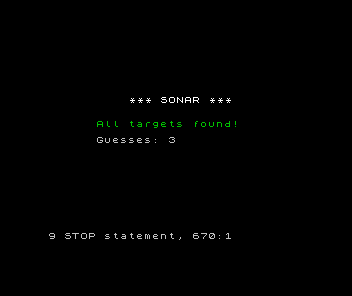
Counting toward the win
Two counters start at line 180: hits and guesses. Every valid probe bumps guesses (line
430); every hit bumps hits (line 580). Line 600 is the win check — IF hits = 3 THEN GO TO 620 — jumping to a win screen that reports the guess count. The status line at the top (line
210) shows Found: n/3 and the running guess total, so the player always knows where they
stand. This is the same score-and-check loop from earlier games, now driving a board game to its
conclusion.
Guarding the probe
A grid game has a new failure the earlier games did not: probing the same cell twice. Lines 410
and 420 catch it — if the cell already holds a distance (> 0 AND < 9) or a found target
(-1), the program says so and loops back without spending a guess. The three cell states the
grid has carried since the start are exactly what makes this check possible: the value already
records whether a cell has been touched, so the guard is a single comparison. State you stored
for one reason often answers a question you did not plan for.
The game is complete and playable. The last unit polishes it into the finished Sonar — a proper title, a graphical grid, and a play-again loop.