Sonar
Polish the playable game into the finished Sonar — a title screen, a drawn grid, a probe limit with a reveal, ratings, and a play-again loop.
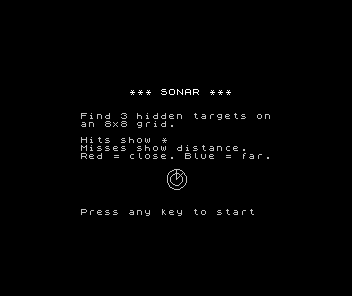
Everything works; now it becomes a game you would sit down to play. This unit adds the framing — a title screen, a grid drawn with real lines, a probe limit that can lose you the game, a rating for how sharp you were, and a loop back to a fresh board.
  10 BORDER 0: PAPER 0: INK 7: CLS
  20 LET a$ = "*** SONAR ***": LET y = 5: GO SUB 9000
  30 PRINT AT 8, 4; "Find 3 hidden targets on"
  40 PRINT AT 13, 4; "Red = close. Blue = far."
  50 CIRCLE 128, 44, 10: CIRCLE 128, 44, 6: PLOT 128, 44: DRAW 7, 7: PLOT 128, 44: DRAW 0, 10
  60 PRINT AT 9, 4; "an 8x8 grid."
  70 PRINT AT 11, 4; "Hits show *"
  80 PRINT AT 12, 4; "Misses show distance."
  90 PRINT AT 20, 4; "Press any key to start"
 100 PAUSE 0
 110 RANDOMIZE
 120 DIM g(8,8)
 130 FOR i = 1 TO 3
 140 LET r = INT (RND * 8) + 1: LET c = INT (RND * 8) + 1
 150 IF g(r,c) = 9 THEN GO TO 140
 160 LET g(r,c) = 9
 170 NEXT i
 180 LET hits = 0: LET guesses = 0
 190 CLS
 200 INVERSE 1: PRINT AT 0, 0; "        *** SONAR ***           ": INVERSE 0
 210 PRINT AT 1, 2; "Found: "; hits; "/3  Guesses: "; guesses; "  "
 220 INK 5: FOR i = 0 TO 8: PLOT 68, 139 - i * 16: DRAW 128, 0: NEXT i
 230 FOR i = 0 TO 8: PLOT 68 + i * 16, 139: DRAW 0, -128: NEXT i: INK 7
 240 PRINT AT 3, 9; "1 2 3 4 5 6 7 8"
 250 FOR r = 1 TO 8
 260 LET pr = 3 + 2 * r: PRINT AT pr, 7; r
 270 FOR c = 1 TO 8: LET pc = 7 + 2 * c
 280 LET v = g(r,c)
 290 IF v = 9 OR v = 0 THEN INK 7: PRINT AT pr, pc; "."
 300 IF v = -1 THEN INK 4: PRINT AT pr, pc; "*"
 310 IF v >= 1 AND v <= 2 THEN INK 2: PRINT AT pr, pc; v
 320 IF v >= 3 AND v <= 4 THEN INK 6: PRINT AT pr, pc; v
 330 IF v >= 5 AND v < 9 THEN INK 5: PRINT AT pr, pc; v
 340 NEXT c
 350 INK 7
 360 NEXT r
 380 INPUT "Row (1-8): "; r
 390 INPUT "Col (1-8): "; c
 400 IF r < 1 OR r > 8 OR c < 1 OR c > 8 THEN GO TO 380
 410 IF g(r,c) > 0 AND g(r,c) < 9 THEN PRINT AT 2, 2; "Already probed!  ": PAUSE 50: GO TO 190
 420 IF g(r,c) = -1 THEN PRINT AT 2, 2; "Already found!   ": PAUSE 50: GO TO 190
 430 LET guesses = guesses + 1
 440 IF guesses > 30 THEN GO TO 720
 460 IF g(r,c) = 9 THEN GO TO 570
 470 LET dist = 99
 480 FOR a = 1 TO 8: FOR b = 1 TO 8
 490 IF g(a,b) <> 9 THEN GO TO 520
 500 LET d = ABS (r - a) + ABS (c - b)
 510 IF d < dist THEN LET dist = d
 520 NEXT b: NEXT a
 530 IF dist > 8 THEN LET dist = 8
 540 LET g(r,c) = dist
 550 BEEP 0.1, -5
 560 GO TO 190
 570 LET g(r,c) = -1
 580 LET hits = hits + 1
 590 BEEP 0.1, 10: BEEP 0.1, 15
 600 IF hits = 3 THEN GO TO 620
 610 GO TO 190
 620 CLS
 630 LET a$ = "*** SONAR ***": LET y = 6: GO SUB 9000
 640 PRINT AT 9, 6; INK 4; "All targets found!"
 650 PRINT AT 11, 6; INK 7; "Guesses: "; guesses
 660 BEEP 0.1, 10: BEEP 0.1, 15: BEEP 0.1, 20
 670 IF guesses <= 10 THEN INK 4: PRINT AT 14, 8; "Expert tracker!": GO TO 810
 680 IF guesses <= 20 THEN INK 5: PRINT AT 14, 10; "Not bad": GO TO 810
 700 INK 6: PRINT AT 14, 8; "Keep searching"
 710 GO TO 810
 720 CLS
 730 LET a$ = "*** SONAR ***": LET y = 6: GO SUB 9000
 740 PRINT AT 9, 6; INK 2; "Out of probes!"
 750 PRINT AT 11, 6; INK 7; "Targets were at:"
 760 LET n = 12
 770 FOR a = 1 TO 8: FOR b = 1 TO 8
 780 IF g(a,b) = 9 THEN PRINT AT n, 8; "("; a; ","; b; ")": LET n = n + 1
 790 NEXT b: NEXT a
 800 BEEP 0.3, -10
 810 INK 7
 820 PRINT AT 18, 4; "Press any key to play again"
 830 PAUSE 0
 840 GO TO 10

9000 PRINT AT y, (32 - LEN a$) / 2; BRIGHT 1; a$
9010 RETURN
A drawn grid
The board is no longer just printed dots. Lines 220–230 draw the grid with PLOT and DRAW —
nine horizontal cyan lines and nine vertical ones, ruling an 8×8 board — and the cells are
spaced two columns apart (lines 260–270) so a number sits cleanly inside each square. PLOT and
DRAW, which you met in Reflex, turn a list of dots into something that looks like a real sonar
display. The clue colours from the last unit now sit on a proper grid.
Losing, and the reveal
A game you can only win is not much of a game. Line 440 caps the search at 30 probes; run out and
the program jumps to a lose screen (lines 720–800) that sweeps the grid one last time and prints
where the targets were — (a,b) for every g(a,b) = 9. That reveal reuses the same grid sweep
yet again, this time to report where the targets sat instead of to measure a distance. The win screen (lines 670–700) rates the
player on guess count: ten or fewer is an “Expert tracker”, and so on — a small reward that gives
skill something to aim at.
Play again
Line 840 — GO TO 10 — sends the finished game back to its own title screen, placing three new
targets and starting over. The whole program is a loop around a single grid, and that one
two-dimensional array carried everything: the hidden targets, the probed cells, the distance
clues, and the final reveal.
What you built
Sonar is your first grid game, and the first time state lived in two dimensions. You used a
2D array as a board, drew it and searched it with the same nested loop, turned a miss into a
Manhattan distance with ABS, coloured the clues into a heat map, and wrapped it all in a
title, a probe limit, ratings, and a replay loop. The design idea underneath is search —
narrowing a hidden location from the clues it leaves.
Next: Three in a Row — where the grid stops being a place to search and becomes a board an opponent plays on too.