The Reveal
INPUT works at the bottom of the screen, so the story already prints on a clean stage — and a CLS keeps it that way once a title arrives.
When you answer a question, where does your typing go? Not where the story goes.
  10 BORDER 0: PAPER 0: INK 7: CLS
  50 INPUT "What is your name? "; n$
  60 INPUT "Name an adjective: "; a$
  70 INPUT "Name an animal: "; b$
  80 INPUT "Name a place: "; p$
  90 INPUT "Name a food: "; f$
 100 CLS
 130 PRINT
 140 PRINT n$; " found a "; a$; " "; b$
 150 PRINT "hiding in "; p$; "."
 160 PRINT "They fed it "; f$; "."
One new line: 100 CLS, sitting in the gap between the last question and the first line of the story. Run it, answer the five questions, and the story appears on a clean screen.
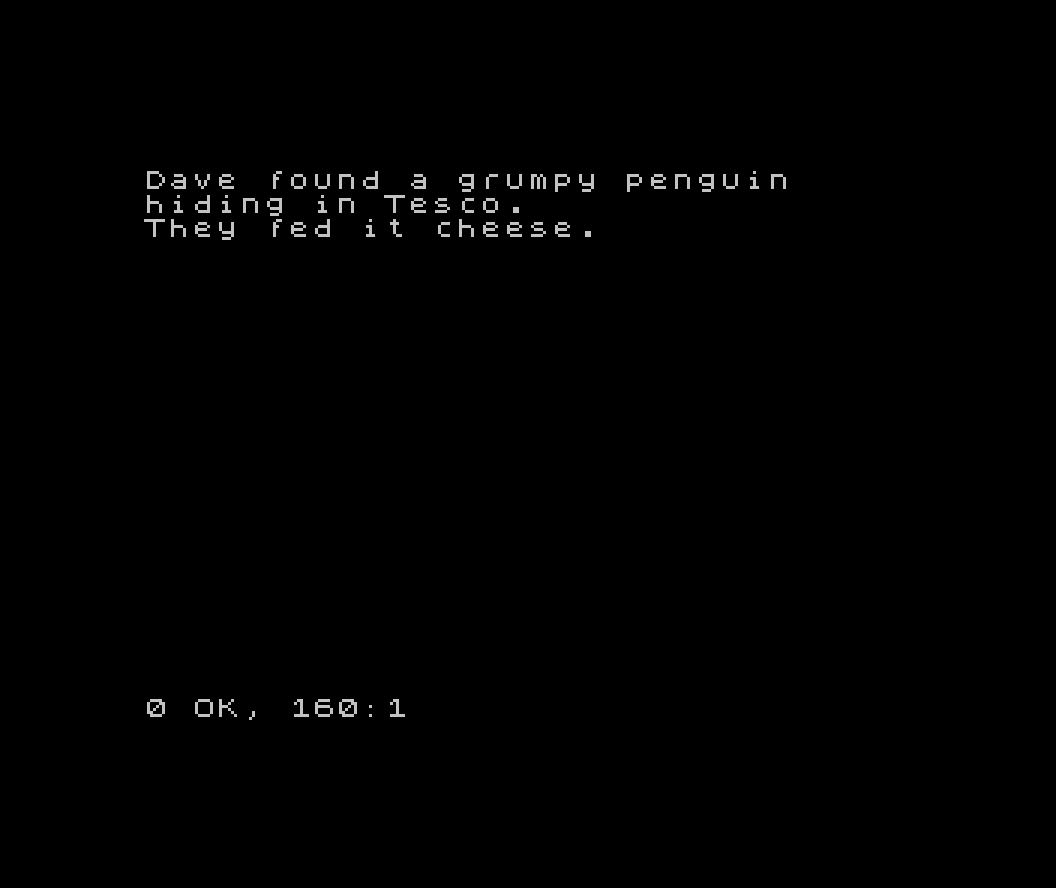
Where the questions went
It looks exactly like unit 3. That is the lesson.
The Spectrum splits its screen in two. INPUT does its asking at the bottom — the lower editing area, two lines reserved for typing. PRINT writes to the main screen above. So your answers never landed among the story; they came and went in a strip the story never touches. The main screen was a clean stage the whole time.
Why add CLS at all, then?
Right now 100 CLS clears a screen that is already empty — it changes nothing you can see. It is groundwork. In unit 6 we add a title to the main screen, and the player would still be looking at it when the story prints. This same CLS wipes the title away first, so the story still gets the stage to itself.
We put the line in now, in the reserved gap, so the later unit drops a title above it without disturbing the reveal. Set it up now; it pays off in two units. Same habit as the line-number gaps — leave room for what is coming.
The design lesson
This is the simplest version of an idea you will use in every game: separate input from output. The player acts in one phase; the result appears in another. The Spectrum hands you half of that for free by giving INPUT its own strip. CLS handles the other half — clearing whatever the main screen was showing — the moment there is something to clear.