The Story
Expand the output into a proper narrative — three paragraphs with a beginning, middle, and end.
A sentence is not a story. A story has a beginning, a middle, and an end.
  10 BORDER 0: PAPER 0: INK 7: CLS
  50 INPUT "What is your name? "; n$
  60 INPUT "Name an adjective: "; a$
  70 INPUT "Name an animal: "; b$
  80 INPUT "Name a place: "; p$
  90 INPUT "Name a food: "; f$
 100 CLS
 130 PRINT "Once upon a time, "; n$
 140 PRINT "found a "; a$; " "; b$
 150 PRINT "hiding in "; p$; "."
 160 PRINT
 170 PRINT "They fed it "; f$
 180 PRINT "and it followed them home."
 190 PRINT
 200 PRINT "The end."
The output section is now three paragraphs. Line 130 opens with “Once upon a time” — the universal story starter. Lines 160 and 190 add blank lines between paragraphs. Line 200 closes with “The end.”
Run it. Type “Dave”, “grumpy”, “penguin”, “Tesco”, “cheese”. The screen clears and prints:
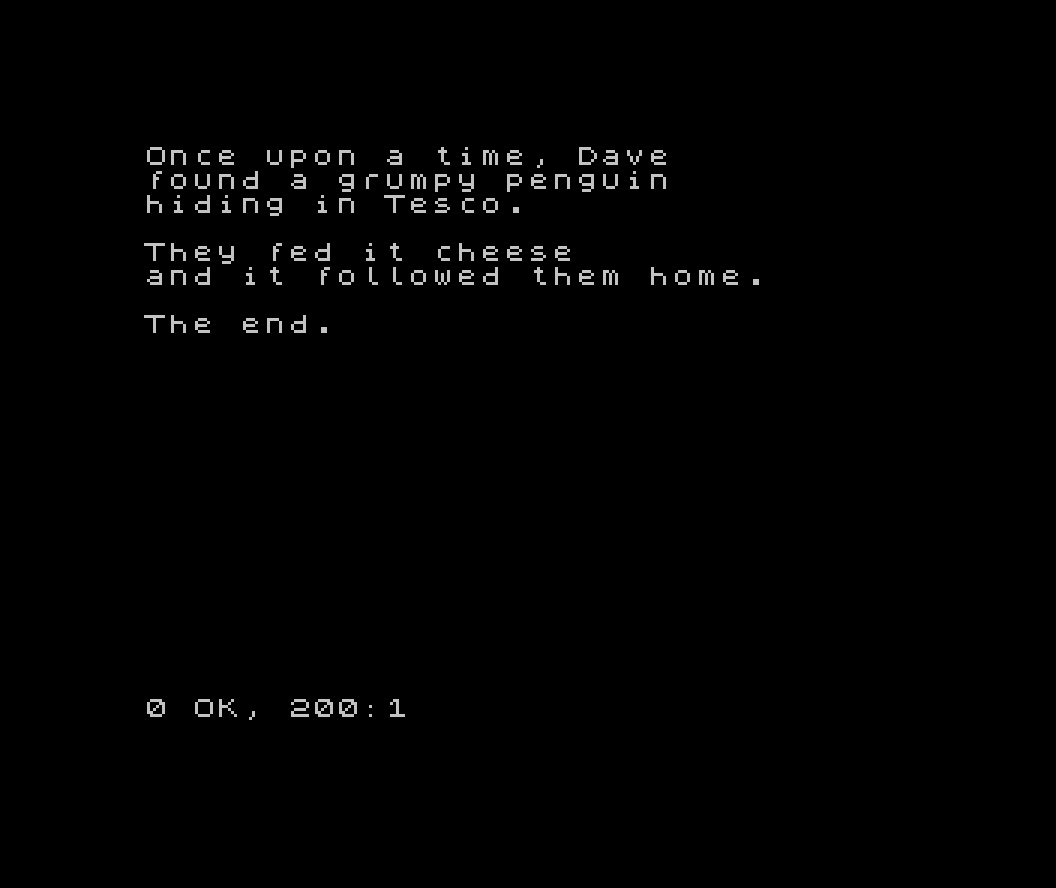
Read it aloud. If it makes someone laugh, the program works.
What changed
The name moves up. Line 130 — a blank line until now — becomes "Once upon a time, "; n$, so line 140 no longer needs the name and now opens with "found a". Lines 170, 180, 190, and 200 are new, carrying the story through to “The end.”; line 160 becomes a blank line to space them apart. The input section (lines 10–90) and the CLS reveal (line 100) are untouched. The story grew, but the engine is the same: questions in, narrative out.
The PRINT on lines 160 and 190 — with nothing after them — print a blank line. That is all paragraph spacing is: an empty PRINT.