Make It Yours
Colour, sound, and timing turn a working program into something you want to show someone.
The program works. Now make it feel like something.
  10 BORDER 0: PAPER 0: INK 7: CLS
  30 PRINT AT 3, 6; BRIGHT 1; "*** STORY BUILDER ***"
  40 PLOT 148, 120: DRAW -20, -30: DRAW 3, 0: DRAW 17, 30: PLOT 128, 90: DRAW -8, -12
  50 INPUT "What is your name? "; n$
  60 INPUT "Name an adjective: "; a$
  70 INPUT "Name an animal: "; b$
  80 INPUT "Name a place: "; p$
  90 INPUT "Name a food: "; f$
 100 CLS
 110 PAUSE 50: BEEP 0.1, 24
 120 INK 5
 130 PRINT "Once upon a time, "; n$
 140 PRINT "found a "; a$; " "; b$
 150 PRINT "hiding in "; p$; "."
 160 PRINT
 170 PRINT "They fed it "; f$
 180 PRINT "and it followed them home."
 190 PRINT
 200 INK 7: PRINT "The end."
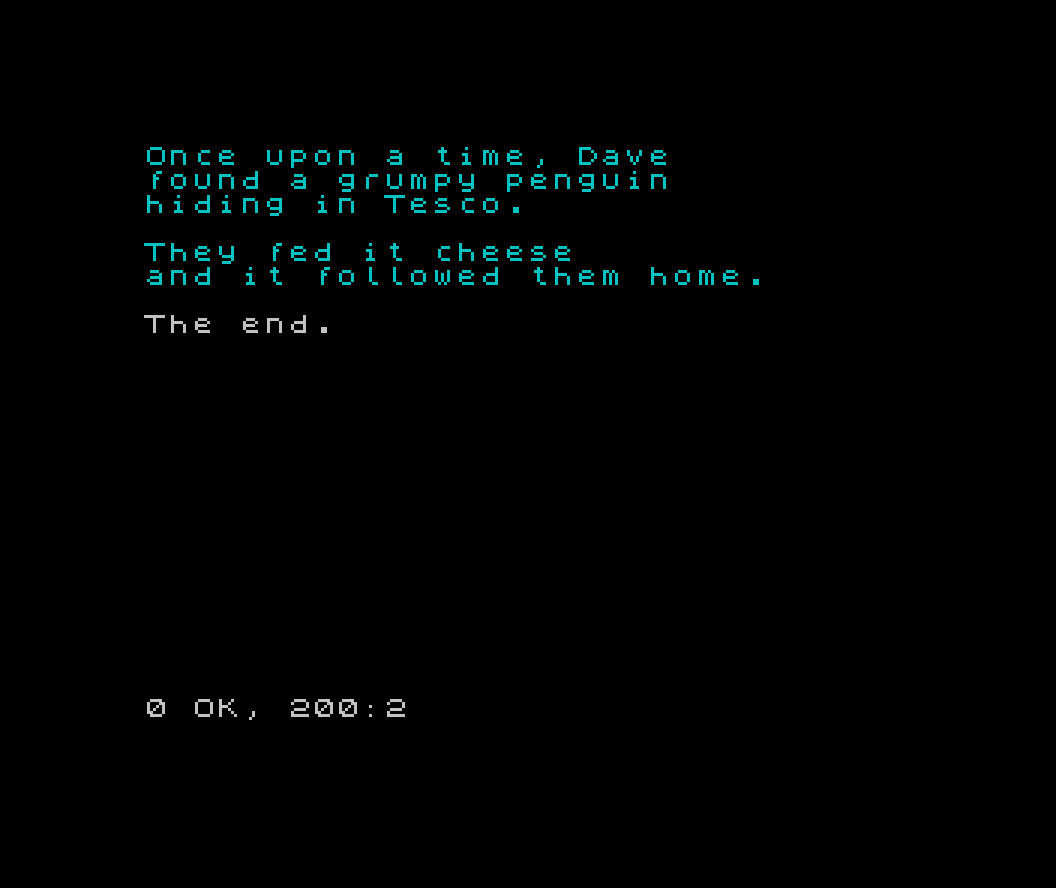
Run it. The title appears in white with a small quill drawn beneath it. You answer the questions, the screen clears, a short beep sounds, and the story prints in cyan.
What changed
Line 40 turns the blank spacer after the title into a small drawing: PLOT and DRAW sketch a quill — fitting for a program that writes stories.
Lines 110 and 120 drop into the gap between the screen-clear (100) and the story (130) — room that has sat empty since the reveal in unit 4. 110 builds anticipation: PAUSE 50 waits one second (the Spectrum runs at 50 frames per second), then BEEP 0.1, 24 plays a short high tone. 120 switches to INK 5 (cyan).
The black screen and white text have been the backdrop since unit 1; now colour does some work. The story prints cyan, marking it as the output — distinct from the white questions. Line 200 switches back to INK 7 (white) for the closing line.
The design lesson
None of these changes affect what the program does. It still asks questions and prints a story. But they change what it feels like. The black screen creates focus. The pause creates anticipation. The colour shift creates a boundary between asking and telling.
This layer — presentation, timing, atmosphere — is what game designers call polish. Polish does not change the mechanics. It changes the experience. A program without polish works. A program with polish works on you.
Make it yours
Write your own story template. Change the colours — try INK 4 (green) or INK 2 (red). Change the pause length — PAUSE 100 for more drama, PAUSE 25 for less. Add more questions. The program is yours now.
Next: Lucky Number — a guessing game where the computer picks a secret number and you try to find it.