Trading
Buy and sell land at a price that shifts each year — a third decision, with one INPUT and one sign handling both directions.
Land has been fixed at a thousand acres. Trading lets you change it — sell land for grain when you are short, or buy land when you are flush and want to plant more next year. It is the third lever, and the neat part is that a single number, positive or negative, handles both buying and selling.
  10 BORDER 0: PAPER 0: INK 7: CLS
 100 RANDOMIZE
 110 LET pop = 100: LET grain = 2800
 120 LET land = 1000: LET yr = 1
 130 CLS
 140 LET a$ = "*** YEARFALL ***": LET y = 0: GO SUB 9000
 150 PRINT AT 1, 4; "Year "; yr; " of 10"
 160 PRINT AT 3, 2; "Population: "; pop
 180 PRINT AT 4, 2; "Grain: "; grain
 190 PRINT AT 5, 2; "Land: "; land; " acres"
 200 LET price = INT (RND * 10) + 17
 210 PRINT AT 6, 2; "Land price: "; price; " grain/acre"
 220 INPUT "Buy(+)/Sell(-) acres: "; trade
 230 IF trade > 0 AND trade * price > grain THEN GO TO 220
 240 IF trade < 0 AND -trade > land THEN GO TO 220
 250 LET land = land + trade: LET grain = grain - trade * price
 260 INPUT "Grain to feed: "; feed
 270 IF feed < 0 OR feed > grain THEN GO TO 260
 280 INPUT "Acres to plant: "; plant
 290 IF plant < 0 OR plant > land THEN GO TO 280
 300 IF plant > grain - feed THEN GO TO 280
 310 IF plant > pop * 10 THEN GO TO 280
 400 LET grain = grain - feed - plant
 410 LET starved = 0
 420 IF feed < pop * 20 THEN LET starved = pop - INT (feed / 20)
 430 LET pop = pop - starved
 440 LET yield = INT (RND * 5) + 1
 450 LET harvested = plant * yield
 460 LET grain = grain + harvested
 470 LET births = 0
 480 IF starved = 0 THEN LET births = INT (RND * 6) + 1
 490 LET pop = pop + births
 500 IF pop <= 0 THEN PRINT AT 14, 2; "Everyone perished!": STOP
 600 PRINT AT 8, 2; "Starved: "; starved
 610 PRINT AT 9, 2; "Harvest: "; harvested; " ("; yield; "/acre)"
 620 PRINT AT 10, 2; "Births: "; births
 630 PRINT AT 11, 2; "Pop: "; pop; "  Grain: "; grain; "  Land: "; land
 750 PRINT AT 14, 2; "Press any key..."
 760 PAUSE 0
 770 LET yr = yr + 1
 780 IF yr > 10 THEN PRINT AT 16, 2; "10 years complete! Pop: "; pop: STOP
 790 GO TO 130

9000 PRINT AT y, (32 - LEN a$) / 2; BRIGHT 1; a$
9010 RETURN
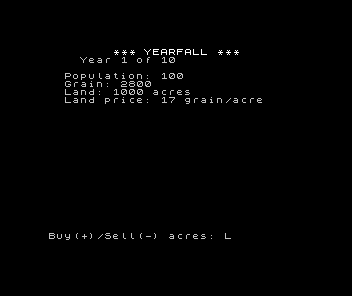
One number, two directions
Line 200 sets a price that changes each year — price = INT(RND * 10) + 17, so 17 to 26 grain an
acre — and line 220 reads a single trade value. A positive number buys, a negative number sells, and
line 250 applies both at once: land = land + trade and grain = grain - trade * price. Subtracting
trade * price does the right thing automatically — buying (trade positive) spends grain, selling
(trade negative) makes the term negative and adds grain. Letting the sign of one variable choose
the direction is a tidy trick that saves writing two near-identical branches.
Guarding both ways
Each direction has its own limit (lines 230–240). You cannot buy more than your grain can pay for —
IF trade > 0 AND trade * price > grain — and you cannot sell land you do not own — IF trade < 0 AND -trade > land. The fluctuating price turns trade into timing: land is cheap some years and dear
others, so selling in a high-price year and buying back when it falls is its own small game inside the
larger one. Trading happens first in the turn, before feeding and planting, so the grain you raise from
a sale is available to spend the same year.
The simulation is complete. The last unit turns the bare numbers into a game you want to keep playing.