Yearfall
Rule a kingdom for ten years — feed your people, plant crops, trade land, and live with the delayed consequences of every choice.
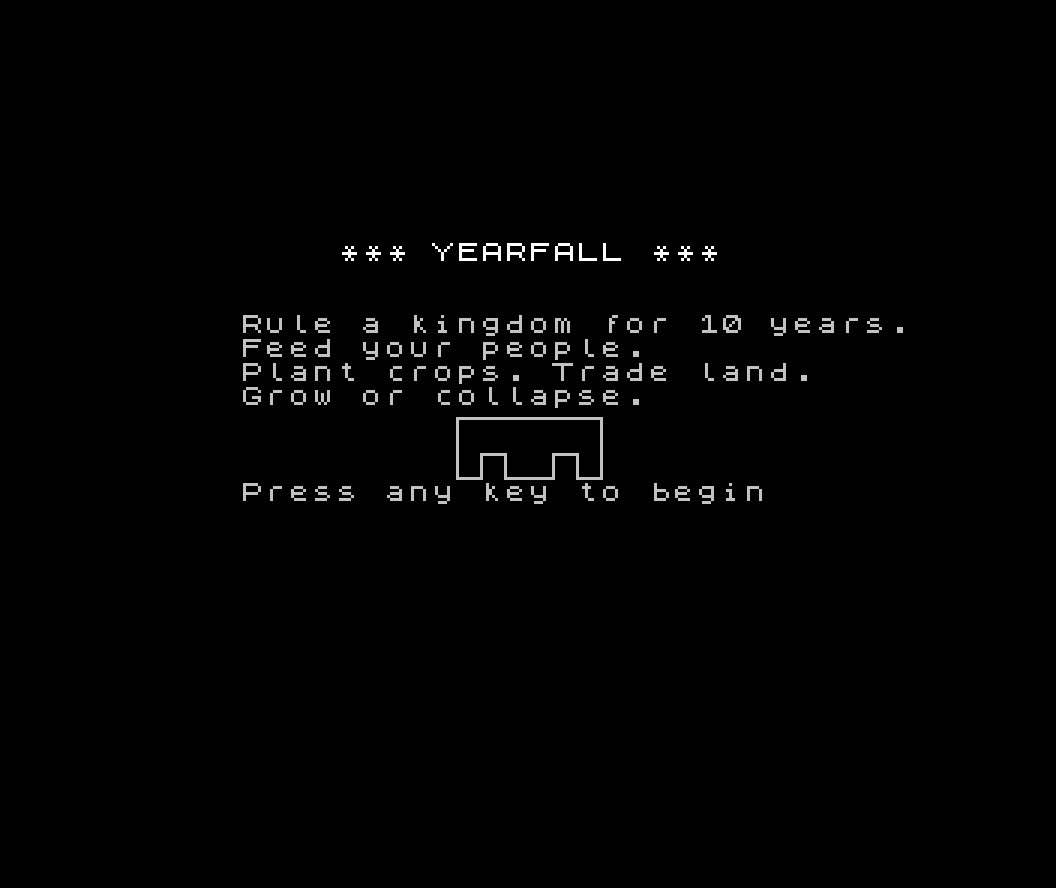
Yearfall is a kingdom you cannot save — only manage. One hundred people, two thousand eight hundred bushels of grain, a thousand acres of land. Ten years to prove you can keep them alive.
This is the purest game in Volume 2 — Patterns of State: no opponent, no maze, no hidden information. Just three numbers and the trade-offs between them. Every value is on screen; the difficulty is entirely in deciding what to do with each.
The new idea is the whole game: state that persists and compounds across turns. Each year you spend grain to feed people and to plant fields, and what you have left — plus a harvest you cannot control — becomes next year’s starting position. A bad choice does not punish you at once; it narrows what you can do a year or two later. That is delayed consequence, and learning to play it is learning to think past the current turn.
What you will build:
- A kingdom held in three persistent variables — population, grain, land
- Feeding under a constraint, and the starvation that follows underfeeding (the new idea)
- Planting, and a random harvest that turns seed grain into more grain — or not
- The ten-year loop, where population grows and choices compound (the new idea)
- Trading land at a price that shifts each year
- The finished game: a year-end report, a final rating, atmosphere, and replay
6 units. About 7–9 hours. This builds on Meet BASIC and Volume 1 — earlier games assumed.
Unit roadmap
The choices
The kingdom's state, and the two decisions that spend it — feeding and planting
The years
A multi-year loop where population grows, and land you can buy and sell
The reckoning
The finished simulation — year-end report, rating, atmosphere and replay