The Kingdom
Three numbers — population, grain, land — are the whole world, and they will persist and change across every year you rule.
Yearfall has no maze, no opponent, nothing hidden. The whole world is three numbers, and learning to read them — and live with how they change — is the game. Before any decision, you need the kingdom on screen.
  10 BORDER 0: PAPER 0: INK 7: CLS
 110 LET pop = 100: LET grain = 2800
 120 LET land = 1000
 130 CLS
 140 LET a$ = "*** YEARFALL ***": LET y = 0: GO SUB 9000
 160 PRINT AT 3, 2; "Population: "; pop
 180 PRINT AT 4, 2; "Grain: "; grain
 190 PRINT AT 5, 2; "Land: "; land; " acres"
 200 STOP

9000 PRINT AT y, (32 - LEN a$) / 2; BRIGHT 1; a$
9010 RETURN
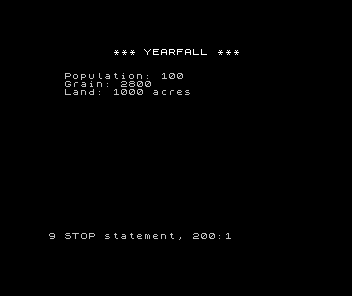
Three numbers, one world
Lines 110–120 set the starting state: pop = 100, grain = 2800, land = 1000. These are plain
variables, the kind you have used since Lucky Number — but their role here is new. Population is who
depends on you. Grain is what you spend, both food and seed from one store. Land is potential — acres
you could plant if you had the grain and the workers. The dashboard (lines 140–190) just prints them.
State that lasts
Every earlier game’s state was momentary — a guess, a board, a room — reset or replaced each turn. Yearfall’s three numbers persist: the grain you have left after this year is the grain you start next year with. That is the idea the whole game rests on. There is nothing to discover and nothing hidden; the difficulty is entirely in what you choose to do with what you can already see, knowing it carries forward.
Next: the first way to spend it — feeding your people.