
De Re Atari opens the Atari 8-bit computer beneath its BASIC commands. It explains display lists, colour registers, character sets, player/missile graphics, sound and operating-system routines. Those parts work together on the screen, but understanding them requires more than a list of POKE addresses.
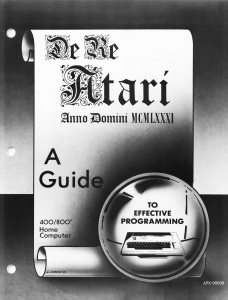
The book was distributed by the Atari Program Exchange as APX-90008. Its preface identifies a team of authors. That credit is more informative than treating the whole book as the work of its best-known contributor.
Different specialists, one machine
The preface credits Chris Crawford with the system and graphics chapters and appendices A and B. Bob Fraser wrote the sound chapter. Jim Dunion contributed the operating-system and display-list-interrupt chapters. Kathleen Pitta wrote Appendix E on GTIA. Lane Winner, with Jim Cox, contributed the chapter on languages and the corresponding appendix; Amy Chen and Gus Makreas also have named contributions.
These divisions follow real areas of expertise. The book’s explanation of ANTIC and GTIA has to connect memory fetching, display interpretation and timed processor work. Its POKEY chapter has a different set of counters, control registers and audio choices to explain.
A display is a program too
The display-list chapters describe how ANTIC reads instructions defining the screen down its height. A program can combine modes or change where display data comes from. Display-list interrupts let processor code alter selected settings at chosen points in the frame.
The resulting freedom still has constraints: display fetching uses memory time, and an interrupt routine must finish the work required of it. The book makes those relationships accessible instead of presenting every graphical effect as an unexplained trick.
Read the concepts and the edition
The sound chapter and GTIA appendix show why a technical book needs a precise scope. Counter combinations, colour registers and pixel interpretations belong to particular hardware facilities. A BASIC mode number alone does not explain them.
The consulted cover bears a 1981 date; copies and transcriptions also circulate with later catalogue dates. Identifying the APX work and the actual chapters used is more reliable than treating one filename’s year as proof of every revision. The useful legacy is its collaborative explanation of how the machine’s cooperating parts produce a running program.
Sources
- Atari, De Re Atari, APX-90008: original cover, contents, preface and chapters. Public transcription and scan. The preface is the source for individual chapter credits.