
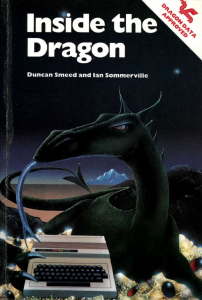
Inside the Dragon explains a computer by following the connections between its layers. Duncan Smeed and Ian Sommerville begin with information representation and the 6809, then examine the Dragon’s software and hardware. The 1983 Addison-Wesley book gives a BASIC owner a route into assembly language without pretending that knowing the instruction names is enough to understand the whole machine.
Its title pages identify Smeed with Dragon Data and Sommerville with the University of Strathclyde. The production note says the authors set the book using UNIX’s NROFF text-processing system at Strathclyde: another small connection between a home-computer reference and the larger computing world around it.
Instructions need an address space
Early chapters explain the processor’s registers, addressing modes and memory-mapped I/O. Those ideas establish how an instruction selects a value and how the computer makes an address refer to RAM, ROM or a device.
The later material can then explain the Dragon’s ROM routines and interfaces in terms of the machine present. A callable routine has assumptions about inputs and state. Understanding those assumptions makes it reusable; knowing only an entry address does not.
Two settings make one graphics mode
A particularly clear example appears in the video chapter. The authors give separate VDGMOD and SAMMOD routines for the MC6847 video generator and SAM memory/timing chip. They explain why the settings normally correspond, then list exceptions for particular modes. (pp. 171–172.)
That separation is the point of going inside the machine. One chip interprets display data; another supplies the required pattern of addresses and timing. A single BASIC command can hide work that still needs two cooperating hardware configurations.
Related computers are not identical computers
The preface notes the Dragon’s relationship with Tandy’s Color Computer. Shared processor and hardware ideas make some of the explanation useful across both. They do not make ROM addresses, tokenised BASIC or peripheral arrangements interchangeable.
The Dragon 32 and Dragon 64 entries supply the machines’ broader history. This book’s contribution is the detailed route from the language prompt to the processor and the hardware beneath it.
Sources
- Duncan Smeed and Ian Sommerville, Inside the Dragon, Addison-Wesley, 1983, ISBN 0-201-14523-5: original title pages, preface, contents and video chapter. Cover design by David John Rowe. Bibliographic and content claims here come from the book itself.